

How to Read an FOMC Statement: A Beginner’s Guide 2026

To read an FOMC statement, work through it in a fixed order: find the rate decision in the first paragraph, read the three paragraphs that assess economic activity, employment and inflation, then the forward guidance sentence near the end, and finally the vote listed at the bottom. The signal is rarely the rate number itself, which markets already price in; it is how the wording differs from the previous release. With the last statement open beside it, a full read takes about ten minutes.
I do this after every scheduled meeting, and the thing that catches beginners out is that the document is short on purpose. About 500 words, four paragraphs, a list of names. Everything in it is deliberate, and every word that appears or disappears between meetings was argued over beforehand.
What You Need
Before you start, gather five things. Missing any one of them turns a careful read into guesswork.
- The current statement from the Federal Reserve’s public website, under FOMC statements. Always use the official version, because news outlets sometimes bold only the words they think matter.
- The previous statement, which is archived on the same site. Word-level comparison is the single most useful thing you can do, and it takes ten seconds to set up.
- The implementation note, released alongside the statement. It describes how the rate decision will be carried out in the markets.
- The latest economic data: the most recent inflation and employment reports, so you can judge whether the Committee’s description matches what you already know.
- A glossary and a worksheet. Keep the Fed’s own glossary of monetary policy terms next to your notes, and one page per meeting where you write down the decision, the wording changes and your expectations before the release. Expectations have to be written down before you read, or hindsight takes over.
One more practical habit: know the timing. The statement is released at 2:00 p.m. Eastern on the second Wednesday of a scheduled meeting month, and the press conference begins at 2:30 p.m. Eastern. The Committee holds eight meetings a year.
Step-by-Step: How to Read an FOMC Statement
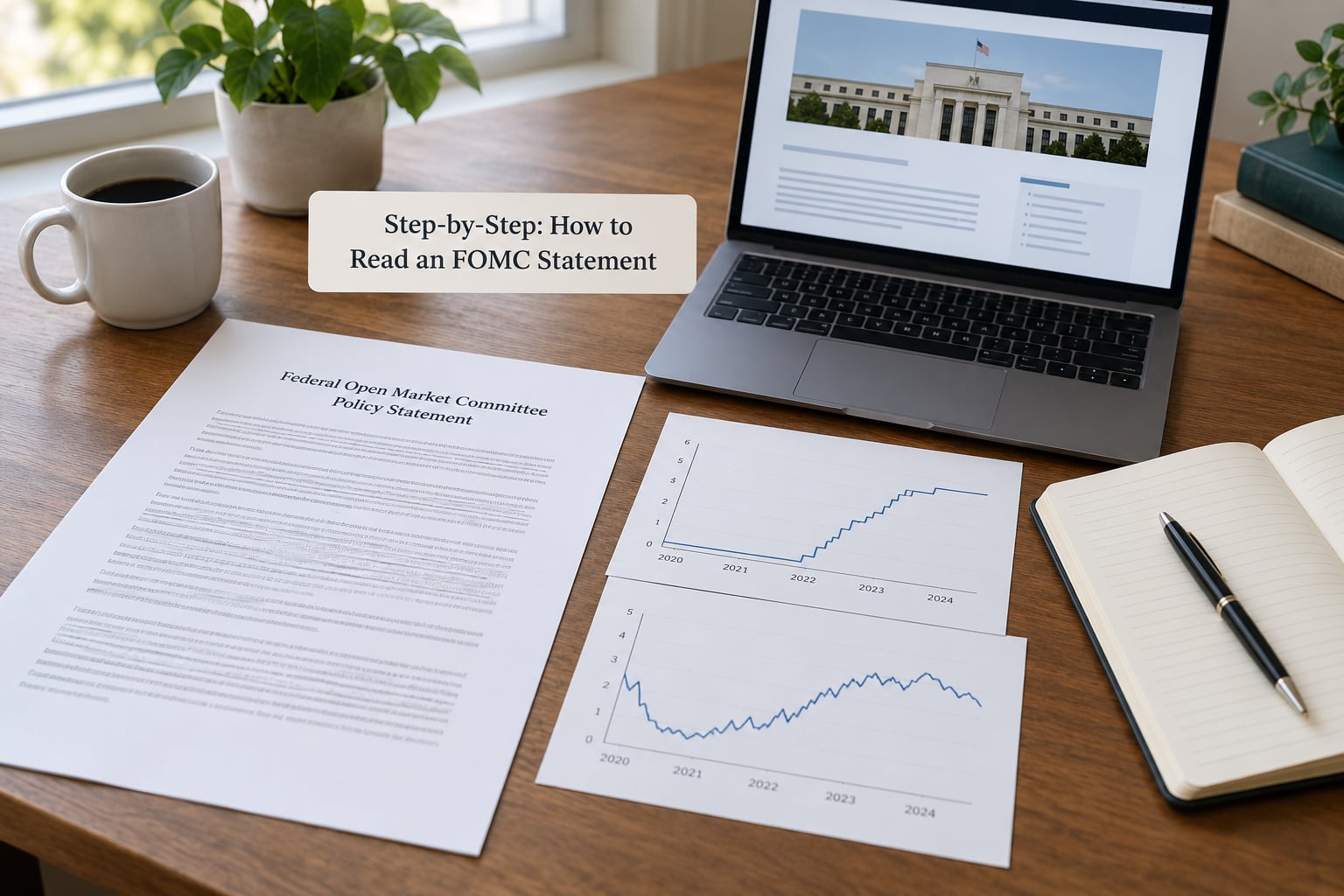
The process below takes about ten minutes on meeting day, longer if you also want the deeper context. Do it in the same order every time so you never skip the boring part, which is usually where the news is.
Step 1: Identify the policy decision and target range
The first sentence tells you what the Committee decided and, in what exact numerical range it will do it. The target range for the federal funds rate is the Committee’s chosen range for overnight loans between banks, and the statement tells you whether the range was raised, cut, or held unchanged.
Note two details people skip: whether the wording includes any qualifier about future action, and how the decision was described, for example a vote to “maintain” the range versus a decision to keep it in place. Those verbs are chosen rather than accidental.
Step 2: Read an FOMC Statement Against the Previous Release
This is where beginners get the most value and spend the least effort. The Federal Reserve publishes each statement with the words that changed from the prior meeting shown in bold, so you can read the changes first, then read the full text afterwards with those changes already in mind.
Track four kinds of edit: a word added, a word removed, a word swapped for a stronger one, and an entire clause dropped. A dropped clause is the loudest of the four. Compare inflation phrasing such as “elevated” against “moderating”, and compare labor-market wording such as “solid” against “softening”. Keep a running list of these shifts in your worksheet, because a string of small removals over several meetings tells you more than any single headline.
Step 3: Read the economic assessment paragraph by paragraph
The middle of the statement is a short narrative in a deliberate order: economic activity first, then the labor market, then inflation, then the Committee’s read on risks. The order matters, since the Committee describes the economy from broadest to most personal for its mandate.
The adjectives are the content. Wording such as elevated, subdued, modest, resilient or firm carries more information than the direction of the policy rate, because it describes the Committee’s confidence about the path from here. Historical phrasing offers a good calibration: in 2022 the Committee wrote that it “may be appropriate to begin to moderate the pace of further tightening”, and by 2023 that same committee referred to “the extent and timing of additional adjustments”. Nothing had been promised in either case, yet the tone shifted sharply.
Step 4: Examine the balance sheet and implementation language
The policy rate is not the only tool. Since 2017 the Federal Reserve has shrunk the size of its holdings of Treasury and agency securities by letting them run off, a process usually called balance sheet runoff or quantitative tightening. Each statement says how much is allowed to run off that month and whether paydowns from mortgage-backed securities are being reinvested into Treasuries or allowed to shrink.
Changes here are rare and therefore informative. An increase in the monthly caps, or a switch from reinvesting to not reinvesting, says the Committee is thinking about how much restraint to apply beyond the rate. The implementation note underneath carries the operational detail about how the rate decision will be implemented, and most beginners can skim it, though it becomes relevant during periods of market stress.
Step 5: Check the vote and any dissents
Twelve officials vote: seven members of the Board of Governors, the president of the Federal Reserve Bank of New York, and four of the other Reserve Bank presidents on rotation. Each statement lists them at the end, naming who voted for the decision and who voted against it.
A dissent tells you the Committee is not unanimous, and often that the gap is wider than one seat, since a dissenter rarely speaks alone. What a dissent does not tell you is the direction of the next meeting, because one voter reacting to inflation fears is not the Committee’s consensus. Two or three dissents on the same side of the issue is a genuine signal; one is a data point.
Step 6: Compare the statement with what markets already expected
Now check the expectation you wrote down before reading. Interest rate futures price the next decision before it happens, and economists publish forecasts ahead of each meeting. If the statement matches those expectations, markets can fall anyway, because the reaction depends on the gap between the release and what was discounted.
This is the step that explains why a “boring” statement can produce a sharp move. A widely expected decision with hawkish language can trigger a sell-off in equities and a rally in the dollar, while an expected decision with soft language can do the opposite. Experienced day traders treat FOMC days as volatility events rather than directional ones for the same reason: much of the surprise gets priced before the text appears.
Step 7: Translate the statement into market implications
Build scenarios rather than a forecast. For each plausible reading of the wording, ask what it would mean for two-year Treasury yields, which track policy expectations most closely, and for ten-year yields, which reflect growth and inflation expectations rather than the next meeting alone.
Carry the same question across assets. A more hawkish read tends to support the dollar and pressure gold, equities and rate-sensitive shares, and a more dovish read tends to do the reverse, though that relationship shifts with the reason behind the move. Inflation-driven hawkishness and growth-driven hawkishness look identical in the wording and behave completely differently. Write down your scenarios, then wait for the price action rather than reacting to a single paragraph.
Common Mistakes
Reading only the first paragraph. The rate decision is known before the text is published, so it carries no information. The vote, the balance sheet language and the descriptive adjectives are where the surprise lives.
Treating the statement as the press conference. Half an hour after the statement, the Chair answers questions, and that exchange frequently reverses how the written wording was read. Wait for both.
Reacting to one word. A single adjective is not a policy promise. Watch whether a change persists across several meetings, because committees frequently spend two or three releases hedging.
Ignoring the vote. Dissenters reveal disagreement inside the room, which is information you cannot get anywhere else.
Confusing policy with pricing. What the Committee says and what markets expect are separate inputs. Join them before you decide anything.
Making an investment decision from the release alone. The statement describes policy intentions, not valuations. It is one input among many, and it says nothing about how any asset is priced today.
One more caution: holding a large directional position through the 2:00 p.m. release exposes you to a gap you cannot manage, because the statement and press conference land while liquidity is thin and spreads widen.
Frequently Asked Questions
The statement is a written 500-word document published at 2:00 p.m. Eastern that summarizes the rate decision, the Committee’s view of the economy and the vote. The press conference starts at 2:30 p.m. Eastern, when the Chair answers reporters’ questions live. The written text is agreed in advance and carefully worded; the press conference is unscripted, so it often confirms, softens or outright contradicts a phrase in the statement. Read both.
Because the rate is only one part of the message. The Committee rewrites its description of economic activity, employment and inflation every meeting to record how it sees the economy, and small edits such as swapping elevated for moderating shift the expected path of future policy. The Fed even publishes each statement with changed words in bold, which confirms that wording changes are deliberate and reviewed rather than cosmetic.
No. A unanimous vote describes one meeting only, and it says nothing about what the Committee will do after new data arrives. Twelve officials voting together tells you the decision was supported, not that the path is locked in. Dissent can be more informative in one direction, because a single official voting against may reveal a concern several colleagues share but are not willing to put on the record yet.
Read the adjectives and note whether they have moved between meetings. Terms such as elevated, moderating, solid and softening describe the Committee’s confidence about the path of prices and hiring, and they shift gradually. When several descriptive words soften at once across activity, employment and inflation, that pattern carries more weight than any single phrase, and it usually matters more to markets than the rate decision itself.
No. Markets move on the gap between the release and what was already priced in, so a statement that matches expectations can still produce a large reaction, and a surprise can produce none. The statement also cannot tell you whether hawkishness comes from stubborn inflation or strong growth, and those two situations produce very different outcomes. Use it to build scenarios, not to generate a forecast on its own.
Everything official sits on federalreserve.gov. The monetary policy section holds the current statement, the archive of every past statement, the implementation notes, the calendar of scheduled meetings, the minutes released about three weeks after each meeting, and transcripts published years later. The Summary of Economic Projections, including the dot plot, is published four times a year on the same site.
Conclusion
Knowing how to read an FOMC statement takes about ten minutes a meeting, and the order is what makes it work. Start with the policy decision, then read the statement against the previous release to catch wording changes, then the economic assessment paragraph by paragraph, the balance sheet language, and the vote at the bottom.
Only after that do you compare the release with what markets already expected and think through the implications for yields, the dollar, equities and gold. Write your expectations down before 2:00 p.m. Eastern, read both the statement and the 2:30 p.m. press conference, and treat the result as one input among many. Nothing here is investment advice, and the FOMC’s own projections are a record of committee views rather than a promise about what comes next.
Source: https://www.pgm-blog.com/how-to-read-an-fomc-statement/
Anyone can join.
Anyone can contribute.
Anyone can become informed about their world.
"United We Stand" Click Here To Create Your Personal Citizen Journalist Account Today, Be Sure To Invite Your Friends.
Before It’s News® is a community of individuals who report on what’s going on around them, from all around the world. Anyone can join. Anyone can contribute. Anyone can become informed about their world. "United We Stand" Click Here To Create Your Personal Citizen Journalist Account Today, Be Sure To Invite Your Friends.
LION'S MANE PRODUCT
Try Our Lion’s Mane WHOLE MIND Nootropic Blend 60 Capsules
Mushrooms are having a moment. One fabulous fungus in particular, lion’s mane, may help improve memory, depression and anxiety symptoms. They are also an excellent source of nutrients that show promise as a therapy for dementia, and other neurodegenerative diseases. If you’re living with anxiety or depression, you may be curious about all the therapy options out there — including the natural ones.Our Lion’s Mane WHOLE MIND Nootropic Blend has been formulated to utilize the potency of Lion’s mane but also include the benefits of four other Highly Beneficial Mushrooms. Synergistically, they work together to Build your health through improving cognitive function and immunity regardless of your age. Our Nootropic not only improves your Cognitive Function and Activates your Immune System, but it benefits growth of Essential Gut Flora, further enhancing your Vitality.

Our Formula includes: Lion’s Mane Mushrooms which Increase Brain Power through nerve growth, lessen anxiety, reduce depression, and improve concentration. Its an excellent adaptogen, promotes sleep and improves immunity. Shiitake Mushrooms which Fight cancer cells and infectious disease, boost the immune system, promotes brain function, and serves as a source of B vitamins. Maitake Mushrooms which regulate blood sugar levels of diabetics, reduce hypertension and boosts the immune system. Reishi Mushrooms which Fight inflammation, liver disease, fatigue, tumor growth and cancer. They Improve skin disorders and soothes digestive problems, stomach ulcers and leaky gut syndrome. Chaga Mushrooms which have anti-aging effects, boost immune function, improve stamina and athletic performance, even act as a natural aphrodisiac, fighting diabetes and improving liver function. Try Our Lion’s Mane WHOLE MIND Nootropic Blend 60 Capsules Today. Be 100% Satisfied or Receive a Full Money Back Guarantee. Order Yours Today by Following This Link.


| Visits: | 1,833,882,533 |
| Stories: | 8,714,979 |
Whistler Blowers, Insiders

