

What Is Stagflation and How to Invest in It Safely (October 2026)

Stagflation is stagnant or shrinking economic growth happening at the same time as persistently high inflation and rising unemployment. That combination breaks the old rule that inflation and unemployment trade off against each other, which is exactly why central banks struggle to fix it and why ordinary portfolio habits stop working.
Understanding what is stagflation and how to invest in it matters because both traditional safe havens can fail together. Long-duration bonds get hit twice, once by rising rates and again by inflation eating their real return, while growth equities suffer from squeezed margins and weak demand at the same moment.
The honest answer on positioning is that no single asset wins in every stagflation. What you can do is give each part of your portfolio a job, know the trade-off each job costs, and size the hedges so a wrong call does not sink the plan. This guide covers the mechanism first, then walks through asset classes one at a time, including the parts where hedging is expensive or already priced in.
Nothing here is individual investment advice. Rules, tax treatment and account types vary by country, and asset returns are never guaranteed.
What Is Stagflation?
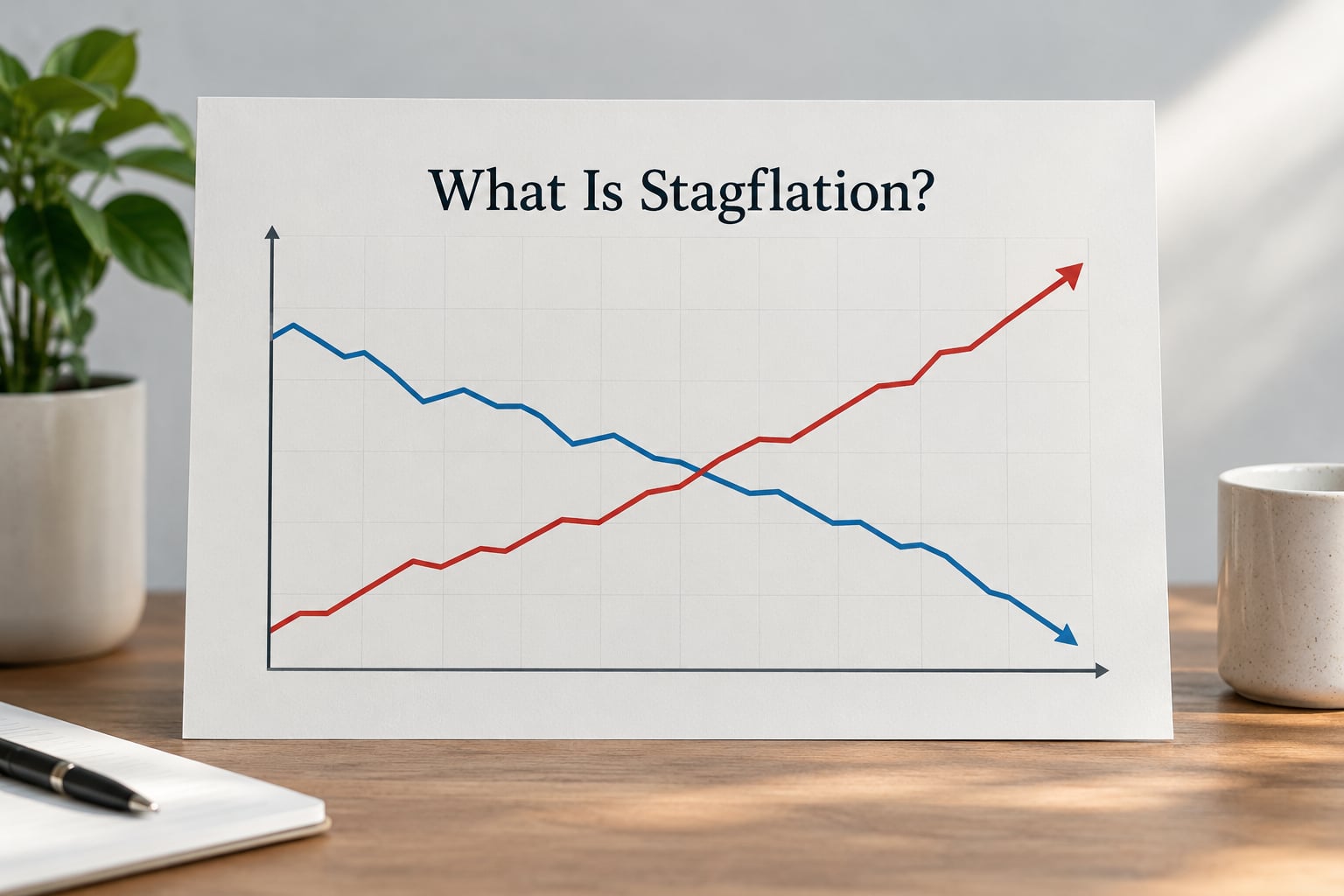
Stagflation is a period when prices keep rising, output stops growing or falls, and unemployment climbs, all at once. The name is just two conditions stitched together: stagnation and inflation.
The word came from Iain Macleod, a British Member of Parliament who used it in a House of Commons speech in 1965 while arguing that the economy could suffer from both at the same time. He was largely ignored at the time, and the term became common only after the 1970s proved him right.
What makes this combination unusual is the Phillips curve. That economic relationship held for decades: when demand was strong and unemployment low, prices tended to rise, and when unemployment rose, price pressure eased. Stagflation describes a world where both sides of that trade-off move upward together.
A concrete example of what it looks like
Imagine a country where an oil embargo triples the price of fuel in eighteen months. Energy costs feed into transport, manufacturing and food, so household prices climb quickly. At the same time, fuel rationing and higher input costs force factories to cut production and stop hiring, so output stalls and joblessness rises.
Now add the policy problem. Raising interest rates to stop the price increases makes borrowing expensive, which hurts the weak parts of the economy that are already struggling. Cutting rates to help those parts risks feeding the inflation further. Neither lever does an obvious good.
How stagflation differs from high inflation and from a recession
| Factor | Stagflation | Ordinary high inflation | Plain recession |
|---|---|---|---|
| Economic growth | Stagnant or negative | Usually positive, sometimes strong | Negative |
| Consumer prices | Rising fast | Rising fast | Falling or flat |
| Unemployment | Rising | Falling or stable | Rising sharply |
| Typical trigger | Supply shock plus weak demand | Demand pull or loose policy | Credit tightening or demand collapse |
| Typical central bank response | Trapped between goals | Tighten until prices settle | Cut rates to support demand |
| Relatively comfortable for | Real assets and cash flow businesses | Borrowers fixed at low rates | Long bonds and rate-sensitive assets |
| Hardest on | Long bonds and high-multiple growth names | Cash savers on fixed incomes | High-yield credit and cyclical equities |
Readers often use the word loosely for any period of rising prices. That matters, because the correct response changes completely. With ordinary high inflation and healthy growth, aggressive equities and modest fixed income can still work. In stagflation, that pairing is the one most likely to disappoint.
How Does Stagflation Happen?
Stagflation usually starts with a shock that raises costs while cutting the amount of goods available, and then gets locked in by policy choices that respond too slowly. The usual suspects fall into a short list.
- Supply shocks and supply-side disruption: wars, shipping disruptions, natural events and production stoppages raise input costs while shrinking output.
- Commodity price surges: an oil price spike hits the cost of almost everything, from freight to plastics to electricity, and it lands before any economy can adjust.
- Trade restrictions such as broad tariffs, which function much like a tax increase on imported goods and on domestic producers who rely on imported inputs.
- Monetary policy error: holding rates too low for too long after a demand shock can de-anchor expectations, which turns a temporary price rise into a persistent one.
- Fiscal pressure: heavy government spending sustained during weak growth can keep demand alive long enough that supply cannot respond, holding prices up.
- Weak productivity growth: when output per worker stalls, wages rise without a matching rise in what the economy can produce, and the gap shows up as inflation.
The last two are the quiet ones. Most people notice the oil shock headline and miss the slower erosion underneath, where years of flat productivity mean firms have no spare capacity and every cost increase passes straight through to prices.
The reason this mix is so hard to untangle is timing. A central bank faces a supply shock, and the textbook response of higher rates is aimed at demand, which is not what broke. Hiking then treats a broken supply chain as if it were overheating.
How Can You Tell If an Economy Is Experiencing Stagflation?
You cannot tell from a single number. You can tell from the pattern, which means watching several series at once and asking whether the combination persists for more than a couple of quarters.
A practical monthly or quarterly routine covers six things. First, inflation persistence: watch both headline and core readings, and pay attention to whether three-month and six-month trends are still climbing rather than flattening.
Second, labour market direction, where a rising unemployment rate alongside rising prices is the clearest tell. Third, output and activity data such as industrial production, retail sales and purchasing managers surveys, looking for weakness rather than a dip in one month.
Fourth, wage growth net of inflation, since a wage-price spiral only really exists when pay is climbing faster than prices are already climbing. Fifth, breakeven inflation rates implied by inflation-linked bonds, which show what markets expect inflation to be over the next five to ten years rather than what happened last month.
Sixth, policy expectations, because a central bank that is raising rates while growth weakens is describing a stagflationary dilemma in real time. The widely followed misery index, which simply adds the inflation rate to the unemployment rate, compresses two of these into a single number and is a decent monthly summary.
Temporary inflation versus true stagflation
| Signal | Temporary price shock | True stagflationary environment |
|---|---|---|
| Unemployment | Falls or stays low | Rising alongside prices |
| Growth | Slowing but positive | Flat or contracting |
| Duration of the price rise | One or two quarters | Several years, with expectations moving |
| Wages | Cooling as prices ease | Accelerating to catch up |
| Policy rate | Hikes then holds or cuts | Hikes persist while activity weakens |
| Corporate pricing power | Returning as costs normalise | Widening for firms with real pricing power |
Be honest about the limits here. These indicators lag, and revisions happen, so a checklist built from published data will always be a few weeks behind the turning point. Its value is that it stops you from reacting to one noisy month.
How Do Central Banks Respond to Stagflation?
Central banks respond by raising rates to hold expectations in place, while trying not to trigger a deeper slowdown. That is the whole trade-off, and it is why stagflation is harder to fight than either inflation or recession on its own.
The theory is that if people believe high inflation is permanent, they demand higher wages, businesses price to that, and the expectation becomes self-fulfilling. Higher rates are meant to break that loop by making current spending less attractive.
The United States ran this test in the late 1970s and early 1980s. After two recessions and years of rising prices, the federal funds rate peaked at roughly 19 to 20 percent in 1981, and unemployment reached 10.8 percent in 1982. Inflation came down. So did employment, hard.
For investors, the lesson from that era is about sequencing rather than the final outcome. Hiking stops inflation eventually, and in the meantime long bonds and rate-sensitive equities can take heavy losses. A plan built around a quick resolution to the inflation half is a plan built around the wrong half.
There is one more wrinkle worth watching. If rates are cut aggressively while inflation is still elevated, demand can recover into a constrained supply base and push prices higher again, which is how a period of stagflation can extend rather than end.
How to Invest in Stagflation Without Chasing the Headlines
The framework that holds up best is boring: give each asset a specific job, size hedges so they cannot hurt you if the scenario does not arrive, and rebalance on a schedule rather than on a headline.
Start with liquidity. Cash does nothing for you in a high-inflation year, but it funds the next opportunity and the next bill without forcing you to sell something at the wrong moment. Most people are under-hedged on this and over-hedged on gold.
Next, shorten duration. Bonds with maturities under five years and floating-rate notes reprice as inflation moves, which turns the biggest traditional weakness into something closer to a neutral. Long-duration bonds are the classic stagflation casualty.
Inflation-linked bonds are the one instrument designed for the problem. Treasury Inflation-Protected Securities adjust their principal with a published index, so the real return is fixed at issue while cash flows stay current. They trade like ordinary bonds, which means they can fall in price when real rates rise, so they are a hedge against inflation rather than a hedge against everything.
Real assets come next, meaning broad commodity exposure, precious metals and energy producers. These have a direct link to the price level, and that link is exactly what you are missing elsewhere. The cost is volatility, and the honest framing is a satellite position rather than a portfolio’s foundation.
For equities, quality is the filter that matters most. Look for low debt, strong free cash flow, and the pricing power to pass cost increases through to customers. A company that can raise prices without losing volume is doing something structurally different from one that has to defend its margins.
Geographic diversification does quietly useful work too. Currency de-anchoring is part of many stagflation episodes, and a portfolio held entirely in one currency and one market is taking that risk whether it means to or not.
What to avoid is worth stating plainly. Long-duration government bonds, high-yield and junk credit, unprofitable companies priced on distant expectations, and any single position large enough to sink the plan if it goes wrong. None of these are bad assets outside stagflation. Inside it, they compound the damage.
On sizing, the most common forum question has no universal answer, and anyone offering one is selling something. A defensive sleeve of low single-digit percentages, with a written rebalancing rule attached, is easier to hold through a drawdown than a heroic allocation you abandon at the bottom.
What Is Stagflation and How to Invest in It Across Asset Classes?
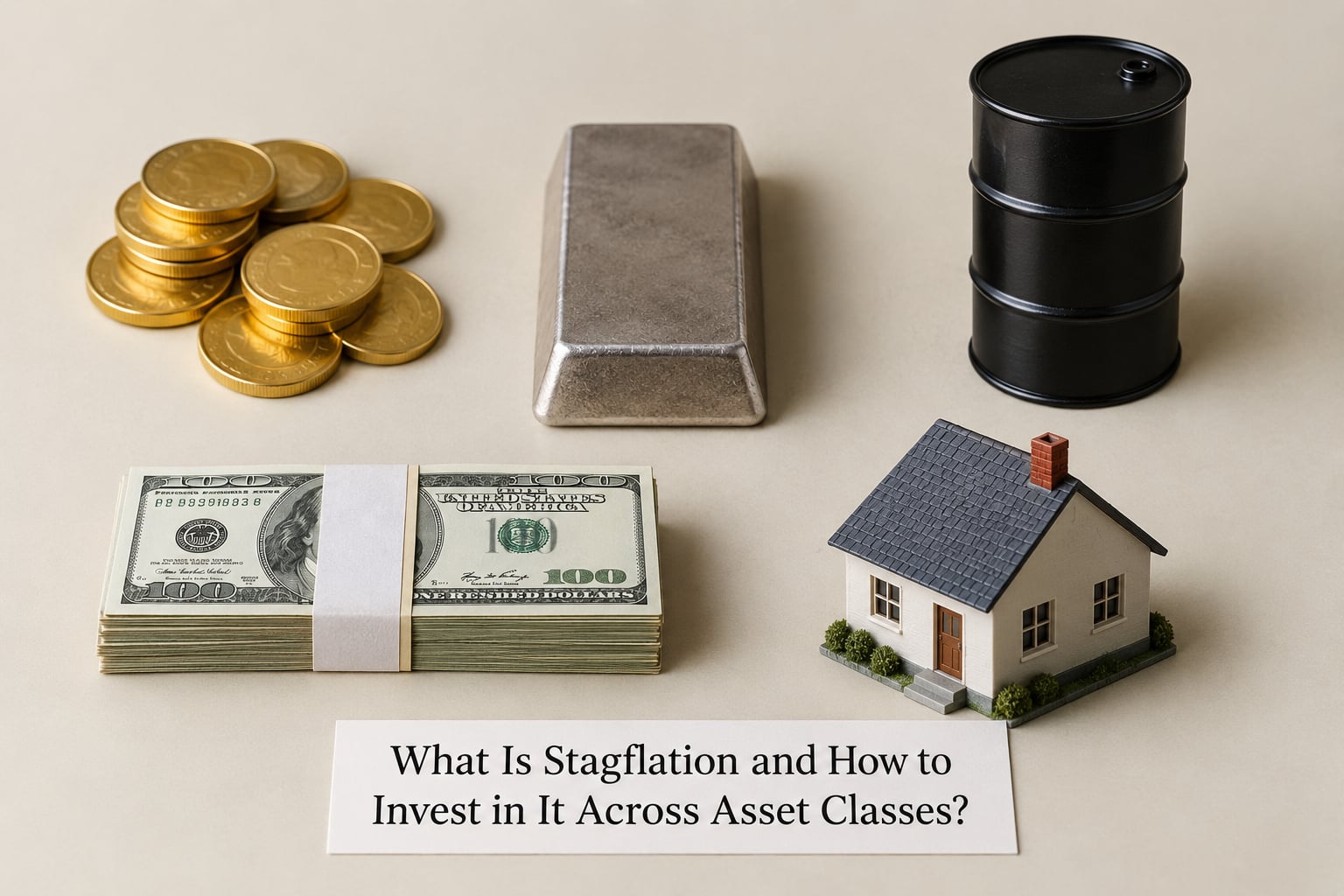
This table gives each asset class a role rather than a verdict, because the same holding behaves differently depending on the shape of the stagflation. Read the risk column before the role column.
| Asset class | Role in a stagflationary regime | Key risk | Type of exposure |
|---|---|---|---|
| Cash and short-term bills | Liquidity and optionality; earns close to the policy rate | Purchasing power erodes if inflation stays high | Defensive |
| Inflation-linked bonds | Real return fixed at issue while principal adjusts with the index | Price falls when real yields rise | Direct |
| Short-duration and floating-rate bonds | Reprices quickly as policy rates move | Little upside if rates fall sharply | Defensive |
| Long-duration bonds | Most exposed to rising real yields and inflation risk | Double hit from rates and purchasing power | Avoid or reduce |
| Precious metals | Holds value against currency debasement and confidence shocks | No cash flow, volatile, storage cost, no yield | Direct hedge |
| Broad commodities | Direct link to the price level across energy, metals and agriculture | Roll costs in futures-based products, sharp drawdowns | Direct hedge |
| Energy and resource producers | Operating leverage to higher commodity prices plus cash flow | Company-specific risk, capital discipline, policy exposure | Direct |
| Dividend and staples sectors | Pricing power and steady cash flow when demand is weak | Already well priced, rate sensitivity | Defensive |
| International equities | Different inflation drivers, currencies and policy cycles | Currency swings, no control over foreign policy | Diversifier |
| Property and infrastructure | Rates, leverage, slow to adjust, local regulation | Direct, unleveraged preferred |
Read the last column carefully. Direct exposure means the asset tends to rise when prices rise, and it usually brings volatility with it. Defensive exposure protects the portfolio from something else going wrong, usually a drawdown in equities. Most people need a small amount of the first and a sensible amount of the second.
Precious Metals: A Potential Hedge, Not a Guaranteed Answer
Gold and silver sit closest to the price level because they carry no counterparty and no cash flow that can be repriced downward. Gold has a long history as a store of value when confidence in paper money weakens, which is one of the reasons it tends to get bought during this kind of stress.
The historical case is what makes it interesting. A widely cited figure in one r/HENRYUK discussion thread put gold’s rise across the 1970s at roughly 2,200 percent over the period. That is a real run, and it is also the reason the purchase price matters so much today. Anyone buying after a 40 or 50 percent rally in a year is underwriting a very different entry point than the 1970s buyers faced.
There is an argument that gold is already priced in, and it deserves a hearing. If markets believe a stagflationary period is coming, hedging demand should already be in the price. The honest answer is that nobody knows, which is an argument for a sizing rule rather than a view.
Physical metal has real costs too. Storage, insurance, spreads between the buy and sell price, and no income while you hold it. Funds and backed accounts avoid the storage problem but add a fee and, in some cases, a counterparty. Silver is more volatile still and carries heavier industrial demand, so it behaves less like a hedge and more like a leveraged version of the same idea.
Mining equities are a different asset wearing similar clothing. They respond to gold prices, but they also carry operating risk, energy costs, permitting timelines and management decisions. They can fall while gold rises, and that gap catches people who thought they were buying a safe asset.
Commodities and Natural Resources: Inflation Linked but Volatile
Commodities are the most direct link an ordinary investor can own between inflation and their portfolio. When prices rise across an economy, the raw inputs that prices are made from generally rise too, and energy, industrial metals and agricultural products are where you see it first.
Broad exposure is usually obtained through a pooled vehicle rather than individual contracts. That convenience has a cost. Futures-based products are rolled from contract to contract, and in a market where nearby prices are often below later ones, that roll quietly subtracts from returns over time. Understanding that mechanic matters more than the headline tracking difference, which many investors never check.
The second cost is volatility, and it is severe. Commodity prices are cyclical by nature, and a hedging position that has doubled often gives back a large share quickly. Position size is what keeps this from damaging the rest of the plan, and it is why a commodity sleeve sized like an equity sleeve tends to get sold at exactly the wrong time.
Commodity producers give you the same link with the addition of a business. That business can be well run, badly run, over-levered to a boom, or brilliant at returning cash when prices fall. Energy companies in particular have a long record of spending their way through a high-price year, which is why cash flow discipline matters more than the commodity outlook.
One structural question deserves attention: a tariff-driven price increase is a domestic cost shock, while an oil shock is a global one. A broad commodity basket hedged the first kind of event historically better than some assume, because domestic tariffs do not raise world prices. Tariffs mainly hurt importers, domestic manufacturers who use imported inputs, and anything bought in dollars. Treating a tariff shock as if it were 1979 is a mistake worth avoiding.
Bonds, Equities, and Cash: Where They Fit in a Stagflation Plan
Bonds, equities and cash each fail in a different way, which is why a plan that leans on only one of them tends to disappoint. Understanding the failure mode is more useful than picking a winner.
Bonds: duration is the problem
A thirty-year bond paying a fixed rate is a promise about next year’s income in today’s money. If inflation runs at 8 percent, that promise loses purchasing power fast. On top of that, rising inflation usually pushes rates up, which lowers the price of existing bonds. You get the loss twice, and long duration makes both losses larger.
Short maturities, floating-rate notes and inflation-linked bonds all address this in different ways. Short maturities roll into higher rates quickly. Floating-rate instruments reset with the policy rate. Inflation-linked bonds adjust principal. None of them is free, and all three have periods where they lag a sharp fall in rates.
Equities: pricing power is the whole game
Broad equity indices usually fall during a stagflationary episode, and the reason is arithmetic. Costs rise faster than a company can pass them through, so gross margins compress, and falling demand makes volume worse at the same time. Companies with genuine pricing power, meaning a brand or a service customers need, can keep raising prices and keep their margins.
Value-oriented and cash-generative businesses tend to hold up better than long-duration growth names in this environment, because a distant earnings stream is discounted more heavily when real yields rise. There is a serious counter-argument in forum discussion, and it deserves weight: a globally diversified equity portfolio is the best long-run inflation fighter most people will ever own, and panicking out of it before a difficult stretch is how real losses happen.
Both things can be true. The counter-argument is about decades. The stagflation concern is about eighteen months, and a portfolio built for decades can absorb a rough year, while a portfolio that panics cannot.
Cash: an option, not a strategy
Cash loses to inflation, and it is not an asset class worth building a plan around. It is what buys you time, covers an emergency, and lets you rebalance without selling something at a loss. For retirees, a cash buffer sized in years of spending rather than months is what turns a bad market year into a bad quarter.
Retirees face a specific problem
Sequence-of-returns risk is the part that catches people who are drawing income. A portfolio that falls 20 percent in the first year of retirement and withdrawals continue has to recover from a much larger base, and a bad start plus persistent inflation is the hardest version of that problem.
The structural responses are unglamorous. Keep maturities short so bonds mature rather than fall. Hold a cash buffer measured in years, not months. Keep withdrawals flexible enough to trim in a weak year. And remember that with roughly half a retirement horizon still ahead, there is time to recover, which is not something a 40-year-old can say in the same situation.
How to Build a Stagflation-Resistant Investment Plan
A workable plan comes down to seven steps, and the order matters more than the details.
- Name your goal and your horizon. A hedge that helps a 25-year-old matters far less than the same hedge matters to someone drawing income for 25 years. Time horizon changes sizing before it changes allocation.
- Check your fixed-rate obligations. Stagflation is uniquely hostile to borrowers on fixed-rate debt, because their payments stay flat while their income does not. Paying down expensive fixed debt is a hedge in a way that most investing commentary never mentions.
- Measure your real duration. Add up the long bonds, the high-yield credit and the cash-like balances that sit at low yields. Many people carry more inflation sensitivity than they think once mortgage and property are included.
- Choose one or two direct hedges and size them. Broad commodities and inflation-linked bonds cover the price-level risk. Whatever you pick, write the percentage down before you buy, because sizing decided while watching a rally is not sizing at all.
- Add equity quality rather than equity themes. Low debt, strong free cash flow and demonstrated pricing power travel across sectors, and they matter more than picking the right sector label.
- Rebalance on a calendar. Set a date, check twice a year, and trade back toward your targets. That single rule prevents the most common failure, which is selling a hedge after a large run because the position has become uncomfortable.
- Re-examine the thesis, not the feeling. Re-read your original reasoning quarterly. If you wrote down why you own something, you can tell the difference between a thesis that has broken and a quarter that felt bad.
How the emphasis shifts by investor type
These are illustrations of emphasis, not models to copy. The numbers below are round figures meant to show where attention goes, not what you should buy.
| Investor type | Where the attention goes | Typical starting error |
|---|---|---|
| Long-term accumulator, decades ahead | Keep equity exposure high, add a small direct hedge sleeve, accept more volatility | Panic selling a diversified equity portfolio in the first weak quarter |
| Balanced, mid-career | Cut long duration, add inflation-linked bonds, hold quality equity with pricing power | Holding a bond fund that has quietly become mostly long duration |
| Near-retiree or retiree drawing income | Short maturities, cash buffer measured in years, flexible withdrawals, minimal long duration | Treating a two-year cash reserve as adequate for a 25-year retirement |
| Income and dividend investor | Dividend growth and coverage first, sector diversification second | Buying yield rather than dividend safety as yields rise |
The common thread is that hedges are sized to be survivable. A position you cannot hold through a 30 percent drawdown is not a hedge, it is a bet on your own temperament.
Frequently Asked Questions
No. High inflation means prices are rising, which can happen during healthy growth with falling unemployment. Stagflation is narrower: prices rise while output stalls or shrinks and unemployment climbs. That difference changes the response. With ordinary high inflation, growth equities and modest fixed income can still work. Under stagflation, long-duration bonds and high-multiple growth names tend to lose on both sides at once.
Historically, real assets with a direct link to the price level have led: precious metals first, then broad commodity exposure and energy producers. Inflation-linked bonds hold their real return by design, though they can fall in price when real yields rise. No asset leads in every stagflation episode, and results depend heavily on the entry point and on sizing. A defensive sleeve sized to survive a drawdown works better than a large, late allocation.
Gold has a genuine history as a hedge against currency debasement and confidence shocks, and it carries no cash flow that can be repriced downward. The objections are equally real: no income, storage or management costs, and price swings large enough to test any allocation. A widely cited figure in one r/HENRYUK thread put gold’s 1970s rise near 2,200 percent, which tells you about the opportunity and about the entry point that produced it. Size it small and set a rebalancing rule in advance.
Long-duration bonds usually do, and they lose twice. Rising inflation erodes the real value of a fixed coupon, and rising inflation expectations push yields up, which lowers the price of existing bonds. Shorter maturities, floating-rate notes and inflation-linked bonds reduce that exposure because they reprice or adjust quickly. A bond portfolio that is mostly short and medium maturity is far less exposed than one anchored in thirty-year bonds.
It varies, and the honest range is wide. The United States episodes of 1974 to 1975 and 1978 to 1982 lasted years, not quarters, and ended only after policy forced a deep slowdown. Supply-driven episodes can end quickly if the shock itself fades, while expectations-driven ones last longer because wage and price setting adapts slowly. Most observers treat a horizon of one to three years as the realistic planning window rather than assuming either a quick resolution or a permanent condition.
Check your fixed-rate debt first, since it is uniquely exposed. Shorten bond duration and consider inflation-linked or floating-rate exposure. Hold a cash buffer measured in years of spending if you are drawing income. Add a small direct hedge in broad commodities or metals, sized so a large drawdown does not force you to sell, and filter equities for low debt, free cash flow and pricing power. Rebalance on a calendar and review the reasoning quarterly rather than reacting to headlines.
Conclusion: Start With Diversification and a Plan
Stagflation is stagnant or shrinking growth arriving at the same time as high inflation and rising unemployment, a combination that breaks the trade-off central banks have relied on for decades. Because both traditional safe havens can fail at once, the answer is not one asset but a portfolio where each holding has a stated job.
Start where most people have not: your fixed-rate debt and your real duration. Then shorten maturities, add a small direct hedge in real assets sized so you can hold it, and filter equities for pricing power and clean balance sheets. Write the target percentages down before the next headline, and rebalance on a date rather than on a feeling.
If you take one action from this guide, take the inventory. Write down what you hold, how long it takes to mature, and what happens to it if prices keep rising while growth stalls. That single page usually reveals more than any stagflation forecast will.
Source: https://www.pgm-blog.com/what-is-stagflation-and-how-to-invest-in-it/
Anyone can join.
Anyone can contribute.
Anyone can become informed about their world.
"United We Stand" Click Here To Create Your Personal Citizen Journalist Account Today, Be Sure To Invite Your Friends.
Before It’s News® is a community of individuals who report on what’s going on around them, from all around the world. Anyone can join. Anyone can contribute. Anyone can become informed about their world. "United We Stand" Click Here To Create Your Personal Citizen Journalist Account Today, Be Sure To Invite Your Friends.
LION'S MANE PRODUCT
Try Our Lion’s Mane WHOLE MIND Nootropic Blend 60 Capsules
Mushrooms are having a moment. One fabulous fungus in particular, lion’s mane, may help improve memory, depression and anxiety symptoms. They are also an excellent source of nutrients that show promise as a therapy for dementia, and other neurodegenerative diseases. If you’re living with anxiety or depression, you may be curious about all the therapy options out there — including the natural ones.Our Lion’s Mane WHOLE MIND Nootropic Blend has been formulated to utilize the potency of Lion’s mane but also include the benefits of four other Highly Beneficial Mushrooms. Synergistically, they work together to Build your health through improving cognitive function and immunity regardless of your age. Our Nootropic not only improves your Cognitive Function and Activates your Immune System, but it benefits growth of Essential Gut Flora, further enhancing your Vitality.

Our Formula includes: Lion’s Mane Mushrooms which Increase Brain Power through nerve growth, lessen anxiety, reduce depression, and improve concentration. Its an excellent adaptogen, promotes sleep and improves immunity. Shiitake Mushrooms which Fight cancer cells and infectious disease, boost the immune system, promotes brain function, and serves as a source of B vitamins. Maitake Mushrooms which regulate blood sugar levels of diabetics, reduce hypertension and boosts the immune system. Reishi Mushrooms which Fight inflammation, liver disease, fatigue, tumor growth and cancer. They Improve skin disorders and soothes digestive problems, stomach ulcers and leaky gut syndrome. Chaga Mushrooms which have anti-aging effects, boost immune function, improve stamina and athletic performance, even act as a natural aphrodisiac, fighting diabetes and improving liver function. Try Our Lion’s Mane WHOLE MIND Nootropic Blend 60 Capsules Today. Be 100% Satisfied or Receive a Full Money Back Guarantee. Order Yours Today by Following This Link.


| Visits: | 1,833,882,533 |
| Stories: | 8,714,979 |
Whistler Blowers, Insiders

