

What Are Real Interest Rates? A Simple Guide for Investors (2026)

A real interest rate is the interest rate you get after removing inflation from it. In short: real interest rate = nominal interest rate minus the inflation rate. If a savings account pays 5% and inflation runs at 3%, the real rate is 2%. Investors care because the nominal number tells you what your balance grows by, while the real rate tells you what your purchasing power actually grew by.
The gap between those two numbers is where most confusion comes from. Plenty of people assume the rate printed on a bank statement is the real rate, and it is not. Every rate a bank quotes you is nominal until inflation is subtracted.
What Are Real Interest Rates?
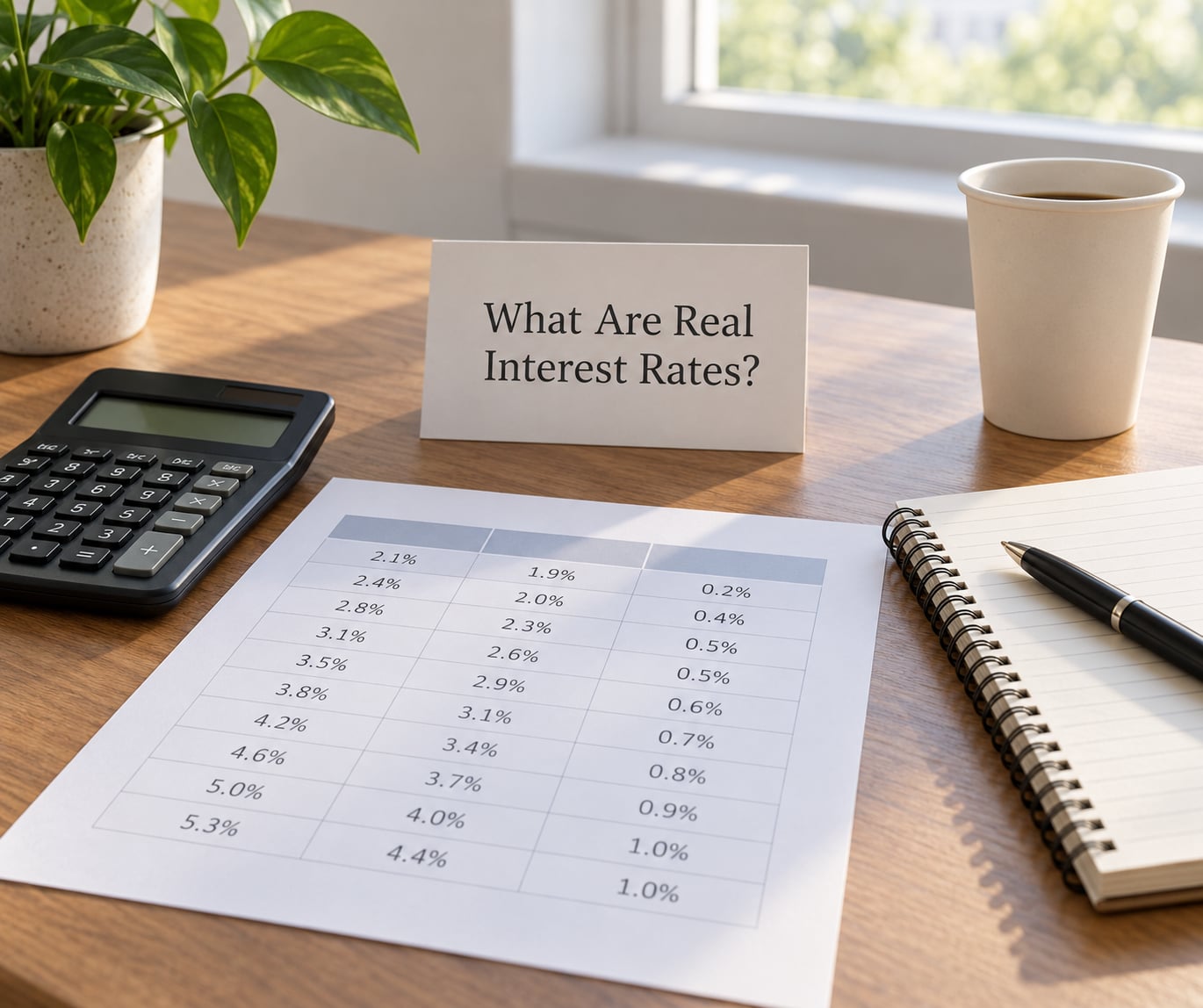
A real interest rate is a nominal interest rate adjusted for inflation, so it shows the true cost of borrowing and the true yield on saving. The calculation is a subtraction: take the rate you are quoted and take away the rate at which prices rose over the same period.
So a 5% certificate of deposit during 3% inflation earns roughly 2% in real terms. A 1% savings account during 3% inflation loses roughly 2% of its value every year, even though the balance in the account goes up. The account is not wrong about the interest. It is just that each dollar you hold buys slightly less than it did a year earlier.
That second case is what most people mean when they ask whether real interest rates are negative. Nobody has to subtract money from your balance. The loss is quieter than that, and it shows up at the checkout rather than on a statement.
How Are Real Interest Rates Calculated?
The everyday shortcut is the approximate version: real rate = nominal rate − inflation rate. It is accurate enough when inflation is low and the rates involved are small, and it is what most calculators and most articles use.
The more precise version is the Fisher equation: real rate = (1 + nominal rate) ÷ (1 + inflation rate) − 1. With a 5% nominal rate and 3% inflation, the approximation gives 2.0% while the exact figure comes to about 1.94%. The difference is small but it grows when inflation is high, which is exactly when you most want an honest number.
Here is the same nominal rate against four inflation scenarios, using both methods.
| Nominal rate | Inflation rate | Real rate (approximate) | Real rate (Fisher) |
|---|---|---|---|
| 4% | 2% | 2.0% | 1.96% |
| 4% | 3% | 1.0% | 0.97% |
| 4% | 5% | -1.0% | -0.95% |
| 5% | 3% | 2.0% | 1.94% |
One more distinction matters before you use any of these numbers. An ex ante real rate uses expected inflation, so it is the rate a market participant was pricing at the start of the period. An ex post real rate uses inflation that actually happened, which is the return you ended up with. The same 5% nominal rate can look generous on paper and disappointing in reality if inflation ran hotter than anyone assumed.
Forum threads about this topic keep circling the same complaint: writers use the phrase for both, without saying which one they mean. If a number is quoted to you without that label, ask.
What Is the Difference Between Nominal and Real Interest Rates?
The nominal rate is the number on the account, the loan or the bond. The real rate is that number with inflation removed. Both are correct; they answer different questions.
| What it measures | Nominal interest rate | Real interest rate |
|---|---|---|
| Basic definition | The rate as quoted, before adjusting for prices | The nominal rate minus inflation |
| Where you see it | Savings accounts, certificates of deposit, mortgages, Treasury yields | TIPS yields, real policy rate estimates, your own calculation |
| Which inflation figure | None, it makes no adjustment | CPI, PCE or core, and your choice matters |
| What it tells you | How much the balance grows in cash terms | How much purchasing power actually grew |
| Example at 4% and 3% inflation | 4% earned | About 1% earned |
| Best use | Comparing accounts or loans on identical terms | Comparing returns across years or against alternatives |
Traders on investing forums tend to treat the real rate as the number that matters and the nominal rate as background. The argument is straightforward: two nominal yields of 4% are completely different investments if one was written when inflation ran at 1% and the other when inflation ran at 5%.
Which Real Interest Rate Should Investors Use?

There is no single official real rate, and anyone who quotes you one without a source is choosing for you. Four measures cover most practical needs.
Central-bank policy estimates. Most major central banks publish an estimate of the short-term real policy rate, adjusted for their inflation target or a near-term forecast. It is a model figure built from policy rates and inflation assumptions, so read the methodology before quoting it as fact.
Inflation-indexed bond yields. A 10-year TIPS yield is a real yield quoted directly by the market, stripped of expected inflation at issuance. It is the cleanest long-horizon real rate available to an individual investor.
Nominal yields minus a forecast. Subtract a consensus inflation forecast from a 10-year Treasury yield and you get a rough real yield. It is transparent and easy to reproduce, and the forecast is the weak link. Twelve-month and ten-year forecasts can disagree by a full percentage point.
Realized rates, for reviewing what happened. Once a period is over, subtract the inflation that actually printed from the nominal return you received. This is the only version that cannot be argued with, which makes it the one to use when reviewing a portfolio.
On the measurement question, one honest caveat beats false precision. Consumers feel headline inflation because groceries and rent dominate the basket, while the index many models use may exclude those or weight them differently, so your lived real rate and the official one can drift apart by several tenths of a point.
Why Do Real Interest Rates Matter for Investors?
A real rate is the price of money in goods and services. Every asset in a portfolio is priced against that price, so when it moves, relative values shift with it.
- Bonds. Higher real yields push existing bond prices down, because a fixed coupon buys less purchasing power than it used to. Duration-heavy portfolios suffer most.
- Saving. A positive real rate rewards patience. A negative one quietly taxes every cash balance in the economy.
- Borrowing. A higher real rate makes debt service consume a larger share of income, which is one reason savers on forums treat real rates as an early signal of stress.
- Currencies. Higher real yields attract capital into a currency, because the return on assets denominated in it improves.
- Equities. Future cash flows are discounted at a real rate, so a persistent rise in real rates compresses valuations, especially for companies far from profitability.
Markets tend to react to the direction of travel rather than the level itself. A steady 2% real rate that everyone expects is unremarkable; the same 2% arriving unexpectedly is what moves prices.
How Do Real Interest Rates Affect Gold and Commodities?
Gold pays no coupon and no dividend, so its appeal is the absence of yield risk. When real yields rise, holding a non-yielding asset looks worse next to a Treasury that keeps pace with inflation, and gold usually has a harder time.
That relationship is a tendency, not a law. During an inflation shock, real yields can rise and gold still climb, because a fast and unexpected rise in prices raises demand for a hedge. When a crisis makes investors nervous, the safe-haven bid can outweigh the yield drag entirely. Currency moves complicate it further, since dollar strength usually presses on dollar-priced metals.
If you trade precious metals or commodity equities, the practical move is to watch the real yield and the breakeven inflation rate together. When one rises and the other falls, the story is about real returns. When both rise, it is usually about inflation.
What Are TIPS and How Do They Reveal Real Rates?
Treasury Inflation-Protected Securities are US government bonds whose principal adjusts with the Consumer Price Index each year. When the CPI rises, the principal you get back at maturity rises with it, and the coupons are paid on that higher amount.
The yield quoted on a TIPS is therefore a real yield. A 10-year TIPS quoted near 2% tells you the market is pricing an expected real return of roughly 2% a year, before you account for how the inflation adjustment actually turns out.
Three numbers get confused here. The real yield to maturity is what you earn on an inflation-adjusted basis. The nominal yield to maturity is what you earn in cash, including the compounding effect of the principal adjustments. The breakeven inflation rate is the difference between a nominal Treasury yield and a TIPS yield of the same maturity, and it is the market’s implied inflation forecast.
Breakevens are worth watching closely because they can move sharply on supply and demand for the securities themselves, which is why they are read as an expectations measure with caveats rather than a crystal ball.
How Can You Track Real Interest Rates?
A short watchlist is enough to stay current, and every item on it is free to check.
- The 10-year real interest rate series published by the Federal Reserve Bank of Cleveland and carried on the St. Louis Fed database. It blends Treasury yields, inflation data, inflation swaps and survey expectations into a single model-based estimate.
- TIPS yields across maturities. One point on the curve is noise; the slope tells you whether the market expects rates to stay high.
- Breakeven inflation rates from the same maturities, compared against survey-based consumer expectations.
- The headline and core inflation prints you would actually subtract yourself, remembering that the two give different answers.
- Your own numbers. The rate on your savings account and the rate on your mortgage, recalculated whenever inflation data lands.
The Federal Reserve Bank of Cleveland reported a 10-year real interest rate of 2.24% for September 2026 on its published series, which is a reasonable anchor for where long-horizon real rates sat at that point.
What Common Misconceptions Should Investors Avoid?
A positive real rate is not automatically good news. A high real rate rewards savers and punishes borrowers at the same time. Whether that helps you depends on whether you hold cash or owe money, and it can slow the economy on the way there.
A rate cut does not automatically mean easier financial conditions. If lenders anticipate that cuts are coming, long-term borrowing costs can fall ahead of the policy rate. Meanwhile the real cost of borrowing can still be climbing if inflation is dropping faster than nominal rates are.
TIPS do not remove every kind of risk. They adjust for the index they are tied to, which is not necessarily the inflation you personally face, and they trade at fluctuating prices before maturity. There is also a lag between when prices rise and when the adjustment catches up.
No single real-rate estimate is exact. Change the inflation measure and the answer moves. Change the horizon and it moves again. Long-horizon real rates are estimates built from several imperfect inputs, and anyone who treats one to two decimal places as gospel is over-reading the data.
Frequently Asked Questions
Yes, long-horizon real rates have been positive recently. The Federal Reserve Bank of Cleveland reported a 10-year real interest rate of 2.24% for September 2026, and 10-year TIPS yields have also stayed in positive territory over recent years. Short-horizon measures tell a different story, though, because they follow the policy rate more closely and have at times been negative. Check the maturity you actually care about before quoting a figure.
Subtract the inflation rate from the nominal rate over the same period. A 4% return during 2% inflation gives an approximate real rate of 2%. For more precision use the Fisher equation: (1 + nominal rate) divided by (1 + inflation rate) minus 1, which returns about 1.96% in that example. Match your time periods carefully, since comparing a five-year nominal return to one year of inflation overstates the real result.
They are bad for savers and good for borrowers. When inflation runs above your nominal rate, the purchasing power of your cash falls even though the balance rises. Borrowers repay with money that is worth less than when they borrowed it. Investors who move into assets that adjust with inflation, such as TIPS or equities with pricing power, are partly protected, while long-duration bonds tend to suffer when real yields are deeply negative.
A TIPS yield is a real rate: it already excludes expected inflation. The inflation rate is the raw change in prices. Comparing the two does not make sense, which is why the useful comparison is between a nominal Treasury yield and a TIPS yield of the same maturity. The difference between those two is the breakeven inflation rate, an estimate of what the market expects inflation to average over that period.
Not on their own, but they are one of the biggest drivers. Gold pays no yield, so higher real yields raise the opportunity cost of holding it and usually weigh on the price. The relationship breaks down during inflation shocks, when demand for a hedge can push gold higher even as real yields rise, and during risk-off periods, when safe-haven demand can dominate. Currency moves and central-bank buying also shift the balance.
Key Takeaways
Real interest rates are what an interest rate is worth after inflation, and the difference between nominal and real is usually larger than people expect. Before you do anything else, take the rate on your own savings or loan and subtract the inflation rate over the matching period. You will get a number no headline ever gave you.
From there, watch a TIPS yield and a breakeven rate, and treat the direction of change as more informative than the level on any given day. If you hold metals or commodity exposures, use real yields as one input alongside inflation expectations and currency moves, not as a switch that decides the trade on its own.
Source: https://www.pgm-blog.com/what-are-real-interest-rates/
Anyone can join.
Anyone can contribute.
Anyone can become informed about their world.
"United We Stand" Click Here To Create Your Personal Citizen Journalist Account Today, Be Sure To Invite Your Friends.
Before It’s News® is a community of individuals who report on what’s going on around them, from all around the world. Anyone can join. Anyone can contribute. Anyone can become informed about their world. "United We Stand" Click Here To Create Your Personal Citizen Journalist Account Today, Be Sure To Invite Your Friends.
LION'S MANE PRODUCT
Try Our Lion’s Mane WHOLE MIND Nootropic Blend 60 Capsules
Mushrooms are having a moment. One fabulous fungus in particular, lion’s mane, may help improve memory, depression and anxiety symptoms. They are also an excellent source of nutrients that show promise as a therapy for dementia, and other neurodegenerative diseases. If you’re living with anxiety or depression, you may be curious about all the therapy options out there — including the natural ones.Our Lion’s Mane WHOLE MIND Nootropic Blend has been formulated to utilize the potency of Lion’s mane but also include the benefits of four other Highly Beneficial Mushrooms. Synergistically, they work together to Build your health through improving cognitive function and immunity regardless of your age. Our Nootropic not only improves your Cognitive Function and Activates your Immune System, but it benefits growth of Essential Gut Flora, further enhancing your Vitality.

Our Formula includes: Lion’s Mane Mushrooms which Increase Brain Power through nerve growth, lessen anxiety, reduce depression, and improve concentration. Its an excellent adaptogen, promotes sleep and improves immunity. Shiitake Mushrooms which Fight cancer cells and infectious disease, boost the immune system, promotes brain function, and serves as a source of B vitamins. Maitake Mushrooms which regulate blood sugar levels of diabetics, reduce hypertension and boosts the immune system. Reishi Mushrooms which Fight inflammation, liver disease, fatigue, tumor growth and cancer. They Improve skin disorders and soothes digestive problems, stomach ulcers and leaky gut syndrome. Chaga Mushrooms which have anti-aging effects, boost immune function, improve stamina and athletic performance, even act as a natural aphrodisiac, fighting diabetes and improving liver function. Try Our Lion’s Mane WHOLE MIND Nootropic Blend 60 Capsules Today. Be 100% Satisfied or Receive a Full Money Back Guarantee. Order Yours Today by Following This Link.


| Visits: | 1,833,895,646 |
| Stories: | 8,715,030 |
Whistler Blowers, Insiders

