

What Is Financial Repression? A Plain-English Guide (October 2026)

Financial repression is the use of government financial policy to hold down the returns savers earn, so that private money ends up financing the state instead of the saver. In plain terms: a government carrying too much debt keeps interest rates low, steers banks and pension funds into its own bonds, and makes it harder to move money abroad. The result is a slow transfer of purchasing power from the people who save to the government that borrows.
The term sounds dramatic, but the mechanism is mostly boring paperwork: a rate ceiling, a reserve requirement, a collateral rule, a capital control. That is exactly why it is hard to notice and easy to live through. Below I walk through the levers, the historical cases, and what an ordinary saver can actually watch. This is general information, not advice — rules and rates differ by country and change over time.
What Is Financial Repression?
What is financial repression? It is a set of government policies that channel private domestic funds to the public sector, usually to bring down a high debt-to-GDP ratio without defaulting, devaluing, or cutting spending outright.
The idea is old. Edward Shaw and Ronald McKinnon used the term in 1973 to describe governments that kept their financial systems deliberately unreformed, so that cheap credit would flow to industry and the state rather than to the bidder with the highest return. Reinhart and Sbrancia later documented the same toolkit across dozens of countries, and the phrase is now standard in IMF and central bank writing.
The government is the debtor in all of this. Every mechanism has the same shape: make saving less attractive, and the money that would have gone into private assets ends up on the public balance sheet at a yield the state can afford.
Governments use several tools to repress the financial system:
- Interest rate caps — a ceiling on deposit and bond yields, so savers cannot outbid the treasury.
- Government ownership or control of domestic banks — public banks and state-owned lenders take lending decisions that serve fiscal policy.
- High reserve requirements — banks park more at the central bank and less in loans or securities.
- Captive domestic markets for government debt — pension funds, insurers and banks are pushed or bribed into sovereign bonds.
- Capital controls — limits or taxes on moving money across the border.
Other levers show up in the same period: forced pension allocations to domestic sovereigns, directed lending programmes with credit ceilings, taxes on financial transactions, and heavy capital and liquidity rules that quietly make government paper the most attractive asset on a bank or insurer’s balance sheet.
Researchers have tried to put a number on the effect. A 1993 study of 24 emerging markets by Giovannini and de Melo estimated the resulting tax above 2% of GDP in seven countries, and near 6% of GDP in Mexico — roughly 40% of that country’s total tax revenue.
How Does Financial Repression Affect Savers and Investors?
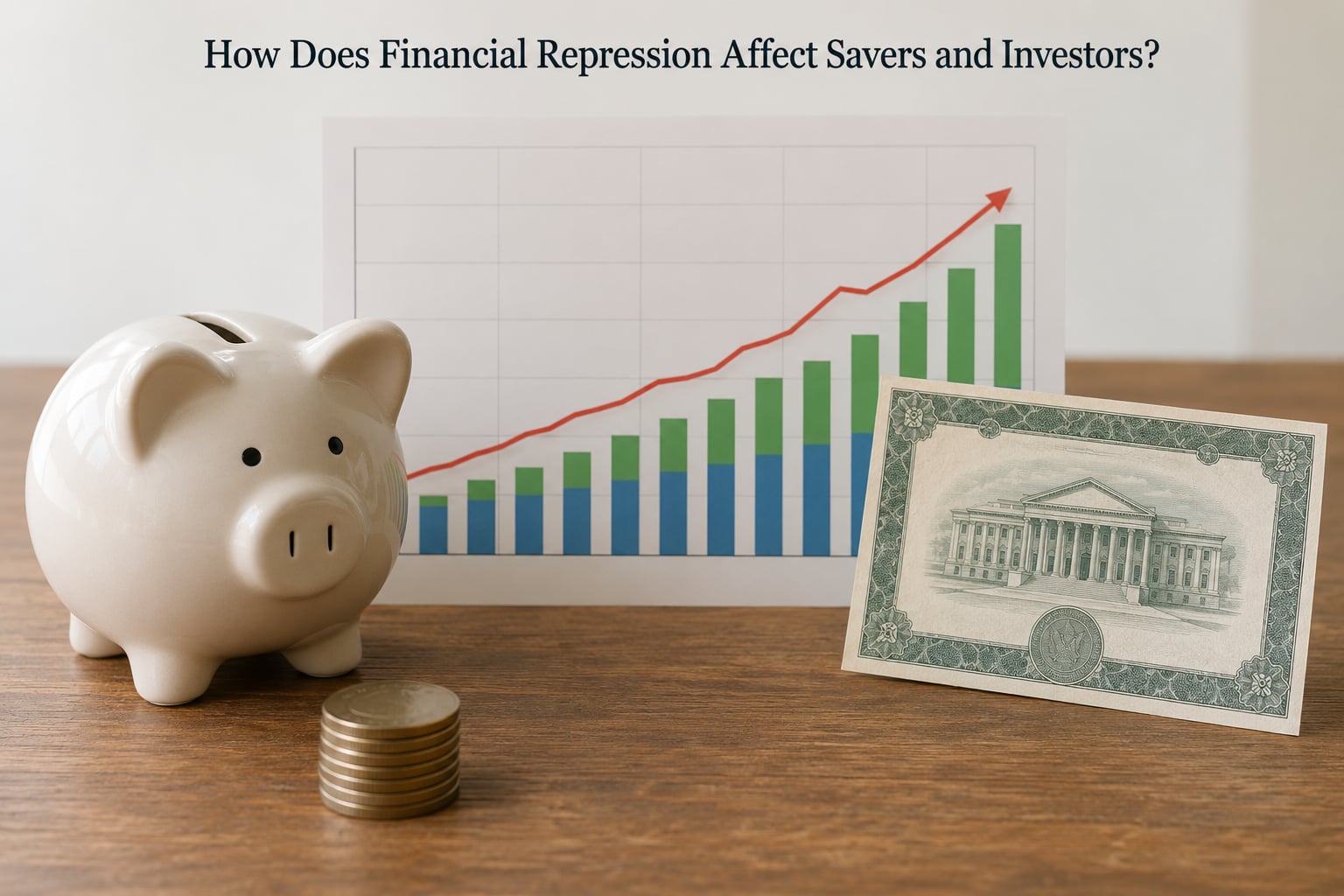
The damage shows up in one number: the gap between what you are paid nominally and what your money can actually buy. A deposit paying 3% while consumer prices rise 4% is not paying you 3%. It is quietly costing you 1% a year, and the loss compounds silently.
Start with 10,000 saved at 3% with 4% inflation. After a year you have 10,300 in nominal terms. Prices rose by 4%, so the same 10,300 buys roughly 9,900 worth of goods a year ago. Nobody sends you a statement about the 100 you lost. That is the whole trick of the repression tax.
Three consequences matter most for savers and investors:
- Negative real yields — the nominal return sits below inflation for long stretches, so holding cash or short bonds becomes a slow transfer from saver to debtor.
- Wealth redistribution — the gain accrues to the state and to borrowers, while pensioners and households on fixed incomes absorb the loss.
- Market distortion — capital is pushed into low-yielding sovereign debt and away from productive private investment, which is the crowding-out effect economists warn about.
The arithmetic behind it is the relationship between the interest rate and the growth rate. When borrowing costs sit persistently below the growth rate of the economy, a debt ratio that should be falling instead grinds upward, because the government pays more in interest than the economy adds in nominal terms.
For investors, the practical consequence is that the safe option stops being safe. A portfolio built entirely of government bonds looks conservative and behaves like a short position on the currency and on the policy rate at the same time.
How Financial Repression Works
The mechanics run through three channels, and they reinforce each other.
The interest rate channel. A central bank holds the policy rate below inflation, or a treasury caps yields outright. In the United States, Regulation Q did this from the 1930s into the 1970s by prohibiting higher interest on savings accounts than the maximum the rules allowed. Savers were pushed into mutual funds, Treasury bills, and eventually equities — anything that beat the cap.
The regulatory channel. Capital adequacy rules, liquidity requirements and collateral policy decide which assets a bank or insurer can comfortably hold. When the central bank accepts government bonds as high-quality collateral and penalises other holdings, sovereign debt gets a regulatory advantage that shows up in every portfolio’s required allocations. That is how pension funds end up with bond mandates they did not choose, and how a captive domestic market for government debt forms without anyone passing a law.
The conversion channel. Capital controls sit on top of both. A 25% tax on converting local currency into dollars, a limit on how much you can take out per year, or a rule requiring approval for a foreign purchase all reduce the return to moving money, which raises the effective attractiveness of staying put.
None of this requires a dramatic announcement. It arrives as amendments to rulebooks, consultation papers and accounting guidance — which is precisely why the term stays unfamiliar while the policy does not.
What Policy Tools Do Governments Use?
Here is the working set, with what each one actually does and where it lands.
| Tool | How it works | Who absorbs the loss | Seen in |
|---|---|---|---|
| Interest rate ceiling | Regulator sets a maximum yield on deposits or government debt | Depositors and bondholders | Regulation Q in the US, fixed-rate eras across Europe |
| Reserve requirements | Banks must hold a set share of deposits idle at the central bank | Borrowers and bank shareholders | Emerging-market systems through the 1990s |
| Bank ownership and directed credit | State lenders and credit ceilings decide who gets financed | Private borrowers competing for funds | Development banking in China and elsewhere |
| Captive demand for sovereign debt | Pension, insurer and bank rules favour domestic bonds | Anyone saving outside government paper | Post-2008 Europe, bank recapitalisation programmes |
| Capital controls | Taxes or quotas limit conversion and cross-border purchases | Anyone holding or wanting foreign assets | Multiple 1990s crises, 2020 pandemic round |
| Financial taxes | Levies on transactions, balances or bank balance sheets | Bank customers and shareholders | Proposed repeatedly, enacted rarely |
| Monetary financing and inflation | Rate held below inflation so the real value of debt erodes | Every creditor of the currency | The post-1945 devaluation decades |
The list is easier to read as three questions. Is the return on saving held below inflation? Is the state structurally obliged to buy its own debt? Can you leave? If two of the three are yes, the policy set is doing something more than stabilising a bank.
What Is Financial Repression in Practice?
Plenty of financial regulation is not repression at all. Liquidity requirements exist so a bank does not fail on Tuesday. Macroprudential capital buffers exist so it does not fail on a Tuesday in a crisis. Collateral frameworks exist so a central bank can push money into the economy when private lenders pull back. A government that runs a tight fiscal position has no reason to reach for any of the levers above.
The line between the two gets blurry when the same tool serves both purposes, which is exactly the argument economists have had about Europe since the sovereign debt crisis. One camp says governments were substituting financial regulation for fiscal adjustment — holding yields down through regulatory pressure rather than through spending restraint. The other says the whole story runs the other way, with banks and financial institutions shaping policy rather than obeying it, a description better captured as regulatory capture than repression.
Both can be true at once, and the honest test is intent plus outcome: does policy keep the private return on saving below inflation over years, and who ends up holding the resulting debt?
What Are Examples of Financial Repression?
The clearest run of it came after the Second World War, when the United States and the United Kingdom faced debt ratios that made headlines even then.
The United States after 1945. Federal debt stood near 122% of GDP in 1945. Over the following decades, policymakers held the real interest rate below 1% for roughly two-thirds of the period from 1945 to 1980, partly through Regulation Q and the bond market regulation that came with it. The debt ratio fell mostly because nominal GDP grew and prices rose, not because the government paid its way out in cash.
The United Kingdom, 1945 to 1955. Debt fell from about 216% of GDP to 138% of GDP in a decade, with a large part of that coming from a forced conversion: a 1950s levy on wartime holdings of government securities paid for by non-interest-bearing stock. Savers were offered a choice between taxes, forced loans and lower coupons.
Emerging markets through the 1970s to 1990s. High reserve requirements, directed lending and captive demand for government debt produced measurable repression taxes across Latin America, Asia and Africa, with Mexico’s estimated at close to 6% of GDP in the early 1990s.
China. The state directed bank lending toward investment and infrastructure and leaned on household and corporate deposits to fund it, a savings-financed model that relied on depositors accepting low returns. In December 2014 the direction reversed: deposit rates rose enough to allow a one-year rate near 3.3% against inflation of roughly 1.6%. That move is the standard illustration of un-repression — rates allowed above inflation for the first time in a generation.
Europe after 2008. As sovereign stress peaked, central bank claims on the banking sector passed 30% of euro-area GDP in 2011, and national bank recapitalisation schemes pushed domestic sovereign paper onto bank balance sheets. Whether that counts as repression or necessary emergency support is still argued over, which tells you something about the definitional overlap.
The criticism worth knowing is the empirical one. If deliberately low rates reliably restart investment, the post-2008 decade should have produced an investment boom, and it did not — which is why one prominent line of thinking treats low rates as a symptom of weak demand rather than a workable policy lever.
Is Financial Repression the Same as Capital Controls?
No. They overlap, and either can appear without the other.
Capital controls are a single tool: limits or taxes on cross-border movement. They can exist in a financially open system purely to defend the currency during a crisis, which is what most of the 2020 restrictions were meant to do.
Financial repression is the wider project: reducing the real or risk-adjusted return on private savings and steering that money toward government priorities. A country can have capital controls and no rate caps, or rate caps and an open currency account.
Monetary financing and QE sit somewhere in between. A central bank buying its own government’s bonds removes duration risk from the market and can suppress long yields, which functions like repression on the funding side. It differs in that the policy is framed as market operation, and it is reversible in a way a capital account rule is not.
The inflation tax is a related concept rather than a synonym: the loss from holding currency that inflates away. Repression is broader, because a state can extract a similar transfer through a captive bond market without ever printing money.
Ordinary regulation is what financial repression looks like when it is working as intended. The distinguishing question is whether a rule pushes money toward the public balance sheet as its objective, rather than toward safety, stability or transparency.
What Should Retail Investors Watch For?
You cannot see repression coming reliably, but the signals are public and mostly free to check. Here is what I would put on a quarterly review list.
- The real yield, not the headline rate. Subtract consumer price inflation from the yield on the safest thing you own. Persistently negative is the defining feature.
- Who is buying government debt. Watch for pension and insurer rules that require domestic sovereign holdings, and for bank balance sheets that expand rather than shrink.
- Regulatory direction. Consultations on collateral, capital requirements and liquidity rules matter more than speeches. They change what institutions must hold.
- Tax proposals on savings. Proposed transaction taxes, levy caps on balances or surcharges on foreign currency purchases are the most direct signals.
- Fiscal arithmetic. Persistent primary deficits alongside rising debt service costs keep the pressure on, and pressure is what produces these policies.
- Currency restrictions. New conversion taxes, purchase limits, approval requirements or mandated repatriation.
- Inflation trend. Not the monthly print — whether the annual rate is drifting above what your bonds and deposits pay.
- Deposit guarantees and liquidity. Shifts in coverage, or limits on access to your own money, change how much risk a bank balance carries.
- Availability of alternatives. When a domestic index excludes foreign assets by design, or a pension default option is removed, capital is being pointed somewhere.
None of these signals says act now. Several of them together, sustained over quarters rather than weeks, tell you the return on passive holding is being managed downward — and that changes how much of your plan rests on a single currency and a single asset class.
What you do with that is a personal decision about horizon, tax position and tolerance for volatility. This article is general information, not individual financial advice, and nothing here is a promise of how any asset will perform.
Frequently Asked Questions
Not always, and the answer depends on your position. Borrowers, issuers of new debt and people with near-term spending needs benefit when the state lowers the return on saving. Fixed-income holders, retirees on fixed incomes and savers with long time horizons tend to pay for it. What is financial repression does not mean is that every security falls — nominal bond prices can rise while the purchasing power behind them shrinks.
Watch the real return on safe assets, not the headline rate. If a deposit or short bond pays less than consumer prices rise over a sustained period, that is the clearest sign. Other tells include pension or insurer rules that force holdings of domestic government bonds, proposed taxes on savings or currency conversion, reserve requirements that keep bank lending tight, and capital controls on outflows.
Not directly. Repression works through returns and incentives rather than through a trigger, so it rarely arrives as a single crash. It can raise the odds of one, though: capital crowded into government bonds leaves equities thinly funded, banks carrying heavy sovereign holdings are more exposed to a credit event, and a sudden lift of the repression on an unready market can unwind positions that policy had been propping up.
They sit at opposite ends of the same axis. Financial repression keeps nominal returns below inflation through regulation and market structure, so prices may rise modestly and bonds still pay a coupon. Hyperinflation is money itself failing as a store of value. Repression can persist for decades in a functioning currency; hyperinflation destroys the currency entirely, and no yield structure survives it.
No. It hits anything that competes with government debt for savings. Pension funds and insurers feel it through forced allocations and solvency rules, equities through crowding-out of private investment, and households through the shrinking purchasing power of cash. Fixed income and deposits are simply where the effect is easiest to measure, because a stated yield sits next to a published inflation figure.
Conclusion
Financial repression is the quiet management of what savers earn, so that private money ends up financing the state. It runs through rate ceilings, reserve rules, bank ownership, captive demand for government debt and capital controls — ordinary-looking regulations rather than announcements.
Start by assessing three things: whether the real return on your safest holdings is being held below inflation, whether savings are being pushed toward particular assets, and whether you can move money freely. Then judge what those conditions mean for your own time horizon and tolerance for risk, because the honest answer differs for a 25-year-old with thirty years of saving ahead and for someone drawing down a pension today.
Source: https://www.pgm-blog.com/what-is-financial-repression/
Anyone can join.
Anyone can contribute.
Anyone can become informed about their world.
"United We Stand" Click Here To Create Your Personal Citizen Journalist Account Today, Be Sure To Invite Your Friends.
Before It’s News® is a community of individuals who report on what’s going on around them, from all around the world. Anyone can join. Anyone can contribute. Anyone can become informed about their world. "United We Stand" Click Here To Create Your Personal Citizen Journalist Account Today, Be Sure To Invite Your Friends.
LION'S MANE PRODUCT
Try Our Lion’s Mane WHOLE MIND Nootropic Blend 60 Capsules
Mushrooms are having a moment. One fabulous fungus in particular, lion’s mane, may help improve memory, depression and anxiety symptoms. They are also an excellent source of nutrients that show promise as a therapy for dementia, and other neurodegenerative diseases. If you’re living with anxiety or depression, you may be curious about all the therapy options out there — including the natural ones.Our Lion’s Mane WHOLE MIND Nootropic Blend has been formulated to utilize the potency of Lion’s mane but also include the benefits of four other Highly Beneficial Mushrooms. Synergistically, they work together to Build your health through improving cognitive function and immunity regardless of your age. Our Nootropic not only improves your Cognitive Function and Activates your Immune System, but it benefits growth of Essential Gut Flora, further enhancing your Vitality.

Our Formula includes: Lion’s Mane Mushrooms which Increase Brain Power through nerve growth, lessen anxiety, reduce depression, and improve concentration. Its an excellent adaptogen, promotes sleep and improves immunity. Shiitake Mushrooms which Fight cancer cells and infectious disease, boost the immune system, promotes brain function, and serves as a source of B vitamins. Maitake Mushrooms which regulate blood sugar levels of diabetics, reduce hypertension and boosts the immune system. Reishi Mushrooms which Fight inflammation, liver disease, fatigue, tumor growth and cancer. They Improve skin disorders and soothes digestive problems, stomach ulcers and leaky gut syndrome. Chaga Mushrooms which have anti-aging effects, boost immune function, improve stamina and athletic performance, even act as a natural aphrodisiac, fighting diabetes and improving liver function. Try Our Lion’s Mane WHOLE MIND Nootropic Blend 60 Capsules Today. Be 100% Satisfied or Receive a Full Money Back Guarantee. Order Yours Today by Following This Link.


| Visits: | 1,833,895,646 |
| Stories: | 8,715,030 |
Whistler Blowers, Insiders

