

How to Protect Savings From Inflation in 2026: Practical Guide

Inflation erodes the purchasing power of money, so protecting savings means holding cash and investments that grow at least as fast as prices rise. The practical version of how to protect savings from inflation is unglamorous: keep three to six months of spending in a high-yield savings account, place money needed within five years in short-duration bonds or a certificate of deposit ladder, and put money needed a decade from now into a diversified mix of equities, inflation-linked bonds and a small precious-metals allocation.
There is no single asset that keeps up with inflation in every year. Cash protects you in the years when rates run above prices, equities pay you for taking risk over long stretches, and metals help in the specific scenario of falling confidence in the currency. This guide covers how each one works, how much to hold, and where people usually go wrong.
Everything here is general education rather than personalised investment advice. Tax rules, account limits and inflation rates differ by country and change over time, so check the current figures with your own bank, broker or tax authority before you move money.
What Does Inflation Do to Your Savings?
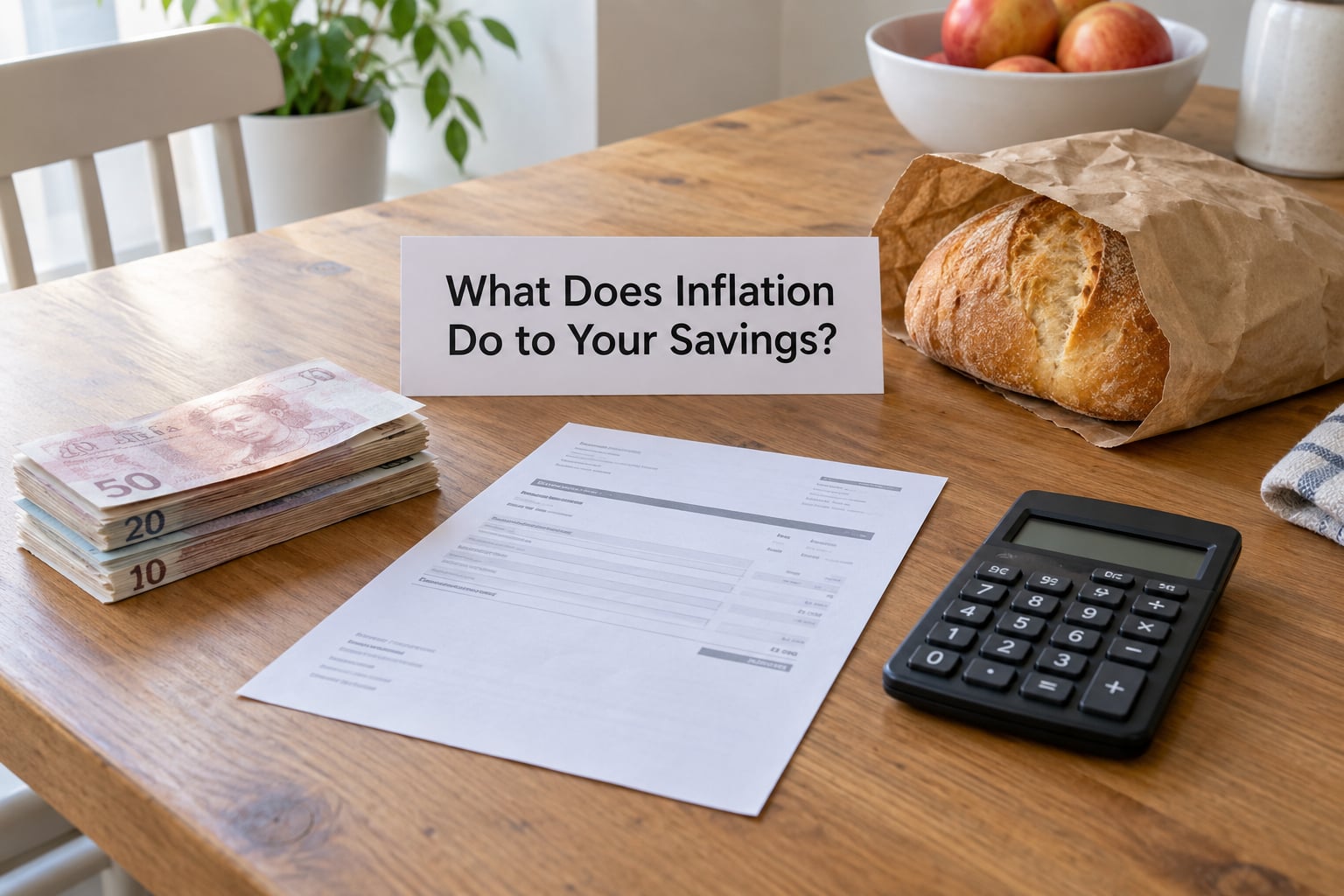
The damage is slow and easy to miss. Inflation means the same amount of money buys fewer goods and services a year from now than it does today, and the effect compounds quietly in the background.
The number most savers look at is the account balance, which is the nominal value. The number that matters is the real value: what that balance can actually buy after prices are taken into account. Real return is calculated as (1 + nominal return) / (1 + inflation rate) – 1. Run a 4% savings rate against 2.6% inflation and the real return is about 1.4%, not 4%.
Run that across a decade and the gap becomes hard to ignore. At roughly 2.6% annual inflation, 100,000 dollars loses about 22% of its real purchasing power over ten years and close to 40% over twenty years. Nothing dramatic happens in any single quarter. The whole balance is still there; it just buys less.
How inflation is measured
Most people read the Consumer Price Index, or CPI, published monthly by national statistics agencies such as the US Bureau of Labor Statistics. Headline CPI includes everything from fuel to shelter, while core CPI strips out the most volatile food and energy components. The Federal Reserve prefers a third measure, the personal consumption expenditures price index, because it captures spending patterns more broadly. Producer prices matter mainly to businesses, not to your savings account.
Which assets suffer and which hold up
- Cash and savings accounts: lose purchasing power whenever the interest rate sits below inflation. Safe and instant, but only a hedge in higher-rate periods.
- Fixed-rate bonds and certificates of deposit: locked at a rate that can look generous today and poor later. Long-dated bonds also lose value when rates rise.
- Shares and equity funds: companies can raise prices and wages when costs climb, so equities tend to pass inflation through over long periods, with painful drawdowns along the way.
- Real assets such as property and infrastructure: rent, occupancy costs and replacement costs often rise with the price level.
- Commodities and precious metals: respond to real interest rates, currency confidence and supply shocks rather than to the inflation print itself, so the timing is unreliable.
Economists also distinguish demand-pull inflation, where too much money chases too few goods, from cost-push inflation, where supply disruption lifts prices, plus a modest built-in component from wages and expectations. Understanding which one you are living through matters, because a cost-push shock and a demand-driven boom rarely peak at the same moment.
How to Protect Savings From Inflation
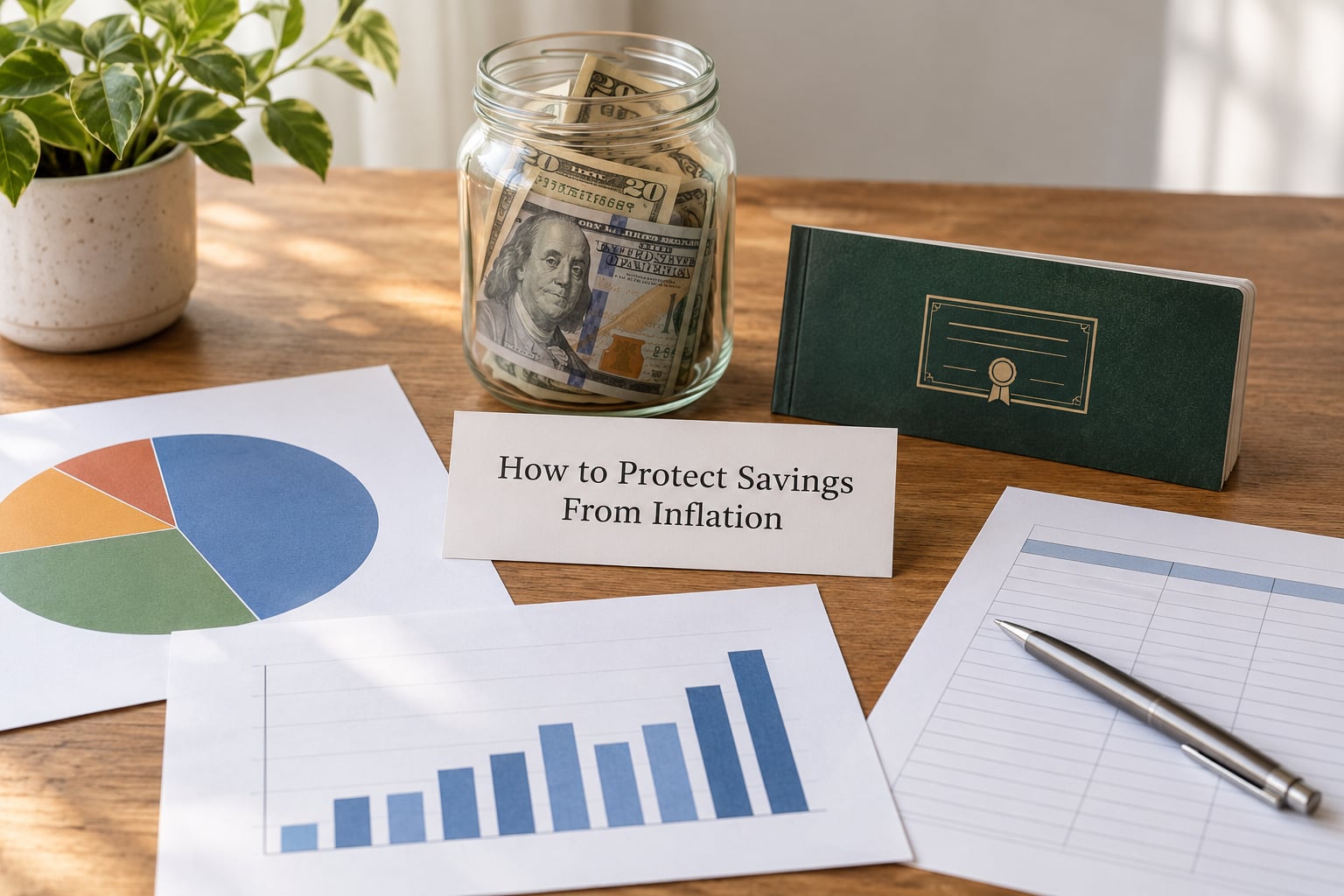
Three buckets cover most households, and the order matters more than the products you pick. Work through cash first, then long-term money, then debt. If you try to build a commodity position before you have an emergency reserve, one bad quarter can force you to sell at the worst possible moment.
Three buckets that make it easier to protect savings from inflation
Bucket one: optimise your cash savings
- High-yield savings accounts: insured deposits paying a variable rate, useful because the rate moves with policy rates and can outpace prices.
- Money market funds and brokerage cash sweeps: slightly higher yields and check-writing access, but not deposit-insured.
- Certificates of deposit in a ladder: split the balance into tranches maturing in one, two, three years and beyond, rolling each into a new rate as it comes due.
- Series I savings bonds: inflation-adjusted, redeemable after one year, and capped at 10,000 dollars of new purchases per person per year.
Bucket two: invest for long-term growth
- Inflation-linked government bonds and inflation-linked bond funds: principal adjusts with the consumer price index.
- Broad equity index funds: the main engine for money with a fifteen-year horizon.
- Dividend growth companies: businesses that raise payouts and have pricing power.
- Real estate investment trusts and real assets: income linked to rents and occupancy costs.
- Gold and silver, in small size: insurance against currency and confidence shocks, sized as a few percent rather than a core holding.
Bucket three: manage debt and spending
- Clear high-interest balances first: paying off a 24% credit card is an instant inflation-proof return on that money.
- Review recurring costs: subscriptions, insurance and utilities usually rise faster than the headline index.
- Keep some fixed-rate debt in moderation: a mortgage at a fixed rate is a hedge against your income rising faster than prices.
Three ideas hold the whole framework together. Time horizon decides the vehicle: money you need in eighteen months has no business in equities. Costs decide the result, since a one percent expense ratio quietly removes a fifth of a thirty-year return. Taxes decide how much of it you keep, because nominal interest and dividends are taxed as ordinary income in most countries.
Which Assets Can Help Preserve Purchasing Power?
Each asset class protects a different slice of your money. Cash is about availability, inflation-linked bonds are about the price level, equities are about growth over decades, and metals are about tail risk. Comparing them side by side makes the trade-offs obvious.
| Asset | How it responds to inflation | Tax treatment in the US | Liquidity | Watch out for |
|---|---|---|---|---|
| High-yield savings account | Protects only while the rate exceeds inflation | Taxed as ordinary income, fully | Instant | Rate can fall at any policy meeting |
| Money market fund | Variable yield, same logic as cash | Taxed as ordinary income | Same day or next day | Not deposit-insured |
| Certificate of deposit ladder | Locks a rate that may fall behind prices | Taxed as ordinary income | Penalties if broken early | Reinvestment at a much lower rate |
| Series I savings bonds | Index-linked plus a fixed two-part rate | Federal tax deferred, state rules vary | After 12 months, with penalty in year one | 10,000 dollar annual purchase cap |
| Inflation-linked Treasury bonds and funds | Principal adjusts with CPI every six months | Taxed as ordinary income on inflation and real income | Trades like a bond; funds are liquid | Price falls when real yields rise |
| Short-duration bond funds | Little direct protection, low rate risk | Taxed as ordinary income | Daily | Can lag inflation for years |
| Broad equity index funds | Long-run growth plus dividends that tend to rise | Taxable dividends; retirement accounts defer tax | Daily | Drawdowns of 20% or more are normal |
| Dividend growth companies | Pricing power and rising payouts | Qualified dividends taxed at lower long-term rates | Daily | Concentration risk in a few names |
| REITs and real estate | Rents and occupancy costs rise with prices | Dividends pass through to shareholders | Daily through funds, slowly if you own property | Leverage, vacancy, maintenance, illiquidity |
| Gold and silver | Hedge for currency and real-rate shocks, not a steady hedge | Collectibles taxed at up to 28% federally | Sell quickly for bullion, physical takes days | No yield, storage cost, bid-ask spread |
Two details deserve a note because they confuse people constantly. First, why inflation-linked funds fall: when market real yields rise, the fixed real rate on new inflation-protected issues becomes less attractive and existing bonds drop in price. That is the mechanism working, not failing. As of late 2026 a widely held short inflation-protected Treasury fund was yielding roughly 1.9% above inflation while its share price had drifted lower over the year. Second, gold and silver carry no yield at all, so every year they sit still they are losing ground against inflation even when the price rises.
How to Build an Inflation-Resistant Savings Plan Step 1: Work out what you actually spend
Pull three months of statements and total the essentials: housing, food, transport, insurance, utilities, minimum debt payments. Multiply by three to six for your emergency reserve, then multiply by twelve for your true annual spending. Most inflation mistakes begin with a round guess instead of a real number.
Step 2: Sort every pot of money by date
Write each account next to the date you will need it. Anything inside two years needs no market risk, because a ten percent equity fall right before a house purchase is a real loss rather than a paper one. This single habit prevents most of the damage people blame on inflation.
Step 3: Fill the emergency fund before anything else
Keep it in an instant-access high-yield savings account, not in the market. Emergency money that falls twenty percent in a quarter is emergency money you cannot use at the moment you need it. Some people add a second pot equal to one month of expenses, held in a money market account or a short CD ladder, purely for its extra yield.
Step 4: Build the CD ladder for the two-to-five-year bucket
Split the balance into equal pieces. Put one third in a one-year CD, one third in a two-year CD and one third in a three-year CD, each renewing into a new tranche as it matures. When rates fall you keep the higher earlier rates longer, and when rates rise you replace pieces gradually instead of all at once. Laddering is the honest way to accept that you cannot know future rates.
Step 5: Put long-term money to work
For money with a fifteen-year horizon, a broad equity index fund is the workhorse, with the portion you hope to hold for thirty years or more spread across an index fund, a modest sleeve of dividend growth companies, a real asset or REIT fund, and a small precious-metals allocation. Buy your inflation-linked exposure in a way that matches the job: an index-linked bond or savings bond for money that must keep pace with prices, a fund for liquidity.
Step 6: Rebalance on a schedule, not on headlines
Look at your weights once or twice a year and rebalance only when a holding has drifted far from its target, which is commonly a five-percentage-point band. Selling the winners to buy the losers after a scare is exactly the behaviour that turns a working plan into a loss.
A sample allocation by time horizon
This illustration suits a household in their thirties with a stable income and medium risk tolerance. It is an example of the structure, not a recommendation for your circumstances.
| Bucket | Share of investable savings | Typical contents |
|---|---|---|
| Needed within one year | 5% | High-yield savings, money market fund |
| Emergency reserve | 10% | Instant-access savings, one short CD tranche |
| Needed within two to five years | 15% | CD ladder, short-duration bond fund, I Bonds |
| Five to fifteen years | 20% | Index-linked bonds, conservative equity funds |
| Fifteen years and beyond | 40% | Broad equity index funds, dividend growth companies, REITs |
| Currency and crisis insurance | 5 to 10% | Gold and silver, kept small and rebalanced yearly |
| High-interest debt being cleared | Any balance above | Repay before investing for growth |
Common Inflation-Protection Mistakes Keeping everything in cash
The most common error is treating a fat savings balance as protection. It is protection against running out of money, not against prices rising. Once your reserve is funded, cash above that line belongs in something that can grow.
Buying after inflation is already high
Metals, real estate and cyclical shares have already moved by the time a worrying inflation print appears. Entering at that point means buying after the anticipation and often selling before the outcome. Set the allocation while things look calm and rebalance on a calendar.
Ignoring tax drag on nominal income
A savings rate taxed as ordinary income needs to clear the inflation rate plus your tax bracket before it protects anything. A 4% yield taxed at 25% leaves 3%, which is barely above inflation. Retirement accounts, tax-advantaged savings accounts and inflation-linked bonds taxed more lightly are worth the paperwork for exactly this reason.
Concentrating in one hedge
Gold at a fifth of the portfolio can drag on returns for a decade. A single rental property ties up cash you may need. Broad, boring diversification across several inflation-responsive asset classes is what makes a plan survive an awkward decade.
Trying to time the central bank
Cutting equities after a spike or piling in after a scare rarely works, and switching strategies every few months usually produces fees and taxes with no benefit. Set the plan by time horizon, then leave it alone until a scheduled review.
Confusing speculation with a hedge
A hedge is something that has historically held value when prices rise. Single commodity bets, leveraged products and crypto are directional trades with no historical relationship to the consumer price index. Treat them as speculation funded with money you can afford to lose, and size them accordingly.
Frequently Asked Questions
Cash only works as a hedge when the interest rate exceeds the inflation rate. In periods when high-yield savings accounts pay more than consumer prices rise, cash holds its purchasing power. Over long stretches, though, a cash-heavy balance quietly loses ground, which is why most people keep a few months of expenses in cash and put the rest to work.
Gold has held value across centuries of currency debasement and tends to rise when real interest rates fall or government borrowing soars. It is not a dependable one-year hedge; the metal can drop ten percent or more in a quarter while prices climb, and it pays no yield at all. A 5% to 10% allocation is the usual suggestion, not a large position.
Yes, for the part of your portfolio that must move with prices. Treasury Inflation-Protected Securities adjust principal with the consumer price index every six months and pay a real yield on top. Series I savings bonds work the same way and add a fixed rate for the first year. Both can decline in price when real yields rise, and both are taxable as ordinary income in the US.
A common starting point is three to six months of expenses in cash, money needed within five years in short-duration bonds or a CD ladder, and money needed in ten years or more in equities and other growth assets. The split depends on your time horizon, income stability and tolerance for a market that can fall twenty percent in a year without warning.
Rental property and REITs carry rents and occupancy costs that often rise with prices, which is why they have historically been one of the better inflation hedges. They also bring leverage, maintenance, vacancy risk and a large cash outlay. Many people use a real estate investment trust instead of one property, which keeps the exposure diversified and easy to sell.
Once or twice a year is enough, usually after you file taxes and again later in the year. Rebalance only when a holding has drifted far from its target weight, often by five percentage points, not because a headline made you nervous. Also revisit any pot whose date has moved closer, such as a down payment fund entering its final year.
Conclusion: What Should You Do First?
Start with the sequence, not the products. Secure three to six months of spending in a high-yield savings account, then move money with a two-to-five-year date into a CD ladder or short-duration bonds. After that, clear high-interest balances, because each point of interest you stop paying is a certain return.
Then put the long-term money to work across several inflation-responsive asset classes, with precious metals kept as a small, deliberate slice rather than the centre of the plan. Review twice a year, rebalance on a rule instead of on news, and remember that no asset guarantees a real return. Inflation rates, tax rules and your own goals all shift, which is exactly why the plan needs a review date.
Source: https://www.pgm-blog.com/how-to-protect-savings-from-inflation/
Anyone can join.
Anyone can contribute.
Anyone can become informed about their world.
"United We Stand" Click Here To Create Your Personal Citizen Journalist Account Today, Be Sure To Invite Your Friends.
Before It’s News® is a community of individuals who report on what’s going on around them, from all around the world. Anyone can join. Anyone can contribute. Anyone can become informed about their world. "United We Stand" Click Here To Create Your Personal Citizen Journalist Account Today, Be Sure To Invite Your Friends.
LION'S MANE PRODUCT
Try Our Lion’s Mane WHOLE MIND Nootropic Blend 60 Capsules
Mushrooms are having a moment. One fabulous fungus in particular, lion’s mane, may help improve memory, depression and anxiety symptoms. They are also an excellent source of nutrients that show promise as a therapy for dementia, and other neurodegenerative diseases. If you’re living with anxiety or depression, you may be curious about all the therapy options out there — including the natural ones.Our Lion’s Mane WHOLE MIND Nootropic Blend has been formulated to utilize the potency of Lion’s mane but also include the benefits of four other Highly Beneficial Mushrooms. Synergistically, they work together to Build your health through improving cognitive function and immunity regardless of your age. Our Nootropic not only improves your Cognitive Function and Activates your Immune System, but it benefits growth of Essential Gut Flora, further enhancing your Vitality.

Our Formula includes: Lion’s Mane Mushrooms which Increase Brain Power through nerve growth, lessen anxiety, reduce depression, and improve concentration. Its an excellent adaptogen, promotes sleep and improves immunity. Shiitake Mushrooms which Fight cancer cells and infectious disease, boost the immune system, promotes brain function, and serves as a source of B vitamins. Maitake Mushrooms which regulate blood sugar levels of diabetics, reduce hypertension and boosts the immune system. Reishi Mushrooms which Fight inflammation, liver disease, fatigue, tumor growth and cancer. They Improve skin disorders and soothes digestive problems, stomach ulcers and leaky gut syndrome. Chaga Mushrooms which have anti-aging effects, boost immune function, improve stamina and athletic performance, even act as a natural aphrodisiac, fighting diabetes and improving liver function. Try Our Lion’s Mane WHOLE MIND Nootropic Blend 60 Capsules Today. Be 100% Satisfied or Receive a Full Money Back Guarantee. Order Yours Today by Following This Link.


| Visits: | 1,833,895,646 |
| Stories: | 8,715,030 |
Whistler Blowers, Insiders

