

How Tips Bonds Work for Investors: A Simple Guide (2026)

TIPS bonds work by protecting the purchasing power of your principal. The U.S. Treasury indexes the amount you get back to the Consumer Price Index, pays a fixed real interest rate on that adjusted amount every six months, and guarantees at maturity you receive at least your original principal.
That is the whole promise in two sentences. The rest of this guide unpacks what actually happens between the auction and the maturity date, where the arithmetic can surprise you, and the ways this investment can still lose money.
Key Takeaways
- Principal moves with inflation, the interest rate does not. Your coupon rate is fixed for life; the dollar payment changes because the base it is applied to changes.
- The index is CPI-U, applied with a lag. Adjustments use the Consumer Price Index from three months earlier, so you are never paid for the most recent spike or dip.
- There is a floor, and it is lower than most buyers assume. At maturity you get the greater of the adjusted principal or the original face value. That protects the Treasury’s par, not what you paid in the secondary market.
- Real yield is your return before inflation; breakeven is the hurdle. If inflation comes in below the breakeven rate, a nominal Treasury would have beaten your TIPS.
- Duration cuts both ways. A long TIPS can fall sharply when real yields rise, even though no issuer is in any danger.
- Taxes treat the inflation adjustment as income. You can owe federal tax on a principal increase you have not yet received in cash.
What Are Tips Bonds?
TIPS are the short name for Treasury Inflation-Protected Securities, bonds issued by the U.S. Department of the Treasury. They are not corporate debt, not municipal bonds, and not a fund. Each one is a single loan to the United States government, backed by the full faith and credit of the government.
The distinguishing feature is the link between principal and consumer prices. When the Consumer Price Index for All Urban Consumers rises, your principal rises by the same proportion. When that index falls, your principal falls with it, down to a floor set at the original face value.
What TIPS actually protect against is unexpected inflation, which is the difference between what inflation turned out to be and what investors had already priced in through the breakeven rate. They are not a general-purpose safety net. A TIPS holding can lose a lot of market value when real yields climb, and it can quietly underperform a plain Treasury bond over any given stretch.
How Tips Bonds Work for Investors
The lifecycle runs from auction to maturity, and every step is mechanical. Here is how tips bonds work for investors from the moment you buy to the day you get your money back.
The short version of how tips bonds work for investors
You buy the bond either at a Treasury auction or from another investor on the secondary market. The Treasury sets a real coupon rate at auction and it never changes for the life of the bond. Twice a year, the outstanding principal is recalculated by applying an index ratio derived from CPI-U. Interest is calculated on that new, higher or lower principal. At maturity, you receive the adjusted principal or the original par, whichever is greater, plus the final coupon.
Step 1: Buying the bond
Auctions run on a regular schedule across maturities from five to thirty years, and reopenings of recent issues are common. Direct investors place a non-competitive bid at TreasuryDirect, or a competitive bid through a broker, and need to meet a 100 dollar minimum in 100 dollar increments. Buying on the secondary market means accepting whatever the market price happens to be that day, which for a seasoned bond can be far from par.
Step 2: The semiannual interest payment
TIPS pay interest on January 15 and July 15. The rate is fixed, but the payment is not, because it is applied to adjusted principal. A bond with a real rate of 1.625 percent paying out at a principal of 101.50 dollars sends roughly 0.82 dollars to the holder each period. Identical rate, different amount, each time the index moves.
Step 3: The inflation adjustment
Every six months the Treasury applies an index ratio. The effect is that your principal permanently moves up or down to reflect changes in consumer prices since issuance. It is not a payment you receive; it is a change in the face amount your future interest and maturity value are based on.
Step 4: Maturity
On the maturity date you receive the adjusted principal or the original face value, whichever is larger, plus the last interest payment. A bond bought at auction and held to maturity is designed so that you know exactly what you will collect, which is the single most practical thing to understand about this security.
The Main Parts of a Tips Bond
Six components do all the work. Once you can read them off a TreasuryDirect auction result or a brokerage statement, TIPS stop being mysterious.
| Component | What it is | Does it change? |
|---|---|---|
| Real coupon rate | The fixed annual interest rate set at auction, applied semiannually | No. Locked for the life of the bond |
| Reference principal amount | The inflation-indexed number that interest is calculated on | Yes. Rises and falls with CPI-U |
| Inflation index | The Consumer Price Index for All Urban Consumers, published by the Bureau of Labor Statistics | Yes. It is the input that moves principal |
| Adjusted principal | Face value multiplied by the index ratio at the last adjustment date | Yes. Recalculated twice a year |
| Maturity date | The date principal is repaid, between five and thirty years from issue | No. Fixed at issuance |
| Real yield to maturity | The total return if you hold to maturity, expressed in inflation-adjusted dollars | Yes. Moves daily with the secondary market |
One more term shows up constantly and deserves an early definition. The indexation ratio, sometimes called the index ratio, is the CPI value today divided by the CPI value when the bond was issued. Multiply it by the face value and you get adjusted principal. Everything else in the formula follows from there.
How Inflation Adjusts the Principal
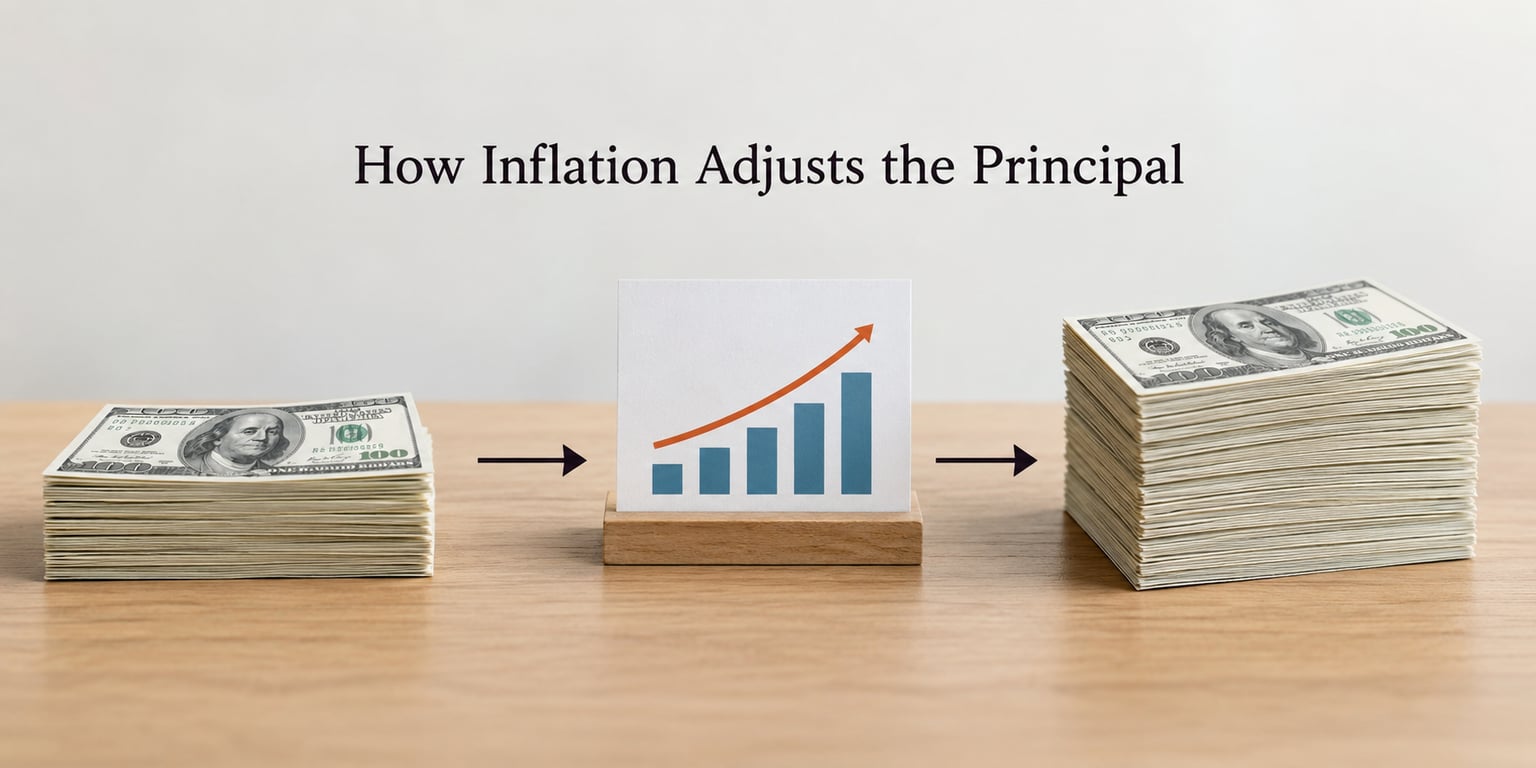
The adjustment is a single multiplication, repeated twice a year, with one important wrinkle.
The formula
Adjusted principal equals the original principal multiplied by the index ratio, and the index ratio equals the current index value divided by the base index value at issuance. If CPI-U reads 311.4 when a bond is issued and 322.4 at an adjustment date, the ratio is 322.4 divided by 311.4, which is about 1.035. Principal of 100 dollars becomes 103.53 dollars.
The three-month lag
The CPI figures used are not the most recent ones. TIPS adjustments use the index published three months before the adjustment date, a convention that smooths out month-to-month noise. This means inflation that spikes in a given month reaches your principal with a delay, and deflation does too.
What the adjustment actually does
It changes your claim, not your cash. No money moves on adjustment day. What changes is the base for future interest and the amount you collect at maturity. A bond issued with 100 dollars of principal that reaches an adjusted principal of 116.10 dollars pays 16.10 dollars more at maturity than it would have without any indexation at all.
Timing and the lag, in practice
Buy a new 10-year TIPS at an auction and you get a price at or above par. Buy a bond issued six years ago and the Treasury publishes an index ratio for it at every payment date, which is how brokerages compute what you actually own. The ratio a bond carries into a new buyer’s hands is the difference between an auction purchase and a market purchase, and it is worth checking before you click through.
How Interest and Total Returns Are Calculated
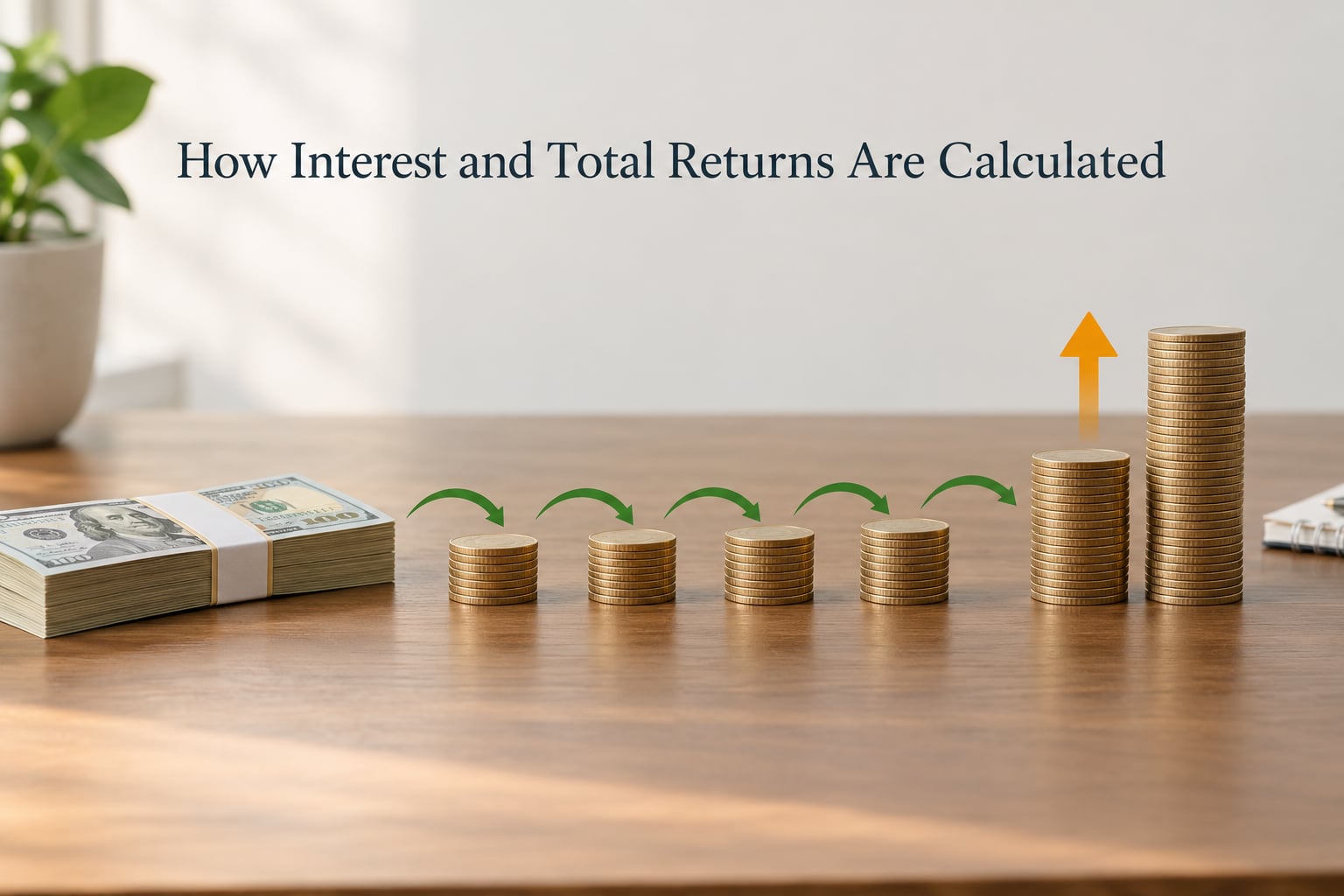
Your return has two parts: the fixed real coupon, and the change in principal. Keep them in separate columns and TIPS arithmetic becomes easy.
The interest calculation
Interest payment equals adjusted principal multiplied by the real coupon rate, divided by two for semiannual compounding. With a real rate of 1.625 percent and adjusted principal of 107.80 dollars, the payment is 107.80 times 0.01625, halved, which comes to about 0.88 dollars.
Putting the two parts together
Consider a five-year bond with a real coupon rate of 1.625 percent, bought at auction for 100 dollars of principal, in a world where CPI-U rises about 1.5 percent every six months. That works out to roughly 3 percent a year.
| Payment period | Index ratio | Adjusted principal | Interest at 1.625 percent real |
|---|---|---|---|
| 1 | 1.015 | 101.50 | 0.82 |
| 2 | 1.031 | 103.10 | 0.84 |
| 3 | 1.046 | 104.60 | 0.85 |
| 4 | 1.062 | 106.20 | 0.86 |
| 5 | 1.078 | 107.80 | 0.88 |
| 6 | 1.094 | 109.40 | 0.89 |
| 7 | 1.111 | 111.10 | 0.90 |
| 8 | 1.127 | 112.70 | 0.92 |
| 9 | 1.144 | 114.40 | 0.93 |
| 10 and maturity | 1.161 | 116.10 | 0.94 |
Total interest over five years is about 8.83 dollars. At maturity you collect 116.10 plus the final coupon of 0.94, for roughly 124.93 dollars all in. That is about 4.6 percent annualized against the 100 dollars you committed, and it splits neatly into roughly 1.6 percent real coupon plus about 3 percent inflation.
Reading a real return honestly
A 4.6 percent nominal figure means nothing on its own. If a different bond had returned 5 percent in the same period, it beat this one. Measuring in real terms, the correct comparison is 1.625 percent here against whatever nominal yield the alternative paid, adjusted for what inflation actually did.
The breakeven inflation rate
The breakeven rate is the simplest test in fixed income: subtract the real yield to maturity on a TIPS from the nominal yield to maturity on a same-maturity Treasury, and the difference is the annual inflation rate the market is pricing into that nominal bond. If a 10-year nominal Treasury yields 4.0 percent and a 10-year TIPS yields a real 1.5 percent, the market expects about 2.5 percent inflation a year.
Three outcomes follow. If realised inflation runs above the breakeven, TIPS beat the nominal bond. If it runs below, the nominal bond wins and your TIPS returns less in purchasing power. If inflation lands right on the breakeven, the two are roughly interchangeable. The breakeven moves daily, so the rate you capture is the one on the auction results sheet, not the one quoted in a year-old article.
Why Investors Buy Tips Bonds
The reasons investors buy these bonds come down to one core idea: money meant for a specific future purchase loses value if prices rise before you get there. A retiree drawing down savings, a parent funding a college bill in eight years, and a saver with a target number and a target date all face the same arithmetic problem.
Protecting purchasing power
This is the headline feature. Because principal tracks CPI-U, the real value of your claim at maturity is closer to what it was when you bought it. A 100 dollar principal that becomes 116.10 dollars during a 3 percent inflation environment keeps pace with the price of the same basket of goods.
Locking in a known real return
If you hold an auction-purchased TIPS to maturity, your real yield is set at purchase. That predictability is unusual. A ten-year nominal Treasury can end up delivering a real loss over the decade, and no amount of intention changes that. The TIPS yield does not move.
Funding a dated future expense
A five-year bond bought now and maturing in five years pays principal adjusted for inflation, which makes it a natural fit for a bill you expect to pay in five years. Matching the maturity date to the spending date removes the guesswork, and it is the clearest reason the security exists.
Portfolio ballast and diversification
TIPS carry no default risk in the conventional sense, and their cash flows behave differently from stocks and nominal bonds in inflationary periods. Adding a measured slice can reduce the overall swings in a portfolio, though it does not remove risk, as the next section shows.
Tips Bonds vs. Regular Treasury Bonds
Both are direct U.S. government obligations with identical credit quality, and that shared credit is the point most often lost in the comparison. The differences sit entirely in how principal, interest and price behave.
| Feature | TIPS | Nominal Treasuries |
|---|---|---|
| Inflation protection | Principal indexed to CPI-U | None. Fixed payments lose purchasing power |
| Interest calculation | Fixed real rate applied to adjusted principal | Fixed nominal rate applied to fixed principal |
| Principal changes | Rises and falls with the index, floored at original par | Constant until maturity |
| Federal tax on inflation adjustment | Taxable as ordinary income each year it accrues | Not applicable |
| State and local tax | None on Treasury interest | None on Treasury interest |
| Market price volatility | Higher, because real yields move more and last longer | Lower for short maturities |
| Best fit | Dated future spending in real terms | Known nominal amounts, short horizons, emergency reserves |
| Worst case in hand | Real yield spike can cut price sharply | Flat until maturity |
Where a nominal bond is the better answer
If the goal is a specific dollar amount on a specific date, a nominal Treasury delivers it exactly and often at a higher starting yield. Emergency funds, a house deposit in two years, and tuition payable in a fixed nominal figure are all reasonable nominal-Treasury jobs.
Where TIPS win
Any target expressed in real terms. If the amount you need is “enough to cover the first year of retirement in today’s dollars,” the inflation-linked security is the only mainstream Treasury instrument built for that instruction.
What about I Bonds?
Series I savings bonds are the other inflation-protected instrument most people know, and they behave differently in useful ways. A Series I bond compounds at a fixed rate plus CPI-U, can be held five to thirty years, and is exempt from state and local tax with federal tax deferred until you cash it out. Annual purchase limits apply, which is the main constraint for larger portfolios. TIPS have no such cap, trade freely, and are taxed annually. The recurring forum verdict is that TIPS suit larger amounts and I Bonds suit smaller, patient sums.
What Risks and Costs Should Investors Know?
Investors on bond forums keep repeating the same one-line summary: TIPS protect you from unexpected inflation, but not from rising interest rates. That sentence contains the entire risk picture, and the following items expand it.
1. Real yield and duration risk
This is the big one. When real yields rise, TIPS prices fall, sometimes sharply. The sensitivity rule is simple: a 1 percent rise in real yields tends to cut the price by roughly the modified duration in percent. A five-year TIPS has a modified duration in the range of four to five, so a 1 percent real yield rise implies a loss of about four to five percent in price. A thirty-year TIPS has a modified duration of fifteen or more, which makes the same move far more punishing. Modified duration is simply a measure of how sensitive a bond’s price is to yield moves, and it grows with maturity.
This is why experienced bond investors tend to buy TIPS when real yields are high and treat them as a long-term holding rather than a parking spot. It also explains the sharp drawdown of the early 2020s inflation shock, when real yields climbed from deeply negative territory in a very short span and long TIPS took heavy losses before recovering.
2. The floor protects the wrong number
The deflation floor guarantees you at least the original face value of the bond, not the amount you paid for it. Buy a seasoned TIPS for 104 dollars after years of indexation and a period of falling prices could leave the adjusted principal below 100 dollars at maturity. The Treasury pays 100. You are 4 dollars short on your investment, and no guarantee covers the difference. This is the single most misunderstood feature of the security, and it is why the auction route and the secondary market route are not equivalent.
3. CPI-U is not your personal cost of living
The index covers a national basket of consumer goods and services. It is not your rent, not your health insurance, and not your particular grocery bill. If your spending rises faster than CPI-U, your TIPS underprotect you. If it rises more slowly, they overprotect you.
4. The indexation lag cuts both ways
The three-month lag smooths volatility, but it also means fast inflation gets paid late and fast deflation gets absorbed early. Over a full cycle it evens out. Over the couple of years you actually hold the bond, it does not.
5. Phantom income tax
The inflation adjustment is taxed as ordinary income by the federal government in the year it accrues, whether or not you receive it in cash. Take the worked example above: in year three, principal rises from 104.60 to 107.80 dollars, a 3.20 dollar indexation gain, while coupons that year total roughly 3.42 dollars. The tax form reflects about 6.62 dollars of income when only 3.42 dollars actually arrived.
You do not lose the money permanently; the tax is on an amount the Treasury will pay you at maturity. But in a high tax bracket, the cash-flow mismatch is real, which is why tax-advantaged accounts are usually the better home for TIPS holdings.
6. Liquidity and cost
Secondary market TIPS carry a bid-ask spread wider than nominal Treasuries of comparable maturity, because fewer investors hold them. Direct purchase at auction from TreasuryDirect avoids the spread entirely, though it takes planning around the schedule.
How to Buy and Manage Tips Bonds
There are three routes, and the right one depends on whether you have a date in mind. That single question resolves most of the debate that shows up in forums.
Route 1: Buy at auction through TreasuryDirect
Best when you want a specific maturity and a known real yield. Place a non-competitive bid at the announced yield and you receive the security at the auction high yield, provided your bid is at or below it. The 100 dollar minimum in 100 dollar increments is a low barrier, though the schedule is published in advance and results are posted after each auction.
Route 2: Buy on the secondary market
Best when a bond with the maturity you want is already outstanding. You pay a market price, which may be above or below par, and you inherit whatever index ratio the bond carries. Always check the price, the real yield to maturity, and how far above or below par you are paying before you buy.
Route 3: Use a TIPS fund or ETF
Best when you do not have a specific date, want small automatic monthly contributions, or want to avoid auction logistics entirely. A fund holds many maturities and rolls them, so it never matures into your hands and its duration changes over time. The trade-off is precise: individual bonds give you a date and a locked real yield; a fund gives you convenience and daily liquidity. The costs sit in the expense ratio and in the fact that a fund holding long TIPS can drop several percent in a bad real yield year.
Where to check real yields and breakevens yourself
Do not take a live rate from any article, including this one. TreasuryDirect publishes auction results, including the high yield and the index ratio, for every TIPS auction. The Federal Reserve Bank of St. Louis, through its FRED database, publishes constant-maturity real yield series for TIPS alongside nominal yields, so you can compute any breakeven yourself. TIPSWatch tracks auction results and seasoned bond pricing. Five minutes on those sources beats any summary written weeks earlier.
Managing a position once you own it
Decide at purchase whether you intend to hold to maturity. If you have a dated goal, a maturity ladder works well: split the amount across bonds maturing in different years matching the years you expect to withdraw. If you hold in a taxable account, expect an annual tax on indexation and consider whether that drag belongs in an IRA or 401(k) instead.
A Tips Bond Investment Example
Numbers teach this better than any definition, so here is the same bond walked through two ways. The figures are illustrative rather than live market levels, which move every day.
Scenario one: inflation runs at about 3 percent
You buy a five-year TIPS at auction with a real coupon rate of 1.625 percent and 100 dollars of principal. CPI-U compounds at roughly 3 percent a year, so adjusted principal climbs from 100 to 116.10 dollars by the final payment date. Total interest across ten semiannual periods comes to about 8.83 dollars. At maturity you receive 116.10 plus the last coupon of 0.94, and your total return is approximately 4.6 percent annualized, made up of about 1.6 points of real yield and 3 points of inflation protection.
Scenario two: deflation runs at about 1 percent
Same bond, same purchase, but CPI-U falls about 1 percent a year. Adjusted principal drifts down and ends near 95.10 dollars, and each coupon shrinks slightly as a result. Total interest is still paid, roughly 7.90 dollars over the five years.
| Payment period | Index ratio | Adjusted principal | Interest at 1.625 percent real |
|---|---|---|---|
| 1 | 0.995 | 99.50 | 0.81 |
| 2 | 0.990 | 99.00 | 0.80 |
| 3 | 0.985 | 98.50 | 0.80 |
| 4 | 0.980 | 98.00 | 0.80 |
| 5 | 0.975 | 97.50 | 0.79 |
| 6 | 0.970 | 97.00 | 0.79 |
| 7 | 0.965 | 96.50 | 0.78 |
| 8 | 0.960 | 96.00 | 0.78 |
| 9 | 0.956 | 95.60 | 0.78 |
| 10 and maturity | 0.951 | 95.10 | 0.77 |
At maturity the Treasury pays the greater of 95.10 and the original 100 dollars of principal, so you receive 100 plus the final coupon. Total returned across five years is about 107.90 dollars, roughly 1.5 percent a year. You never took a principal loss, which is the floor working as designed, but you also collected no inflation compensation, because there was none.
Who Tips Bonds Suit, Situation by Situation
| Situation | Fit | Why |
|---|---|---|
| Retiree drawing down savings | Strong | Spending needs rise with prices, exactly what principal indexation tracks |
| College or home deposit with a known date | Strong | Ladder bonds so each matures when the bill is due |
| Long-horizon inflation hedge in a portfolio | Reasonable | Add in measured slices and rebalance rather than concentrating |
| Taxable brokerage account, high bracket | Weak | Annual tax on unrealized indexation erodes the real return |
| Emergency fund | Poor | A five-year maturity is wrong for money you may need in a week |
| Short-term inflation timing trade | Poor | Rate moves dominate over short horizons, protection does not |
| Buyer on the secondary market at a premium | Caution | The deflation floor sits at par, below what you paid |
Frequently Asked Questions
TIPS are taxed at the federal level as ordinary income, not as capital gains. The interest you receive each year is taxable in the year it is paid, and the inflation adjustment to principal is taxable in the year it accrues, even though you receive no cash for it that year. No state or local tax applies to Treasury interest. For that reason, tax-advantaged accounts such as IRAs and 401(k) plans usually suit TIPS holdings better than taxable brokerage accounts.
On the maturity date the Treasury pays you the adjusted principal or the original face value, whichever is greater, plus your final semiannual interest payment. If you bought the bond at auction and held it the entire term, that amount is known in advance because the real rate never changes. If you bought on the secondary market and inflation has been negative, you may receive less than what you originally paid, since the floor is set at the original par value rather than your purchase price.
Yes. TIPS trade freely on the secondary market through any brokerage account, and a TIPS ETF can be sold any trading day. The catch is price. If real yields rise between your purchase date and your sale date, you sell below what you paid even if the bond itself is perfectly safe. That is why experienced bond investors generally hold individual TIPS to maturity unless a specific need forces a sale, and why a fund with daily liquidity suits money you may need early.
They can, and it is the main risk most people underestimate. When real yields rise, TIPS prices fall, roughly by their modified duration for each 1 percent move. A five-year TIPS with a modified duration near four to five could lose four to five percent of its price on a 1 percent real yield rise, while a thirty-year TIPS with a modified duration of fifteen or more could fall far more. Holding to maturity avoids realised losses only if you do not need to sell before then.
Deflation reduces the adjusted principal of a TIPS and shrinks each interest payment, since both are tied to the index ratio. However, at maturity the Treasury guarantees at least the original face value, so a bond issued at 100 dollars of principal pays at least 100 dollars regardless of what the index did. The catch is that this floor protects the original par, not what you paid, so a secondary-market buyer above par can still come out behind.
It depends on whether your retirement spending rises with prices. Retirees who know roughly what they will spend each year often pair TIPS with nominal Treasuries, holding TIPS for essential expenses and nominal bonds for discretionary spending. The advantage is a reliable real return on the protected portion. The disadvantage is duration risk and annual tax on indexation in taxable accounts, so most retirees keep the inflation-protected share to a measured portion of the portfolio rather than the whole of it.
The Short Version to Remember
If you take one thing from this guide, let it be the breakeven comparison. Look up the real yield to maturity on a TIPS you are considering, look up the nominal yield on a Treasury of the same maturity, and subtract. That gap is the inflation rate the market is already pricing in, and whether you beat it is what decides if the inflation protection was worth having.
Then decide whether you have a date. If you do, buy the individual bond at auction, match its maturity to the spending you have in mind, and hold it. If you do not, a TIPS fund keeps the real-yield exposure without any auction logistics, accepting that its duration will change and its price will move in the years ahead.
For how tips bonds work for investors, the honest summary is that they solve one problem precisely and create three others quietly. They protect purchasing power better than any other mainstream Treasury instrument, and they do it with a rate locked in at purchase. They also introduce price risk driven by real yields, a floor that protects par rather than your cost basis, and annual tax on an adjustment you have not been paid yet. Know which of those three you are accepting before you buy.
Sources and Disclaimer
Mechanics, auction terms, and tax treatment in this article follow guidance from TreasuryDirect on TIPS, the Internal Revenue Service on taxation of Treasury obligations, and Securities and Exchange Commission Office of Investor Education and Advocacy and Financial Industry Regulatory Authority material on bond types and interest rate risk. Readers should confirm current details directly, since rules and market levels change.
This article is educational information only and is not investment, tax, or legal advice. TIPS are not guaranteed to protect you against every source of inflation, and their market value can decline. Consider your own circumstances and consult a qualified financial professional before making investment decisions.
Source: https://www.pgm-blog.com/how-tips-bonds-work-for-investors/
Anyone can join.
Anyone can contribute.
Anyone can become informed about their world.
"United We Stand" Click Here To Create Your Personal Citizen Journalist Account Today, Be Sure To Invite Your Friends.
Before It’s News® is a community of individuals who report on what’s going on around them, from all around the world. Anyone can join. Anyone can contribute. Anyone can become informed about their world. "United We Stand" Click Here To Create Your Personal Citizen Journalist Account Today, Be Sure To Invite Your Friends.
LION'S MANE PRODUCT
Try Our Lion’s Mane WHOLE MIND Nootropic Blend 60 Capsules
Mushrooms are having a moment. One fabulous fungus in particular, lion’s mane, may help improve memory, depression and anxiety symptoms. They are also an excellent source of nutrients that show promise as a therapy for dementia, and other neurodegenerative diseases. If you’re living with anxiety or depression, you may be curious about all the therapy options out there — including the natural ones.Our Lion’s Mane WHOLE MIND Nootropic Blend has been formulated to utilize the potency of Lion’s mane but also include the benefits of four other Highly Beneficial Mushrooms. Synergistically, they work together to Build your health through improving cognitive function and immunity regardless of your age. Our Nootropic not only improves your Cognitive Function and Activates your Immune System, but it benefits growth of Essential Gut Flora, further enhancing your Vitality.

Our Formula includes: Lion’s Mane Mushrooms which Increase Brain Power through nerve growth, lessen anxiety, reduce depression, and improve concentration. Its an excellent adaptogen, promotes sleep and improves immunity. Shiitake Mushrooms which Fight cancer cells and infectious disease, boost the immune system, promotes brain function, and serves as a source of B vitamins. Maitake Mushrooms which regulate blood sugar levels of diabetics, reduce hypertension and boosts the immune system. Reishi Mushrooms which Fight inflammation, liver disease, fatigue, tumor growth and cancer. They Improve skin disorders and soothes digestive problems, stomach ulcers and leaky gut syndrome. Chaga Mushrooms which have anti-aging effects, boost immune function, improve stamina and athletic performance, even act as a natural aphrodisiac, fighting diabetes and improving liver function. Try Our Lion’s Mane WHOLE MIND Nootropic Blend 60 Capsules Today. Be 100% Satisfied or Receive a Full Money Back Guarantee. Order Yours Today by Following This Link.


| Visits: | 1,833,895,646 |
| Stories: | 8,715,030 |
Whistler Blowers, Insiders

