

What Is Resource Nationalism? Causes, Risks and Impacts 2026

Resource nationalism is the policy of a government asserting control over, directing and securing access to the natural resources inside its borders, usually through higher taxes and royalties, state ownership stakes, export bans, local processing rules and limits on foreign ownership of mining and energy assets.
In plain terms: a country that finds something valuable under its soil, then writes rules so that more of the value from it stays at home. Governments have always regulated their mineral wealth. Resource nationalism describes what happens when that regulation shifts from collecting a tax to actively directing and taking control.
It is not the same thing as ordinary regulation. Every country licenses mines, sets royalty rates and can change its mining code. What makes policy resource-nationalist is the intent behind it: capturing more of the economic rent for the state, reducing dependence on foreign buyers and investors, and treating the resource as national property rather than a commercial asset.
For anyone holding mining stocks, energy equities or metals exposure, the distinction matters. Resource nationalism is not a rare event in far-off places. It is a normal, recurring part of how resource markets work, and it is the single most common reason a good project becomes a bad investment.
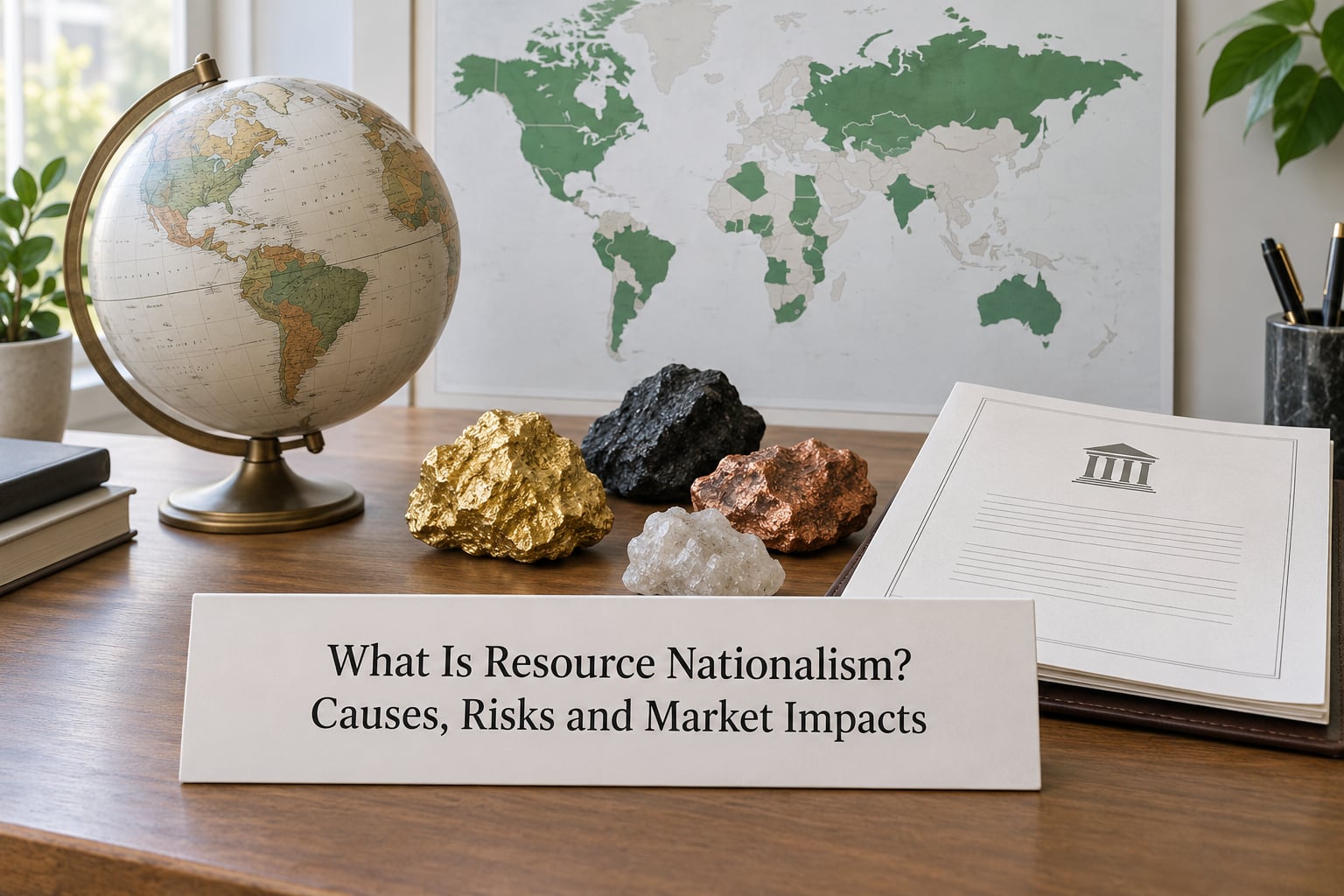
Why Do Governments Pursue Resource Nationalism?
Governments pursue resource nationalism because the money is real and politics are local. A large mine or oil field can generate more tax revenue in a year than the rest of the state’s budget, and the people living next to it want a share.
The usual motives break down into a handful of recurring goals:
- Capturing revenue. Higher royalties, windfall taxes and state equity take a larger slice of the profit a resource generates.
- Diversifying the economy. Moving from raw exports to domestic refining, processing and manufacturing creates industrial jobs.
- Securing supply. Control over lithium, rare earths or gas reserves reduces dependence on foreign suppliers in a crisis.
- Creating local employment. Labour and content rules push companies to hire and build locally.
- Asserting sovereignty. Resource control is a visible, popular way for a government to show it answers to its own citizens.
- Regaining bargaining power. Older contracts signed in weaker bargaining positions can be reopened once prices rise.
None of these motives are inherently hostile. A state asking for a fair share of the rent from its own soil is doing something ordinary. Problems start when policy changes after capital is already committed.
What Are the Main Causes of Resource Nationalism?
Policy follows circumstance, and circumstance changes. The same government that welcomed foreign investors at a low price of metals can reverse course when the price triples.
- The commodity cycle. Resource nationalism historically intensifies in price booms and relaxes when prices fall, because the gap between what a company earns and what locals believe they should earn widens.
- Fiscal pressure. Governments facing deficits, currency weakness or a costly social contract reach for the fastest available source of cash.
- Political legitimacy. Populist governments use resource policy to prove they are taking back what outsiders took.
- Supply-chain security. After the pandemic and the European energy shock, minerals moved from a commodity question to a national security question.
- Climate and industrial policy. Green investment financing brings demands for domestic processing and Chinese restrictions bring demands for other jurisdictions.
- Geopolitical competition. Trade blocs and rival powers compete for supply and friendly sourcing arrangements.
- Changing ownership expectations. Communities that once welcomed a mine now expect a stake, jobs and a share of revenue as a condition of access.
The cyclical component is well documented in commodity research, and the structural component is what makes the wave we are seeing in 2026 different. This generation is not just reacting to prices; it is building policy around minerals that will matter to industry for decades.
Which Resources Are Most Often Affected?
Oil and gas remain the most frequent target, followed closely by minerals, precious metals, agricultural land, water and energy infrastructure. The legal meaning of the term varies by country, and the intensity of policy ranges from a modest royalty tweak to outright state takeover.
Critical minerals have moved to the front of the line. Lithium, cobalt, nickel, graphite and rare earths are the focus now because they are inputs for batteries, electronics and defence, and because processing is concentrated in very few hands. Agricultural land and water attract the same logic applied differently: control over irrigation or food exports becomes a negotiating tool in trade disputes. Energetically, grids, pipelines and refineries count as resources when a government wants to control who supplies the market.
How Does Resource Nationalism Affect Commodity Markets?
The effect runs through investment and supply, not through a single announcement. Government policy changes what a project is worth, which changes who builds it, which changes how much supply arrives and when.
| Policy action | What it does to supply | Typical market effect |
|---|---|---|
| Royalty or tax increase | Raises the cost of every tonne produced | Moves marginal supply off the global cost curve |
| Export ban or quota | Holds material inside the country | Tightens the export market and lifts the world price |
| State equity stake | Diverts a share of dividends and cash flow | No price effect, but a valuation and cash-flow hit |
| Local processing mandate | Delays or removes concentrate exports | Reduces near-term availability of refined material |
| Permit cancellation or delay | Pushes future tonnes out by years | Tightens forward supply expectations |
| Contract renegotiation | Raises required capital or lowers returns | Weakens project viability at the margin |
The upward price effect is real but conditional. It depends on whether the producing country is large enough in global supply to matter, whether alternative sources exist, and how long the restriction lasts. A ban by a small producer rarely moves a price. A ban by a dominant one can do it.
There is a second-order effect too. Higher government take reduces the return on new projects, which means less exploration spending, which means a thinner pipeline of future supply. That is slow, hard to see and easy to underestimate.
What Risks Does It Create for Investors?
The risk is rarely a single dramatic seizure. It is a sequence of smaller changes that each look survivable and together can write off a position.
- Contract renegotiation. Terms reset after capex is sunk, with no offsetting benefit for the company.
- Tax and royalty creep. Rates rise incrementally, each change defensible on its own.
- Permit cancellation. A concession that existed on paper stops existing.
- Capital and dividend restrictions. Cash cannot be moved freely, which hurts returns before any headline event.
- Currency controls. Repatriation is delayed or converted at an unhelpful rate.
- Expropriation. The extreme case, where ownership transfers to the state, usually with compensation.
- Community and environmental blockades. Operations are halted by people rather than by law.
Practitioners often push back on the label, arguing that investors blame resource nationalism for problems that were really poor project economics or bad permitting from the start. Both things can be true, and separating them matters when you decide whether a position is mispriced or simply flawed.
How Can Investors Monitor Resource Nationalism?
Monitor the inputs, not the headlines. Policy changes are usually visible in official documents months before they appear in a press release.

A workable routine covers eight sources:
- Election platforms and speeches. Resource language in a manifesto usually becomes mining-code language within a year.
- Draft mining and petroleum codes. Public consultation periods are the earliest warning.
- Budgets and fiscal plans. Tax and royalty changes show up in revenue forecasts first.
- Ownership rules. Caps on foreign shareholding and local-equity requirements.
- Permit and licensing decisions. Individual refusals reveal a pattern faster than statistics do.
- Court cases. Successful challenges to a contract tell you how much power the state really has.
- National development plans. Long-range documents define which sectors are strategic.
- Company filings. Annual reports disclose arbitration, contract changes and political risk in plain language.
Keep a dated log for each holding. When something changes, you want to know whether it is one decision or the fifth in a sequence, and the log is the only honest way to tell the difference.
How Is Resource Nationalism Different from Resource Sovereignty?
Resource nationalism claims ownership of the resource itself. Resource sovereignty claims the right to decide how that resource is used and traded, which is a much lower bar and describes most normal states.
Every country with a mining industry holds resource sovereignty, including Canada, Australia and Norway, where policy is generally predictable and foreign investment is welcome. Resource nationalism describes an active effort to shift control, so the distinguishing question is not whether a government regulates resources but whether it is trying to move control toward the state.
The two terms overlap in everyday speech, which is why a question on a mining forum can turn into an argument about vocabulary. Precise usage separates a predictable jurisdiction exercising sovereignty from one pursuing a resource-nationalist agenda.
Frequently Asked Questions
No. Resource nationalism is a policy direction that can range from higher royalties to state ownership. Expropriation is the specific, most severe outcome, where the state takes an asset from its owner. Most resource-nationalist policy stays well short of it, though expropriation is possible when smaller measures fail to deliver what the government wants.
The label is applied across Latin America, Africa, Asia and parts of the Middle East. Venezuela, Bolivia, Argentina, Zambia, Zimbabwe, Indonesia, the Democratic Republic of the Congo, Namibia and Chile are cited often because their policies are documented and their resource sectors are large. Chile is watched closely because it was long treated as a stable, mining-friendly jurisdiction.
For gold and silver, the effect is usually indirect, because the major producers are stable jurisdictions and bullion trades as a financial asset. For base and minor metals mined in higher-risk jurisdictions, the effect is direct: export restrictions, state stakes and higher royalties raise costs and can divert metal away from the market. The impact on a price depends on the producing country’s share of global supply.
It can be, and critics of foreign mining companies often make that argument honestly. States that capture more rent can fund roads, power and schools near communities that previously received little. The variable is whether captured revenue reaches those communities or leaks into the capital through connected companies and intermediaries. Outcomes differ sharply between jurisdictions.
Most research and commentary describe it as rising, particularly for critical minerals and energy. Two decades of low commodity prices weakened it, and the price recovery plus supply-chain concerns brought it back. The current wave also looks more structural than earlier ones, because it is tied to industrial policy and national security rather than only to short-term revenue needs.
Conclusion: What to Watch First
Resource nationalism is the policy of a government asserting control over, directing and securing access to the natural resources inside its borders, usually through taxation, state stakes, export controls and local processing rules. It ranges from a royalty adjustment to nationalisation, and it is a normal part of resource markets rather than an exception.
Start with the specific, not the general. For each country and company you hold, read the current mining code, check the draft amendments, and read the risk section of the last annual report. That gives you a dated baseline you can compare against later, which is far more useful than reacting to a headline after the share price has already moved.
Rules, tax rates and political conditions change from country to country and over time, so treat this as a framework for your own research rather than advice about any specific holding.
Source: https://www.pgm-blog.com/what-is-resource-nationalism/
Anyone can join.
Anyone can contribute.
Anyone can become informed about their world.
"United We Stand" Click Here To Create Your Personal Citizen Journalist Account Today, Be Sure To Invite Your Friends.
Before It’s News® is a community of individuals who report on what’s going on around them, from all around the world. Anyone can join. Anyone can contribute. Anyone can become informed about their world. "United We Stand" Click Here To Create Your Personal Citizen Journalist Account Today, Be Sure To Invite Your Friends.
LION'S MANE PRODUCT
Try Our Lion’s Mane WHOLE MIND Nootropic Blend 60 Capsules
Mushrooms are having a moment. One fabulous fungus in particular, lion’s mane, may help improve memory, depression and anxiety symptoms. They are also an excellent source of nutrients that show promise as a therapy for dementia, and other neurodegenerative diseases. If you’re living with anxiety or depression, you may be curious about all the therapy options out there — including the natural ones.Our Lion’s Mane WHOLE MIND Nootropic Blend has been formulated to utilize the potency of Lion’s mane but also include the benefits of four other Highly Beneficial Mushrooms. Synergistically, they work together to Build your health through improving cognitive function and immunity regardless of your age. Our Nootropic not only improves your Cognitive Function and Activates your Immune System, but it benefits growth of Essential Gut Flora, further enhancing your Vitality.

Our Formula includes: Lion’s Mane Mushrooms which Increase Brain Power through nerve growth, lessen anxiety, reduce depression, and improve concentration. Its an excellent adaptogen, promotes sleep and improves immunity. Shiitake Mushrooms which Fight cancer cells and infectious disease, boost the immune system, promotes brain function, and serves as a source of B vitamins. Maitake Mushrooms which regulate blood sugar levels of diabetics, reduce hypertension and boosts the immune system. Reishi Mushrooms which Fight inflammation, liver disease, fatigue, tumor growth and cancer. They Improve skin disorders and soothes digestive problems, stomach ulcers and leaky gut syndrome. Chaga Mushrooms which have anti-aging effects, boost immune function, improve stamina and athletic performance, even act as a natural aphrodisiac, fighting diabetes and improving liver function. Try Our Lion’s Mane WHOLE MIND Nootropic Blend 60 Capsules Today. Be 100% Satisfied or Receive a Full Money Back Guarantee. Order Yours Today by Following This Link.


| Visits: | 1,834,001,127 |
| Stories: | 8,715,728 |
Whistler Blowers, Insiders

