

Developing Mental Toughness for Golf: Build Resilience Shot by Shot

What if mental toughness in golf has less to do with feeling confident and more to do with what you do after a poor shot? One miss can follow you for several holes, especially when your confidence rises and falls with your latest result. Being told to “stay positive” rarely helps when frustration or doubt is already taking hold. Developing mental toughness for golf means practising a steadier response, not demanding that you feel fearless.
You can train how you respond to pressure, mistakes, and uncertainty. This article covers practical ways to reset your attention, commit to the next shot, and stop one setback from shaping the rest of your round. You’ll learn how to build a between-shot routine, manage unhelpful thoughts, and bring mental practice into your regular golf preparation.
Mental resilience isn’t a fixed trait or a promise of perfect rounds. It’s a skill you can strengthen, shot by shot, so your decisions and commitment stay more consistent when pressure rises.
- Developing mental toughness for golf means choosing a useful response under pressure, not eliminating nerves or avoiding mistakes.
- Use a simple between-shot sequence: notice your reaction, accept what happened, choose the next task, and recommit.
- Build practice around one recurring trigger and rehearse a response you can use during a round.
- Reflect after play to identify what helped you regain attention and what you want to practise next.
- Structured mental-game training can help you practise resilience consistently, without promising instant results.
What Developing Mental Toughness for Golf Really Means
Developing mental toughness for golf isn’t about becoming immune to pressure. It’s the ability to choose a useful response when frustration, uncertainty, or nerves show up. You might feel disappointed after a poor strike or uneasy over a demanding shot; the skill is deciding what deserves your attention next. Mental toughness is the capacity to acknowledge an emotion without letting it dictate your next decision.
This distinction matters because feelings and outcomes aren’t fully under your control. You can’t guarantee where every shot will finish, how a putt will break, or what score you’ll post. You can influence your attention, decision-making, preparation, and commitment to the shot you’ve chosen. A useful overview of mental toughness also places resilience among the qualities associated with handling challenge. In golf, resilience shows up in the process you return to, not in a perfect scorecard.
Resilience also isn’t emotional suppression. Trying to force frustration away can make it harder to notice what’s happening and reset deliberately. Instead, name the reaction without judging yourself for having it: “I’m annoyed about that putt.” Then move from reviewing the emotion to identifying the next relevant task. You don’t have to feel calm before you can make a sound decision.
Why resilience matters across a round of golf
A reaction to one shot can shape the next decision, but it doesn’t have to. After a missed fairway, you might feel tempted to force a risky recovery. A short putt can leave you distracted on the walk to the next tee. An unexpected score can pull your thoughts towards what it means for the round. Resilience means returning attention to the immediate task: assess the lie, choose a sensible target, or begin your routine.
Mental toughness is not the same as confidence
Confidence often reflects how likely you feel a result is; commitment means following your process regardless. Confidence can shift after a missed green or a few successful holes. Your routine can remain steady. Before a shot, make a deliberate decision, select a target, and commit to the swing you intend to make, even if doubt hasn’t disappeared. Positive thoughts aren’t a requirement. A grounded cue, such as “pick the target,” gives your attention a useful job.
Think of resilience as a behaviour you can observe, rather than a mood you must achieve. After an unwanted result, ask: “What’s the next decision I can control?” That question doesn’t erase the mistake or guarantee a better outcome. It interrupts the drift from reaction into unhelpful choices and brings your focus back to the next shot. With practice, this response can become part of your normal preparation.
For a structured way to practise the mental side of the game, The Ultimate Mental Game Training System provides digital mental-game training. Use it to build consistency in your response, not as a promise that pressure or mistakes will disappear.
How Mental Toughness Works During a Golf Round
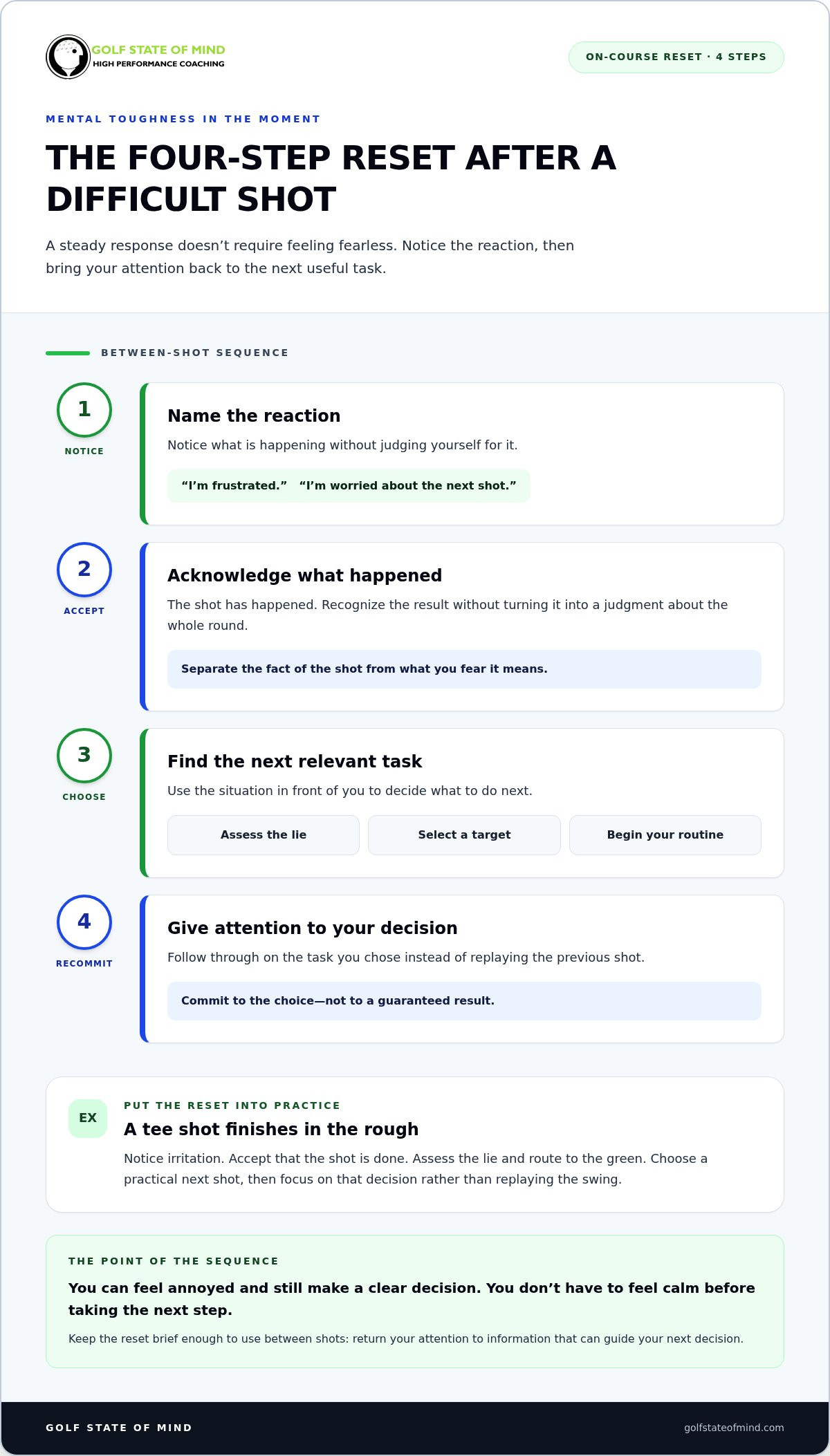
A resilient response is a sequence, not a demand to feel better instantly. After a shot stirs frustration or doubt, use these four steps to bring your attention back to the round:
- Notice the reaction. Name what’s happening, such as “I’m frustrated” or “I’m worried about the next shot.”
- Accept the facts. The shot has happened. Acknowledge its result without adding a judgment about what it means for the whole round.
- Choose the next task. Decide what the situation calls for, whether that’s assessing the lie, selecting a target, or beginning your routine.
- Recommit to that task. Give your attention to the decision you’ve made instead of continuing to replay the previous shot.
Resilience is the ability to reset your attention and recommit to the next task, even while an unwelcome emotion is still present. This separates the feeling from the behaviour. You can be annoyed and still make a clear decision. You don’t need to settle every emotion before taking the next step.
The cycle isn’t meant to become another performance test. Keep it brief enough to use between shots. Notice when your attention has drifted into replaying the past or predicting the future, then direct it towards information that can guide your next decision.
The response after a poor shot
Suppose a tee shot finishes in the rough. Pause long enough to notice your first reaction: “I’m irritated.” Don’t criticize yourself for feeling it, and don’t rush into swing analysis while emotions are high. Take in the facts that matter now, such as the lie and the route to the green, then choose a practical next shot.
If you find yourself replaying the swing, ask, “What does this shot require from me now?” That small reset can keep frustration from taking over your next decision. Golfers who want to work through the moment in more detail can use a dedicated guide to recovering after a bad golf shot.
Staying committed when pressure rises
Pressure can make the mind reach for certainty: “I have to hit this perfectly.” Replace that demand with a decision you can carry out. Pick a specific target, settle on the shot you intend to play, and follow your routine. Your task is to commit to the choice, not to guarantee where the ball will finish.
If doubt remains, let it be there without reopening the decision at the last moment. A clear intention gives your attention something useful to return to. This is a practical focus for developing mental toughness for golf: repeat your routine and honour your decision, even when the result feels important. A focused guide to handling pressure in golf can help you explore that challenge further.
To practise this response beyond the course, The Ultimate Mental Game Training System offers a structured way to build a steadier mental-game practice. Use training to strengthen the process, not to expect pressure to disappear.
Does Mental Toughness Mean Ignoring Nerves or Playing Perfectly?
No. A mentally resilient golfer can feel nervous before a demanding shot, doubt a decision, or feel frustrated with a result. These reactions don’t have to decide what happens next. Expecting yourself to feel perfectly calm before you act can add another burden: now you’re judging both your golf and your emotions.
Acceptance isn’t resignation. It means acknowledging the situation honestly, without pretending you like it or giving up on responding well. You might think, “I’m nervous, and I still need to choose a target.” That leaves room for deliberate action. Resignation, by contrast, says the outcome is settled and there’s no point in engaging. Resilience accepts what’s present, then asks what remains within your influence.
Mental toughness doesn’t replace technical practice. A useful mindset can support clearer decisions and more consistent commitment, but it can’t guarantee a particular result or lower score. Skill development still matters. The mental work is learning to use the skills you’ve practised without requiring ideal emotions or a flawless round first.
Why trying to eliminate every negative thought can backfire
Trying to make sure you don’t think about failure can keep your attention circling around the very outcome you fear. Each time a doubtful thought appears, you may start checking whether you’ve managed to get rid of it. That monitoring can distract from the shot in front of you. Instead, notice the thought as a thought: “I’m worried this could go wrong.” You don’t have to argue with it, obey it, or treat it as a prediction. Let it be present while you return to the decision you’ve prepared to make.
This isn’t an instruction to ignore useful information. If a concern points to a practical choice, such as adjusting your target for the lie or conditions, consider it. But repeatedly asking yourself whether you feel confident enough rarely gives you new information. Separate a thought that helps you plan from one that simply repeats a feared outcome.
What to do when confidence is low
On a day when confidence feels thin, don’t make “feel confident” the task. Make the task following a clear process. Choose your target, settle on an intention, and use the routine you’ve practised. Ground that decision in specific preparation, such as a target you rehearsed during practice or a pre-shot cue that helps you focus. That’s more dependable than insisting, “I’m going to hit a perfect shot.”
You can act deliberately before confidence returns. Confidence may rebuild through experience over time, but it doesn’t need to be a pass you earn before committing to a shot. Developing mental toughness for golf includes making room for uncertainty while choosing your next action. Measure the moment by whether you followed your plan, not by whether you felt fearless or controlled the result.
How to Practise Mental Toughness Between Rounds
Resilience becomes more dependable when you practise it deliberately, not only when a difficult moment arrives on the course. Choose one behaviour to work on, such as recommitting after an unwanted result. Then use the same progression between rounds: identify the trigger, rehearse your response, apply it during play, and reflect afterwards. Keep the focus narrow. Trying to change every part of your mental game at once makes it harder to see what you’re practising.
- Identify a trigger. Think of a moment that tends to pull your attention off the task, such as a missed short putt or a poor tee shot.
- Rehearse a response. Decide on one action you can repeat, such as taking a breath, naming the next task, or using a short cue.
- Apply it. Practise noticing the trigger and carrying out your response during a practice session or round.
- Reflect. Afterwards, note whether you recognized the moment and returned to your chosen behaviour.
Build a personal reset plan
Make your plan specific to your own patterns. Ask, “Which situations most often disrupt my focus?” Choose one trigger, then select a brief cue that points towards a decision, such as “choose the target” or “next task.” Rehearse the cue during practice, including after a shot that doesn’t go as intended. Familiarity gives you something prepared to use on the course, rather than a phrase you have to invent under pressure.
Keep the plan simple enough to remember. If your cue becomes a long speech or another standard you feel you must meet perfectly, shorten it. The goal is to direct attention, not force a particular emotion. As you build a broader routine, this single behaviour can sit within a more complete golf mental training program.
Measure progress by process, not only score
A scorecard records outcomes, but it doesn’t show every useful response you made. After a round, review whether you noticed your trigger and returned to the task you chose. Process measures reveal mental progress more clearly than a single score because they track the responses you can practise and influence.
Keep the reflection proportionate. Write down one moment when you followed your plan and one opportunity to try it again. Avoid turning each mistake into a detailed review of everything that went wrong. The purpose is to learn, not relive the round or judge yourself. Developing mental toughness for golf is gradual; consistent attention to one behaviour gives you a clearer basis for practice than expecting every round to confirm your progress.
For a structured next step, explore The Ultimate Mental Game Training System and use it to support consistent mental practice alongside your golf training.
Turn Golf Mental Toughness Into a Trainable System
Mental toughness becomes more practical when you treat it as a repeatable skill rather than a quality you either have or lack. The sequence is straightforward: notice your response, accept what has happened, choose a useful next task, recommit to it, and reflect afterwards. You won’t control every feeling or outcome, but you can practise how you respond across different situations.
Use the sequence to give your training a clear focus. Pick a recurring challenge, such as losing attention after a disappointing hole. Decide what you’ll practise when it appears, then look for chances to apply that response during practice and play. Afterwards, reflect on whether you returned to the task you chose. The aim is steady repetition, not a perfect performance.
When a structured mental training system may fit
A structured approach can suit you if you want a consistent framework for practising psychological skills rather than relying on occasional reminders during a round. Golf State of Mind offers digital training and 1:1 mental coaching focused on golf’s psychological demands. The Ultimate Mental Game Training System, mental-game audios, and a coaching app provide ways to support ongoing practice. Choose a framework that helps you return to one useful behaviour at a time and reflect on how you applied it.
Guided training can provide direction when you’re unsure how to turn an idea such as “stay committed” into a behaviour you can rehearse. It doesn’t remove pressure or guarantee results. Its value is in supporting purposeful practice, so mental work has a place alongside your existing golf preparation. For those looking to carry these self-regulation and mindset habits beyond the fairways, Rainmakers Coaching International offers structured personal and executive coaching to build resilience in high-stakes professional environments.
Choose a next step you can sustain
Start with one challenge that matters to your rounds. Perhaps you want to regain focus after a mistake or follow your routine when confidence dips. Define the behaviour in plain language, practise it consistently, and review it without making your score the only measure. Once that response feels familiar, decide whether to keep refining it or work on another challenge.
The Ultimate Mental Game Training System is a digital option focused on golf’s mental game for golfers who want structure in their practice. It supports work on psychological skills while keeping expectations grounded: training can support practice, but it can’t promise a particular score or outcome.
Developing mental toughness for golf is a steady commitment to the process, especially when the round doesn’t unfold as planned. Choose one response you can practise, give it time, and use reflection to guide what comes next. Explore the Ultimate Mental Game Training System as a structured next step for your mental-game practice.
Carry One Mental Skill Into Your Next Round
Make your next round a chance to practise, not a test of whether you’ve become mentally tough. Before you play, choose one situation you want to handle differently and decide what response you’ll rehearse. Afterwards, judge the effort by whether you gave that response a genuine attempt, not by whether the round went exactly to plan.
That steady approach is at the heart of developing mental toughness for golf. Progress may be quiet: noticing a reaction sooner, returning to your routine, or making a considered choice while doubt is still present. Keep the practice focused and sustainable. Each round gives you another opportunity to strengthen the way you meet the next challenge.
If you’d like more structure for that ongoing practice, explore the Ultimate Mental Game Training System. Stay patient with the process. Resilience is built through the choices you keep making, one shot at a time.
Frequently Asked Questions Is mental toughness natural, or can golfers develop it?
Golfers can develop mental toughness; it isn’t reserved for naturally confident players. Start by identifying a moment that regularly unsettles you, such as waiting after a slow group or facing a shot you tend to avoid. Choose one response to practise in that situation, then review whether you used it. Early progress may show up as clearer choices or less time spent dwelling on a mistake, even if your scores haven’t changed.
Can you develop mental toughness without playing competitive golf?
Yes. Competition can intensify pressure, but ordinary rounds and practice sessions still offer useful situations to work with. For example, set a target during a practice session and notice how you respond when a shot misses it. You can also practise staying with a club or target decision instead of changing your plan at the last moment. These repetitions help make your responses more familiar before a tournament or another high-pressure round.
How long does it take to develop mental toughness for golf?
There’s no fixed timeline for developing mental toughness for golf. Progress depends on what you practise and how consistently you return to it, so avoid judging the work by a deadline or a particular number of rounds. Look for small, observable changes: perhaps you catch yourself rushing sooner or make a decision without repeatedly reconsidering it. Use those signs to guide your next practice focus, rather than expecting one technique to change your game immediately.
Does mental toughness mean never getting angry after a bad shot?
No. Feeling angry or disappointed after a poor shot doesn’t mean you lack mental toughness. The important distinction is whether the emotion starts steering later choices, such as making a risky play to compensate. Acknowledge the frustration without turning it into a judgment about yourself or the rest of the round. Then give yourself a simple task, such as choosing a safe landing area, while the emotion settles in its own time.
Can mental toughness help when your swing is not working?
Mental skills can’t repair swing mechanics or replace technical instruction. They can help you respond more thoughtfully while your shots feel inconsistent. Rather than chasing a quick fix after every miss, stick to a clear decision routine and avoid letting frustration dictate your next target. Keep the mental task separate: focus on the decision and intention you can manage for the shot ahead.
What is one simple way to practise mental toughness during a round?
Choose one controllable task after a disappointing shot, such as identifying the safest route to the green or setting a clear target for your next putt. Follow through on that decision without requiring yourself to feel confident first. To make the practice useful, briefly note after the round when you managed to stay with your plan. This gives you a specific example to build on, rather than relying only on how the round felt overall.
The post Developing Mental Toughness for Golf: Build Resilience Shot by Shot appeared first on Instruction For The Mental Game of Golf.
Source: https://golfstateofmind.com/developing-mental-toughness-for-golf-build-resilience-shot-by-shot/
Anyone can join.
Anyone can contribute.
Anyone can become informed about their world.
"United We Stand" Click Here To Create Your Personal Citizen Journalist Account Today, Be Sure To Invite Your Friends.
Before It’s News® is a community of individuals who report on what’s going on around them, from all around the world. Anyone can join. Anyone can contribute. Anyone can become informed about their world. "United We Stand" Click Here To Create Your Personal Citizen Journalist Account Today, Be Sure To Invite Your Friends.
LION'S MANE PRODUCT
Try Our Lion’s Mane WHOLE MIND Nootropic Blend 60 Capsules
Mushrooms are having a moment. One fabulous fungus in particular, lion’s mane, may help improve memory, depression and anxiety symptoms. They are also an excellent source of nutrients that show promise as a therapy for dementia, and other neurodegenerative diseases. If you’re living with anxiety or depression, you may be curious about all the therapy options out there — including the natural ones.Our Lion’s Mane WHOLE MIND Nootropic Blend has been formulated to utilize the potency of Lion’s mane but also include the benefits of four other Highly Beneficial Mushrooms. Synergistically, they work together to Build your health through improving cognitive function and immunity regardless of your age. Our Nootropic not only improves your Cognitive Function and Activates your Immune System, but it benefits growth of Essential Gut Flora, further enhancing your Vitality.

Our Formula includes: Lion’s Mane Mushrooms which Increase Brain Power through nerve growth, lessen anxiety, reduce depression, and improve concentration. Its an excellent adaptogen, promotes sleep and improves immunity. Shiitake Mushrooms which Fight cancer cells and infectious disease, boost the immune system, promotes brain function, and serves as a source of B vitamins. Maitake Mushrooms which regulate blood sugar levels of diabetics, reduce hypertension and boosts the immune system. Reishi Mushrooms which Fight inflammation, liver disease, fatigue, tumor growth and cancer. They Improve skin disorders and soothes digestive problems, stomach ulcers and leaky gut syndrome. Chaga Mushrooms which have anti-aging effects, boost immune function, improve stamina and athletic performance, even act as a natural aphrodisiac, fighting diabetes and improving liver function. Try Our Lion’s Mane WHOLE MIND Nootropic Blend 60 Capsules Today. Be 100% Satisfied or Receive a Full Money Back Guarantee. Order Yours Today by Following This Link.


| Visits: | 1,834,625,759 |
| Stories: | 8,718,967 |
Whistler Blowers, Insiders

