

Liquid Chlorine Price 2026: Market Insights, Price Trends and Future Outlook

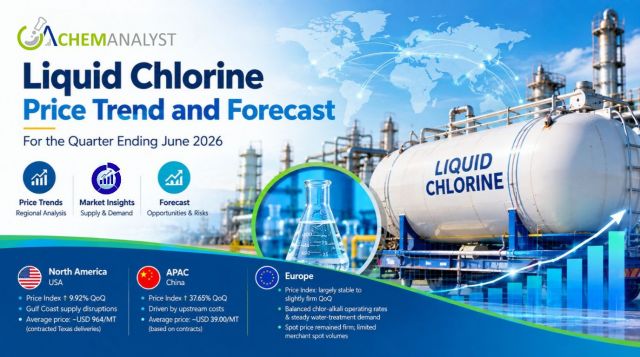
The Liquid Chlorine Price market recorded varied regional movements during the quarter ending June 2026, reflecting differences in chlor-alkali operating rates, downstream demand, energy costs, logistics and local supply availability. While North America and Asia experienced noticeable price increases, the European market remained comparatively stable to slightly firm.
According to ChemAnalyst Liquid Chlorine Price: – https://www.chemanalyst.com/Pricing-data/liquid-chlorine-45
Liquid chlorine is closely integrated with the chlor-alkali industry because chlorine is produced alongside caustic soda and hydrogen. Consequently, changes in plant operating rates, electricity costs, maintenance schedules and downstream consumption can quickly influence chlorine availability and pricing. Chlorine is also difficult to store and transport over long distances, making regional supply-demand conditions particularly important to the Liquid Chlorine Market.
According to ChemAnalyst data, the U.S. Liquid Chlorine Price Index increased by 9.92% quarter-over-quarter, with the average price reaching approximately USD 964/MT for contracted Texas deliveries. In China, the index increased by 37.65% quarter-over-quarter, with the average contract price around USD 39/MT. Europe, meanwhile, recorded a largely stable to slightly firm price environment.
Liquid Chlorine Price in North America
USA Liquid Chlorine Price Rises 9.92% QoQ
In the United States, the Liquid Chlorine Price Index increased by 9.92% quarter-over-quarter during the quarter ending June 2026. The average Liquid Chlorine Price was approximately USD 964/MT for contracted Texas deliveries.
The primary driver behind the increase was supply disruption along the Gulf Coast. Production outages temporarily reduced regional availability, tightening the balance between supply and demand. The resulting reduction in inventories contributed to higher spot-market indications, while higher energy-related expenses and freight costs provided additional support to prices.
The U.S. chlorine market is highly dependent on integrated chlor-alkali operations. Since chlorine is generally consumed close to where it is produced, a disruption at a major production facility can have an immediate effect on local availability. This characteristic also limits the ability of buyers to substitute supply from distant markets.
During the quarter, municipal water-treatment demand provided an additional source of support. Seasonal requirements for water disinfection helped maintain purchasing activity, while PVC-related chlorine consumption remained an important component of the broader demand base. ChemAnalyst also indicated that regional rail logistics and merchant inventories helped limit the extent of further price increases.
The U.S. Liquid Chlorine Price Trend therefore reflected a combination of supply-side disruptions and relatively stable downstream consumption rather than a broad-based surge in demand.
Factors Influencing the U.S. Liquid Chlorine Market
Several factors will remain important for U.S. prices:
- Gulf Coast production reliability
- Chlor-alkali plant maintenance schedules
- Municipal water-treatment demand
- PVC and vinyl-chain consumption
- Energy and electricity costs
- Rail and truck availability
- Merchant inventories
- Regional freight costs
Because liquid chlorine has limited economic transportability, local plant outages can create pricing differences between individual U.S. regions.
Liquid Chlorine Price in APAC
China Liquid Chlorine Price Increases 37.65% QoQ
The Asia-Pacific region recorded a significantly stronger movement in the Liquid Chlorine Price during the quarter. In China, the Liquid Chlorine Price Index increased by 37.65% quarter-over-quarter, while the average contract price was approximately USD 39.00/MT.
The increase was primarily associated with higher upstream costs and changing chlor-alkali operating conditions. Chlorine availability in China can change rapidly because production is tied directly to chlor-alkali plant operations. Maintenance, power restrictions, environmental controls and downstream operating rates can therefore create substantial regional price fluctuations.
Market reports during 2026 highlighted periods of reduced chlor-alkali operating rates in northern China, including supply constraints associated with extreme summer heat and power-related restrictions. Such operating-rate changes can reduce chlorine availability and affect related downstream chemical chains.
At the same time, China’s chlorine market remained highly regional. Since chlorine is hazardous and difficult to transport economically over long distances, producers generally supply nearby consumers. Consequently, local plant utilization and transportation conditions can have a greater impact on the Liquid Chlorine Market than international trade flows.
Available market assessments also show that Chinese chlorine pricing experienced fluctuations during Q2 2026 as weak downstream PVC demand competed with periodic supply restrictions. Maintenance at chlor-alkali facilities later tightened local availability in some areas.
What Is Driving China’s Liquid Chlorine Prices?
The major factors influencing China’s Liquid Chlorine Prices include:
- Upstream production costs: Higher energy and feedstock costs increase chlor-alkali production economics.
- Operating rates: Lower plant utilization directly restricts chlorine availability.
- Maintenance activity: Scheduled and unscheduled shutdowns can tighten regional supply.
- PVC demand: PVC and vinyl-chain activity remains an important chlorine outlet.
- Chemical manufacturing: Chlorinated intermediates and other industrial applications influence demand.
- Regional logistics: Transportation restrictions can limit movement between production and consumption centers.
The 37.65% quarterly increase in China’s index highlights how quickly the Liquid Chlorine Price Trend can change when supply and production costs move simultaneously.
Liquid Chlorine Price in Europe
European Liquid Chlorine Market Remains Stable to Slightly Firm
The European Liquid Chlorine Price Trend was comparatively stable to slightly firm during the quarter ending June 2026. The market was supported by balanced chlor-alkali operating rates and steady demand from municipal water treatment, although weakness in the PVC sector limited stronger upward momentum.
European chlorine pricing is particularly sensitive to electricity costs because chlor-alkali electrolysis is energy intensive. European industry sources have continued to highlight the importance of competitive electricity prices and local chlorine production for maintaining the region’s chemical supply chain.
At the same time, chlorine availability remained closely linked to nearby chlor-alkali production. Because chlorine cannot be easily stored or transported over long distances, buyers often depend on nearby production facilities. This means that plant outages, maintenance and transportation restrictions can quickly influence local spot availability.
European production data also illustrates the importance of operating rates. Euro Chlor reported June 2026 European chlorine production of approximately 625,552 tonnes, 3.9% below June 2025, while average daily production declined from May levels.
The European Liquid Chlorine Spot Price therefore remained firm even though PVC demand was comparatively weak. Transportation limitations restricted merchant spot volumes, preventing excess availability from building quickly in some locations.
👉👉👉Please Submit Your Query to Get Liquid Chlorine Price Index, Market Analysis and Trend & Forecast:- https://www.chemanalyst.com/ChemAnalyst/PricingForm?Product=Liquid%20Chlorine
PVC and Water Treatment Demand
PVC remains a major chlorine-consuming value chain in Europe. Chlorine is converted through intermediate stages into vinyl chloride monomer and subsequently PVC, making PVC production an important balancing outlet for chlorine generated by chlor-alkali plants.
However, the European PVC market faced weaker construction-related demand during parts of 2026, limiting the potential for chlorine demand to accelerate. Market assessments noted that weak PVC and construction activity continued to weigh on chlorine consumption.
Municipal water treatment provided a more stable demand component. Chlorine’s role in disinfection and water treatment means that this segment can offer a relatively consistent source of consumption even when cyclical industrial sectors weaken.
Key Factors Affecting the Liquid Chlorine Price Trend
The Liquid Chlorine Price Trend is shaped by several interconnected factors rather than by a single supply-demand variable.
- Chlor-Alkali Operating Rates
Chlorine is produced as part of the chlor-alkali process. When plants reduce operating rates, chlorine availability can tighten rapidly. Conversely, high operating rates can increase supply, particularly when downstream consumption is insufficient.
- Electricity and Energy Costs
Energy is a major component of chlor-alkali production economics. Higher electricity costs can increase production costs and influence producer pricing. This factor is particularly relevant in Europe, where electricity costs remain a significant consideration for chlor-alkali producers.
- PVC Demand
PVC is one of the most important downstream chlorine value chains. Construction, infrastructure, housing and renovation activity can therefore influence chlorine consumption through PVC production.
- Water Treatment Demand
Municipal and industrial water treatment provides an important source of chlorine demand. Seasonal purchasing patterns can support regional consumption when other industrial sectors are weaker.
- Logistics and Transportation
Unlike many liquid chemicals, chlorine has significant storage and transportation limitations. European industry sources emphasize that chlorine generally needs to be produced close to consumers because large-scale long-distance transportation and storage are challenging.
Consequently, rail disruptions, truck availability, port restrictions and plant-to-customer distances can have an outsized effect on local Liquid Chlorine Prices.
- Plant Maintenance and Outages
Planned maintenance can temporarily remove production capacity, while unexpected outages can create immediate supply shortages. When inventories are limited, even a short disruption can affect spot prices.
Liquid Chlorine Spot Price vs. Contract Price
An important feature of the Liquid Chlorine Market is the distinction between contract and spot pricing.
Contract prices are generally negotiated between producers and regular customers and can provide greater stability. Spot prices, on the other hand, react more quickly to changes in local supply, outages, inventories and transportation availability.
This distinction was visible in North America, where contracted Texas deliveries averaged approximately USD 964/MT while production disruptions pushed spot indications higher.
In Europe, limited merchant availability similarly contributed to firm spot conditions. Since chlorine is typically consumed close to its production source, local spot prices can diverge significantly depending on the operating status of nearby plants.
Liquid Chlorine Market Outlook
The outlook for the global Liquid Chlorine Market remains dependent on the interaction between chlor-alkali production, downstream demand and regional logistics.
In North America, the Liquid Chlorine Price Forecast will likely remain sensitive to Gulf Coast production reliability, maintenance schedules, water-treatment demand and inventory conditions. Any recurrence of production disruptions could create localized price pressure.
In China, the price outlook will depend heavily on upstream costs and chlor-alkali utilization rates. Periods of maintenance, power restrictions or reduced operating rates could support prices, while weaker PVC demand and higher production availability could moderate the market.
In Europe, energy costs and local production capacity will remain central to the pricing environment. The region’s limited ability to move chlorine over long distances means that local production conditions will continue to influence supply security and spot-market pricing.
Liquid Chlorine Price Forecast: What Buyers Should Watch
For procurement teams, monitoring the following indicators can provide early signals of changes in the Liquid Chlorine Price Trend:
- Chlor-alkali plant operating rates
- Planned maintenance and unexpected outages
- Electricity and natural gas prices
- PVC and vinyl-chain operating rates
- Municipal water-treatment demand
- Regional inventory levels
- Rail, truck and tanker availability
- Local spot-market assessments
- Producer contract negotiations
- Changes in downstream chemical production
The most important point is that liquid chlorine is fundamentally a regional market. Global supply-demand statistics alone may not accurately capture short-term pricing conditions because transportation and storage constraints can isolate individual production and consumption areas.
Conclusion
The Liquid Chlorine Price market showed significant regional differentiation during the quarter ending June 2026. In the USA, the price index increased 9.92% quarter-over-quarter, reaching an average of approximately USD 964/MT for contracted Texas deliveries, as Gulf Coast supply disruptions tightened availability. In China, the index increased 37.65% quarter-over-quarter, with average contract prices around USD 39/MT, reflecting higher upstream costs and changing chlor-alkali operating conditions.
Europe presented a different picture, with prices remaining largely stable to slightly firm. Balanced chlor-alkali operations, steady water-treatment demand and limited merchant availability supported the market, while weaker PVC demand restrained stronger gains.
Going forward, the global Liquid Chlorine Market will remain closely connected to chlor-alkali operating rates, electricity costs, downstream PVC demand, water-treatment consumption, maintenance schedules and regional logistics. For buyers and procurement teams, monitoring local supply conditions and production economics will be essential for understanding the next phase of the Liquid Chlorine Price Trend.
Contact -
Address:
420 Lexington Avenue, Suite 300
New York, NY 10170
United States
Phone: +1 332 258 6602
Website: www.chemanalyst.com
LinkedIn: https://www.linkedin.com/company/chemanalyst/
X (Twitter): https://x.com/chemanalysts
Facebook: https://www.facebook.com/ChemAnalysts/
Anyone can join.
Anyone can contribute.
Anyone can become informed about their world.
"United We Stand" Click Here To Create Your Personal Citizen Journalist Account Today, Be Sure To Invite Your Friends.
Before It’s News® is a community of individuals who report on what’s going on around them, from all around the world. Anyone can join. Anyone can contribute. Anyone can become informed about their world. "United We Stand" Click Here To Create Your Personal Citizen Journalist Account Today, Be Sure To Invite Your Friends.
LION'S MANE PRODUCT
Try Our Lion’s Mane WHOLE MIND Nootropic Blend 60 Capsules
Mushrooms are having a moment. One fabulous fungus in particular, lion’s mane, may help improve memory, depression and anxiety symptoms. They are also an excellent source of nutrients that show promise as a therapy for dementia, and other neurodegenerative diseases. If you’re living with anxiety or depression, you may be curious about all the therapy options out there — including the natural ones.Our Lion’s Mane WHOLE MIND Nootropic Blend has been formulated to utilize the potency of Lion’s mane but also include the benefits of four other Highly Beneficial Mushrooms. Synergistically, they work together to Build your health through improving cognitive function and immunity regardless of your age. Our Nootropic not only improves your Cognitive Function and Activates your Immune System, but it benefits growth of Essential Gut Flora, further enhancing your Vitality.

Our Formula includes: Lion’s Mane Mushrooms which Increase Brain Power through nerve growth, lessen anxiety, reduce depression, and improve concentration. Its an excellent adaptogen, promotes sleep and improves immunity. Shiitake Mushrooms which Fight cancer cells and infectious disease, boost the immune system, promotes brain function, and serves as a source of B vitamins. Maitake Mushrooms which regulate blood sugar levels of diabetics, reduce hypertension and boosts the immune system. Reishi Mushrooms which Fight inflammation, liver disease, fatigue, tumor growth and cancer. They Improve skin disorders and soothes digestive problems, stomach ulcers and leaky gut syndrome. Chaga Mushrooms which have anti-aging effects, boost immune function, improve stamina and athletic performance, even act as a natural aphrodisiac, fighting diabetes and improving liver function. Try Our Lion’s Mane WHOLE MIND Nootropic Blend 60 Capsules Today. Be 100% Satisfied or Receive a Full Money Back Guarantee. Order Yours Today by Following This Link.


| Visits: | 1,833,423,279 |
| Stories: | 8,712,532 |
Whistler Blowers, Insiders

