

Free Cash Flow Explained for Investors: Formula (2026)

Free cash flow is the cash a company generates from running its business after paying operating costs and the capital spending needed to keep that business running. It is the money that can fund dividends, buybacks, debt repayment or expansion. This guide covers free cash flow explained for investors: how to calculate it, how to judge its quality, and where the number breaks down.
One thing to set straight early: FCF is a non-GAAP measure, not a line item on the statement of cash flows. That single fact explains most of the arguments you will see about whether a company generates cash. Below, I use the common definition throughout — FCF = operating cash flow minus capital expenditure — and flag the alternatives where they matter.
This is educational material, not investment advice. Valuation methods and accounting treatment vary by company and by reporting standard, so treat every number here as a starting point for your own research.
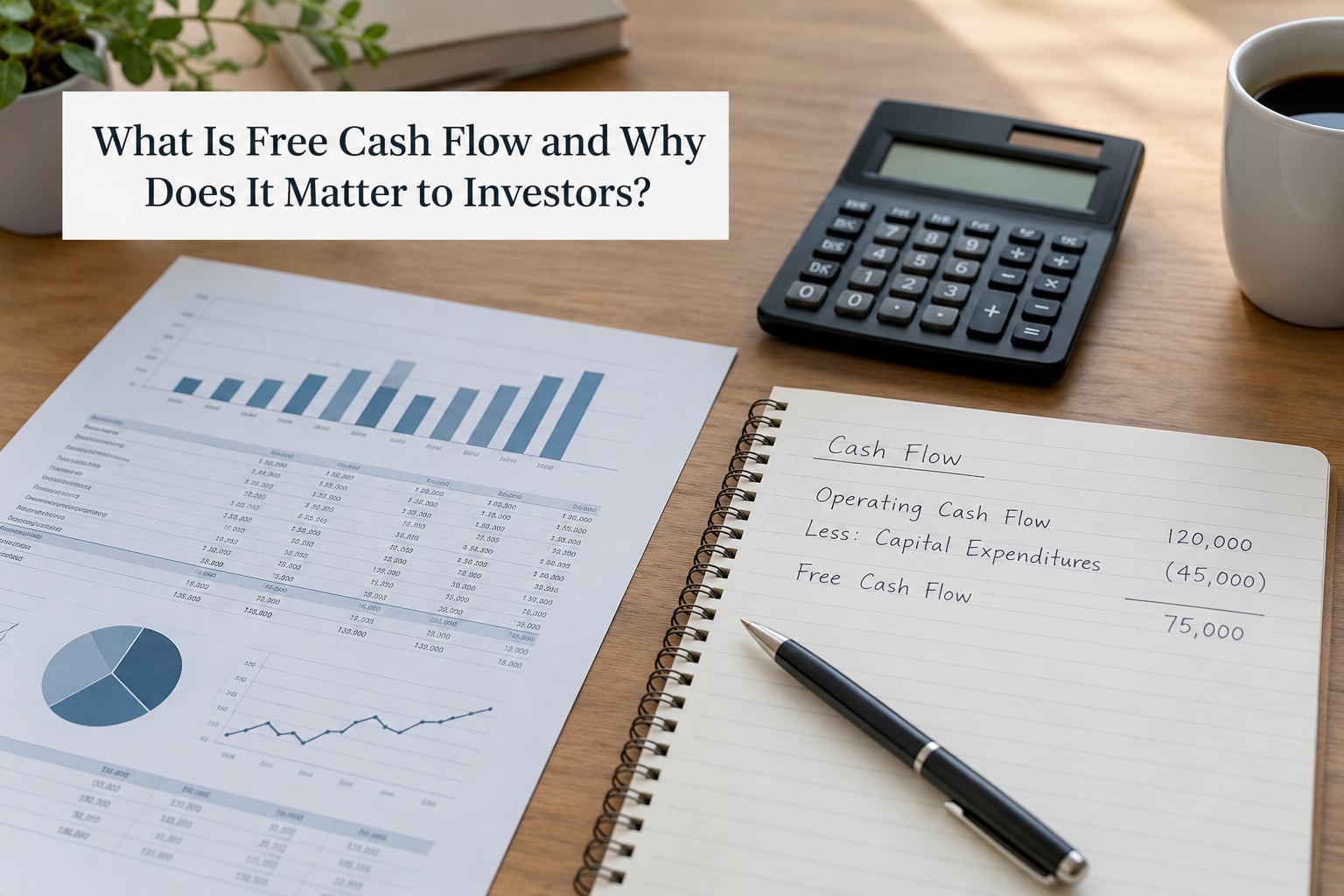
What Is Free Cash Flow and Why Does It Matter to Investors?
Free cash flow is the money a business produces from its own operations once operating expenses and the capital spending required to maintain its assets have been paid. Everything left in that pot is genuinely discretionary: it can go to shareholders, to lenders, or back into growth projects.
The one-sentence version: free cash flow is what remains after a company pays the bills required to keep the lights on, and it is the closest thing accounting gives you to cash in an owner’s pocket.
Investors care about it for three practical reasons.
- It is hard to fake. Net income is built from estimates and non-cash charges, so it can be managed within the rules. Cash from operations and capital spending are money that actually moved.
- It funds everything shareholders care about. Dividends, share buybacks, debt paydown and acquisitions are all paid out of this pot. A company that consistently generates less than it hands out is borrowing to look generous.
- It anchors valuation. Discounted cash flow models and owner-earnings estimates both start from this number, not from reported profit.
Investors who screen for businesses in practice tend to do the same thing: start from free cash flow yield rather than from earnings multiples.
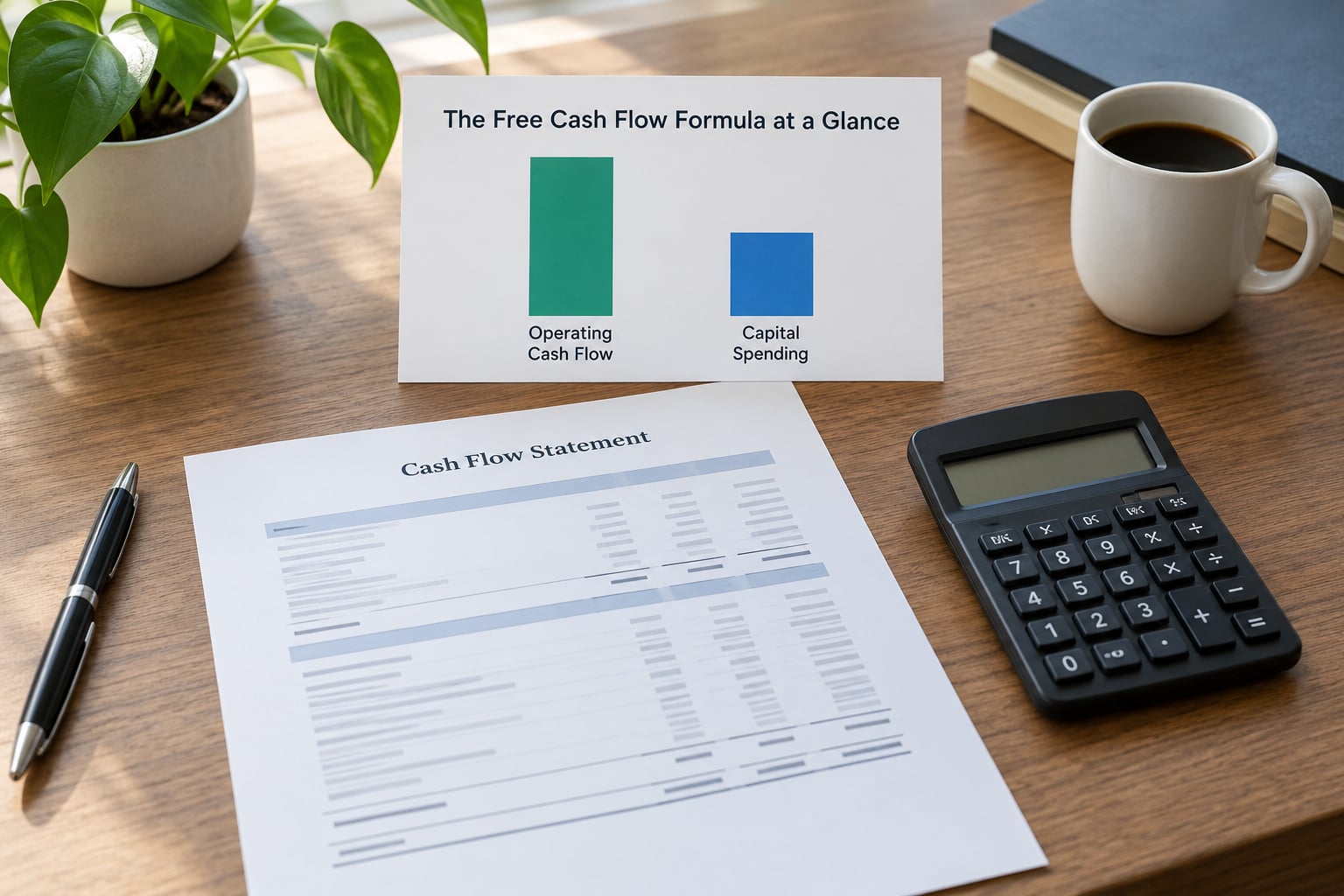
The Free Cash Flow Formula at a Glance
There is no single mandated formula, which is why two reputable data providers can show different free cash flow for the same quarter. This article uses the most common version and lists the alternatives openly.
| Approach | Formula | What each input represents | How to read the result |
|---|---|---|---|
| Standard FCF | Net cash from operating activities minus purchases of property, plant and equipment | Cash actually generated by the business, then the cash spent on long-lived assets | Positive and steady means self-funding. Thin means asset-heavy or in a build phase |
| FCF from net income | Net income plus depreciation and amortisation, minus capex and the change in working capital | Accounting profit, non-cash charges, then cash spent on assets and inventory or receivables | Useful when only income statement data is available; noisier than the operating cash flow route |
| Free cash flow to the firm (FCFF) | Operating cash flow minus capex, before interest and tax adjustments | Cash available to all capital providers | The input for enterprise-level discounted cash flow models |
| Free cash flow to equity (FCFE) | FCFF minus interest paid after tax, minus net debt issued, plus net borrowing | Cash available to shareholders once lenders are served | The input for equity valuation and dividend coverage |
| Owner earnings | Reported earnings plus depreciation, minus average annual capital spending required to maintain competitive position | Normalised maintenance cost rather than reported total capex | Best for a mature business; flattering for one in a heavy investment cycle |
A negative result needs context, not panic. A company building a new plant, buying inventory ahead of demand, or working through a commodity downcycle can print negative free cash flow while the underlying business is fine.
How to Calculate Free Cash Flow
Work through it in this order, using figures in millions from the same reporting period so nothing is mismatched.
- Open the statement of cash flows in the 10-K or 10-Q. Find the line called net cash provided by operating activities. Do not use the net income figure at the top of the income statement.
- Read purchases of property, plant and equipment. In the investing section this usually appears as purchases of property, plant and equipment, or simply capital expenditures. If the company sells significant assets, note that figure separately.
- Subtract capex from operating cash flow. That difference is free cash flow.
- Check what is missing. If the company has large acquisitions, unusually large working capital swings, or a big stock-based compensation add-back, note them before you trust the result.
| Line item (figures in millions) | Amount | Comment |
|---|---|---|
| Net income | 412 | Reported profit for the year |
| Depreciation and amortisation | 305 | Non-cash, added back |
| Stock-based compensation | 64 | Non-cash, but a real cost to shareholders |
| Change in working capital | (58) | Cash tied up in inventory and receivables |
| Net cash provided by operating activities | 723 | Use this figure as your starting point |
| Less: capital expenditure | (288) | Includes 96 of maintenance spending and 192 of growth spending |
| Free cash flow | 435 | 723 minus 288 |
That 435 covers a dividend of 130 and a buyback of 60, so roughly 56% of free cash flow was returned and the rest went to acquisitions and a cash buffer. That ratio is worth checking every year.
If your own calculation disagrees with a data provider, the gap is almost always definitional rather than an error. A recurring pattern looks like this: a data site shows free cash flow of 9.02 billion for a single quarter, the filing shows 8.55 billion, and a hand calculation produces a small negative number. The usual causes are that the provider annualises a quarter, deducts acquisitions, or subtracts total investing cash flow rather than capital expenditure alone. Subtract total investing cash flow and you are counting asset sales, divestments and securities purchases as operating spending, which is why that kind of shortcut produces nonsense.
Free Cash Flow Versus Net Income: Why the Difference Matters
Net income answers a different question from free cash flow. Net income asks what the accounting rules say the business earned. Free cash flow asks how much money moved and what remains after keeping the asset base intact.
The two diverge for understandable reasons:
- Depreciation and amortisation. A real expense in economic terms, but not a cash payment this year. It sits in net income and gets added back in operating cash flow.
- Working capital. If net working capital rises, cash is absorbed by inventory and receivables and operating cash flow falls below profit. When net working capital falls, cash is released and the gap flips the other way.
- Non-cash provisions and impairments. Restructuring charges and write-downs can cut reported profit with no cash consequence.
- Timing of tax and interest. Cash tax rarely matches the tax expense booked, and interest paid is often classified as financing rather than operating under US GAAP.
| Measure | Where it comes from | What it measures | Main weakness |
|---|---|---|---|
| Net income | Income statement | Accounting profit after all expenses and interest | Built on estimates; sensitive to accounting judgement |
| Operating cash flow | Statement of cash flows | Cash generated by day-to-day operations before capex | Can be flattered by a one-off working capital release |
| Free cash flow | Operating cash flow minus capex | Cash genuinely available for distribution or reinvestment | Total capex blends maintenance and growth spending |
| EBITDA | Income statement, non-GAAP | Operating profit before depreciation, interest, tax and amortisation | Ignores the capex a capital-intensive business must spend |
A persistent gap where free cash flow runs well below net income for years on end usually means the business is capital-intensive or the accounting life of its assets is too long. That is worth understanding before you call the earnings cheap.
How Investors Should Judge Free Cash Flow Quality
A single year’s figure tells you very little. Quality is what makes the number repeatable, and five checks separate durable cash generation from a temporary boost.
- Consistency across a cycle. Compare three to five years, ideally including one weak year. Businesses that only generate cash in good years are cyclical, and you should value them on mid-cycle cash flow rather than the peak.
- Working capital movements. A jump in cash flow because receivables were collected faster or inventory was run down is a one-time release. It will reverse.
- Stock-based compensation. It is added back in operating cash flow because it is non-cash, yet it dilutes shareholders. Many investors subtract it to get a conservative figure.
- Acquisitions and asset sales. Cash from selling a business unit or property inflates free cash flow without any operating improvement. Strip it out.
- Relationship to earnings. Sustained free cash flow at or above net income is a good sign. A widening gap deserves an explanation, not an assumption.
Free cash flow is not a one-size-fits-all answer, and the business model matters as much as the number: a mature company with no room to grow is better judged on cash returned to shareholders than on cash generated in total.
How Investors Use Free Cash Flow in Valuation
Once you trust the quality of the number, four practical uses follow.
Owner earnings: the Buffett framing
Warren Buffett’s preferred measure is owner earnings: reported earnings plus depreciation and other non-cash charges, minus the average annual capital spending required to maintain long-term competitive position and unit volume. The point of that adjustment is to strip out growth spending, which belongs to new projects rather than to the existing business. It is a normalisation, and it can flatter a company in a heavy build cycle, so it works best on mature businesses.
A simplified discounted cash flow approach
Value the cash, then discount it. Project free cash flow for five to ten years, apply a discount rate, add a terminal value, and divide by shares outstanding. A starting rate of roughly 12% is common among retail investors, which produces deliberately conservative valuations. Small changes to the growth rate or terminal assumptions swing the result more than most people expect, so treat the output as a range.
Free cash flow yield
Free cash flow yield divides free cash flow by market capitalisation. It inverts the price-earnings ratio: instead of paying a multiple for earnings, you express the cash return as a percentage of the price you pay. That makes comparison across companies with different accounting policies far easier.
| Business type | What normal free cash flow yield tends to look like | What moves it |
|---|---|---|
| Mature, asset-light | Often 5% to 10% or higher | High margins, low reinvestment needs, stable pricing power |
| Capital-intensive | Often 2% to 6% | Depreciation versus replacement spending, utilisation rates |
| High-growth, reinvesting | Can be zero or negative | How much of operating cash flow gets reinvested in growth |
| Cyclical commodity producer | Wide swings, often negative mid-cycle | Realised commodity price and sustaining capital needs |
So is a 6% free cash flow yield good? Sometimes. It is unremarkable for a mature manufacturer and striking for a stable consumer business, so the number only means something next to the business model and the trend behind it. One objection is worth keeping in view: reported profits can be flattered in ways cash flow cannot, which is why owner earnings rather than the bottom line anchors the whole thesis.
Free Cash Flow for Mining, Energy, and Commodity Companies
For mining and energy businesses, free cash flow is the metric that decides whether a project is worth building, so it gets read very differently from a software company.
Sustaining capital is not the same as development capital. Ongoing spending that keeps existing mines, wells or plants producing has to be subtracted before any cash is genuinely free. New spending on growth projects should be excluded from normalised free cash flow and valued separately.
Commodity prices dominate the cycle. A single strong year at elevated prices produces a free cash flow figure that says very little about the next three years. Mid-cycle prices give a more honest picture than either the peak or the trough.
Royalties and streams can quietly reallocate the cash. A portion of production sold forward to a royalty or streaming company means the reported free cash flow overstates what reaches the equity holder, which is exactly what free cash flow to equity is designed to reveal.
Watch acquisitions. Mining consolidators often produce impressive free cash flow after an asset sale and weak free cash flow while funding the next project. Strip both out before comparing years.
The practical rule: judge a commodity producer on free cash flow at a mid-cycle price, after sustaining capital and after the streaming and royalty obligations, and require it to hold up through a downturn.
Common Free Cash Flow Mistakes Investors Should Avoid
- Treating any increase as sustainable. One strong quarter is often a working capital release or an unusually high commodity price.
- Ignoring capital intensity. Comparing a capital-intensive producer with an asset-light business on the same multiple compares two different businesses.
- Switching formulas mid-analysis. Mixing operating cash flow minus total investing cash flow with operating cash flow minus capex across years produces a trend that means nothing.
- Overlooking working capital swings. A rise in net working capital reduces cash flow now and often reverses later. Check which direction you are looking at.
- Comparing companies with different growth profiles. Low free cash flow at a high return on invested capital can be a deliberate choice to reinvest, not a weakness.
- Relying on one year of results. One period says nothing about durability. Pull at least three years, ideally five.
- Trusting a formula you did not verify. Formulas circulating online, including ones written by AI, sometimes subtract total investing cash flow and count asset sales as operating outflows. Check the line items before you build a model on top.
Frequently Asked Questions
No. Free cash flow is what remains after operating costs and capital expenditure, but management decides where it goes: growth projects, acquisitions, debt repayment, cash reserves, dividends or buybacks. A company can generate healthy free cash flow and return almost none of it. What matters for shareholders is how much of it is actually distributed, and whether the dividend is covered by free cash flow after maintenance capital spending rather than by borrowing.
Profit is an accounting measure and cash is a timing measure. A profitable company turns negative free cash flow when it builds inventory, extends customer payment terms, pays tax on a delayed schedule, or spends heavily on new capacity. Debt-funded expansion is the usual cause. Growth explains a temporary dip; a company stuck below zero for many years despite mature sales is a different and more serious situation worth investigating.
No, not when you start from operating cash flow. Depreciation is already added back inside that figure, and capital expenditure already reflects the cash cost of replacing assets, so subtracting it twice double-counts. It only comes out when you build free cash flow from net income and need to add back non-cash charges before subtracting capital spending. Buffett’s owner earnings method goes further and deducts average maintenance capital spending instead of total capital expenditure.
Free cash flow is an absolute amount in currency, so a bigger company naturally produces more of it and comparisons tell you little. Free cash flow yield divides that amount by market capitalisation and expresses it as a percentage of what you pay, which makes companies of different sizes directly comparable. It also inverts the price-earnings ratio: a low yield implies you are paying a high multiple for each dollar of cash generated.
Not always. A business reinvesting heavily at high returns on invested capital may be converting cash into future capacity, and that can be the right choice for shareholders. The questions are how long the cash drain lasts, what return the reinvestment earns, and whether the company can fund the gap without diluting holders or loading up debt. Low free cash flow is only a problem when the reinvestment stops paying off.
Judge it on mid-cycle economics rather than the latest number. Subtract sustaining capital from development spending, apply a long-run commodity price instead of the current one, and account for royalty and streaming arrangements that divert production cash away from shareholders. Then require the result to hold up through a downturn. A strong free cash flow year at peak prices tells you little about whether the asset base can fund itself when prices fall.
Conclusion
Free cash flow explained for investors comes down to one question: does this business generate cash that survives its own capital spending, year after year, without an accounting explanation? Everything else is detail.
Start by pulling three to five years of statement of cash flows, calculating FCF the same way each year — operating cash flow minus capital expenditure — and then checking the result against net income, capital spending and the conditions the business faced. If the number holds up, you have something worth valuing. If it only appears in good years, you have a cyclical business and should value it on mid-cycle cash instead.
Last reviewed: October 2026. Educational content only, not investment advice.
Source: https://www.pgm-blog.com/free-cash-flow-explained-for-investors/
Anyone can join.
Anyone can contribute.
Anyone can become informed about their world.
"United We Stand" Click Here To Create Your Personal Citizen Journalist Account Today, Be Sure To Invite Your Friends.
Before It’s News® is a community of individuals who report on what’s going on around them, from all around the world. Anyone can join. Anyone can contribute. Anyone can become informed about their world. "United We Stand" Click Here To Create Your Personal Citizen Journalist Account Today, Be Sure To Invite Your Friends.
LION'S MANE PRODUCT
Try Our Lion’s Mane WHOLE MIND Nootropic Blend 60 Capsules
Mushrooms are having a moment. One fabulous fungus in particular, lion’s mane, may help improve memory, depression and anxiety symptoms. They are also an excellent source of nutrients that show promise as a therapy for dementia, and other neurodegenerative diseases. If you’re living with anxiety or depression, you may be curious about all the therapy options out there — including the natural ones.Our Lion’s Mane WHOLE MIND Nootropic Blend has been formulated to utilize the potency of Lion’s mane but also include the benefits of four other Highly Beneficial Mushrooms. Synergistically, they work together to Build your health through improving cognitive function and immunity regardless of your age. Our Nootropic not only improves your Cognitive Function and Activates your Immune System, but it benefits growth of Essential Gut Flora, further enhancing your Vitality.

Our Formula includes: Lion’s Mane Mushrooms which Increase Brain Power through nerve growth, lessen anxiety, reduce depression, and improve concentration. Its an excellent adaptogen, promotes sleep and improves immunity. Shiitake Mushrooms which Fight cancer cells and infectious disease, boost the immune system, promotes brain function, and serves as a source of B vitamins. Maitake Mushrooms which regulate blood sugar levels of diabetics, reduce hypertension and boosts the immune system. Reishi Mushrooms which Fight inflammation, liver disease, fatigue, tumor growth and cancer. They Improve skin disorders and soothes digestive problems, stomach ulcers and leaky gut syndrome. Chaga Mushrooms which have anti-aging effects, boost immune function, improve stamina and athletic performance, even act as a natural aphrodisiac, fighting diabetes and improving liver function. Try Our Lion’s Mane WHOLE MIND Nootropic Blend 60 Capsules Today. Be 100% Satisfied or Receive a Full Money Back Guarantee. Order Yours Today by Following This Link.


| Visits: | 1,834,001,127 |
| Stories: | 8,715,728 |
Whistler Blowers, Insiders

