

Difference Between Golf Psychology and Mental Coaching: What Golfers Need to Know

What is the difference between golf psychology and mental coaching, and which kind of support fits your goal? The terms often appear side by side, but they can describe different work. One may help you understand how thoughts and emotions affect your play; the other may help you practise golf-specific skills, such as resetting after a poor shot or following a routine under pressure.
Golf psychology explores how attention, confidence, emotions, and other psychological factors relate to performance. Mental coaching uses relevant ideas to help golfers build and practise performance skills. The approaches can overlap, but they are not always the same.
This article explains where the approaches meet and how to choose a useful next step. You’ll learn when a licensed mental-health professional may be appropriate for broader concerns, when performance coaching can help you work on your mental game, and how to turn a goal into a practice process you can use during a round.
- The difference between golf psychology and mental coaching is often a difference in emphasis: understanding psychological factors versus practising performance skills.
- Name the challenge you want to address, then decide whether it is a golf-specific performance goal or a concern affecting your wider well-being.
- Turn a mental-game goal into a repeatable practice plan instead of relying on advice that may be hard to use during a round.
- Choose a format that suits how you learn, from guided digital practice and mental-game audios to an app or 1:1 coaching.
- Structured mental-skills practice can help you take a more deliberate approach to your performance.
What Do Golf Psychology and Mental Coaching Mean?
Golfers may see “golf psychology,” “sports psychology,” and “mental coaching” used to describe similar tools. All can relate to how a golfer thinks and responds during play. The terms still refer to different things, so it helps to distinguish an area of knowledge from a kind of support.
Golf psychology examines how psychological factors relate to golf performance; mental coaching uses selected performance principles to help golfers practise mental skills and habits. This is a useful distinction, though practitioners may use the labels differently.
What golf psychology describes
Golf psychology studies and applies psychological factors in golf. It considers how attention, confidence, self-talk, emotions, and expectations may shape a golfer’s experience and decisions. For example, a player who keeps replaying a missed putt may find it harder to focus on the next shot. A psychological perspective can help identify that pattern without assuming every golfer responds in the same way.
The broader field of Sport psychology explores how psychological principles relate to sport and athletic performance. Golf psychology applies that perspective to golf’s particular demands, including the time between shots, changing conditions, and decisions made under pressure.
It is also useful to distinguish a field from a job title. Golf psychology names an area of study and practice; “golf psychologist” describes an individual and can mean different things in different settings. A title alone does not tell you whether someone’s work involves research, performance support, therapy, or another form of practice. Not everyone working with golf psychology provides clinical treatment. Training, professional scope, and local rules matter.
What mental coaching means in golf
Mental coaching is structured, goal-oriented support for developing performance-related skills and habits. It can help a golfer move from understanding how pressure affects attention to deciding what to practise and how to use the skill during golf. A goal might be to rehearse returning attention to the present after a frustrating shot.
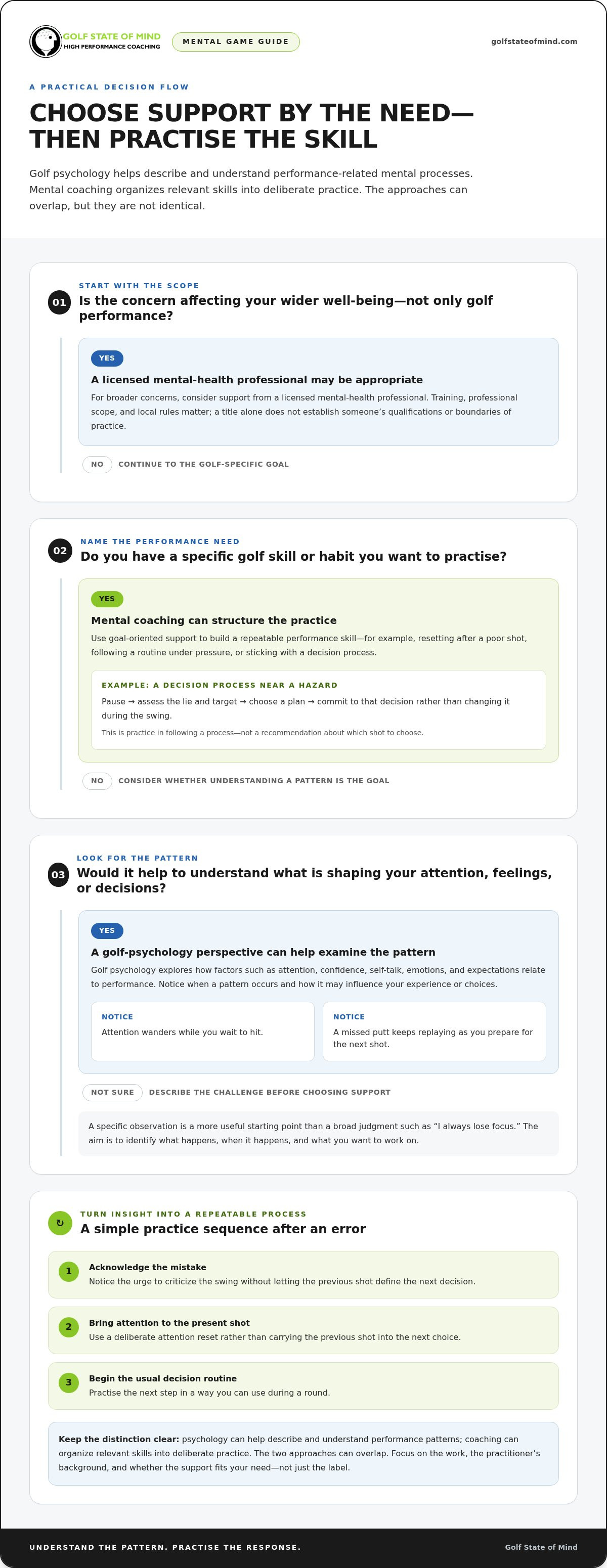
Consider a golfer unsure whether to attempt a risky shot over a hazard. A coaching goal might be to pause, assess the lie and target, choose a plan, and commit to that decision rather than changing it during the swing. This is practice in following a decision process, not a recommendation about which shot to choose.
Coaching scope and professional titles vary by location, so the label alone does not establish someone’s qualifications or boundaries of practice. In short, the difference between golf psychology and mental coaching is often one of emphasis: psychology helps describe and understand performance-related mental processes, while coaching organizes relevant skills into deliberate practice. The approaches can overlap without describing identical work.
How Psychology and Mental Coaching Apply to Golfers
Mental performance on the course is shaped by more than one thought or feeling. Attention may drift toward a hazard, self-talk may turn harsh after a poor shot, or frustration may affect the next decision. Psychological concepts help golfers notice these patterns and consider when they occur and how they influence choices during a round.
Specific observations provide a better starting point than a general judgment such as “I always lose focus.” You might notice that your attention wanders while you wait to hit, or that one mistake leads you to keep thinking about the previous hole. These details help define a performance goal. They do not automatically change your response, but they show what you could work on.
From understanding a pattern to practicing a skill
Noticing a recurring thought is different from rehearsing what to do when it appears. Mental coaching can turn a defined goal into a process to practise, such as using a consistent reset after an error. The aim is not to suppress every reaction. It is to prepare a deliberate next step instead of letting the previous shot shape the next decision.
After missing a fairway, for example, a golfer might notice the urge to criticize the swing while walking to the ball. A practice plan could be to acknowledge the mistake, bring attention to the present shot, and begin the usual decision routine. A practiced attention reset can help a golfer return to the next shot after an error without carrying the previous one into the decision. This is a process to rehearse, not a promise of a particular score or result.
Where the two approaches overlap
Psychology and coaching can both address confidence, concentration, routines, and performance pressure. Psychological understanding can help identify what to practise, while coaching can provide structure for repeating a skill in relevant situations. These approaches are not opposites, and a golfer’s support does not have to fit neatly into one label.
The actual focus and scope of the work matter more than the title. A practitioner’s background and methods shape how they address a performance concern. One may help a golfer examine patterns and understand their responses; another may focus on turning a specific goal into practice and routines. Consider what the support involves and whether it fits your need.
For golfers ready to bring structure to mental-skills practice, The Ultimate Mental Game Training System offers a guided, self-paced way to work on the golf mental game. Connect insight with a process you can practise, then review how consistently you apply it in real golf situations.
Golf Psychology vs. Mental Coaching: Which Fits Your Goal?
The right starting point depends on what you want help with. Are you looking to understand how mental factors shape your golf, practise performance skills, or address distress that extends beyond the course? These needs can overlap, but they do not call for identical support. Use the comparison below to understand the usual emphasis, then consider a practitioner’s training and scope.
| Area | Golf psychology | Mental coaching |
|---|---|---|
| Primary focus | Understanding psychological factors related to golf performance | Practising performance-related mental skills and habits |
| Typical aims | Explore how thoughts, attention, confidence, and emotions relate to play | Build a deliberate process for applying a chosen skill in golf |
| Scope boundary | The term describes a field; it doesn’t by itself indicate clinical services | Performance coaching isn’t a substitute for mental-health diagnosis or treatment |
When a performance-coaching approach may fit
Coaching may suit a golfer with a defined performance goal, such as following a consistent pre-shot routine or using a clear decision process throughout a round. The work is practice-oriented: identify a skill, decide how to rehearse it, then review whether you apply it in play. This can support development without promising a particular score or outcome.
Choose coaching for golf-specific skill development, not as a replacement for clinical care. The goal is to strengthen a performance process, not diagnose or treat a mental-health condition.
When psychological or clinical support may matter
Interest in sport psychology does not automatically mean you need therapy. You may simply want to understand the mental factors involved in performance. If distress is persistent, affects areas of life beyond golf, or raises concerns about your mental health, consider seeking help from an appropriately licensed mental-health professional. You do not need to diagnose yourself before reaching out.
Professional titles and clinical scope can vary by jurisdiction. When you need diagnosis or treatment, look to relevant local standards rather than relying on a title alone. Some golfers may use performance coaching and clinical support at different times, or alongside one another, when each has a distinct role.
The difference between golf psychology and mental coaching is not a choice between understanding and skill practice. Psychology can inform what a golfer wants to work on; coaching can provide a structured way to practise performance skills. If your main aim is to apply mental skills more deliberately in golf, coaching may be a practical fit. If your concern involves broader or ongoing distress, prioritize appropriate clinical support. Match the support to the need and be clear about the goal it should serve.
How Can You Decide What Kind of Golf Mental Support to Seek?
Start with a clear description of your need, not a label. Understanding the difference between golf psychology and mental coaching can clarify the options, but your immediate goal, the scope of support required, and your preferred way to learn are more practical guides. Work through these four steps before choosing a format.
A four-step self-assessment for golfers
- Name the issue. Identify a recurring situation without turning it into a diagnosis. For example, note that you lose confidence after a certain kind of mistake or find it difficult to follow your intended process during a round.
- Define the goal. Ask what you want to be able to do. Is your aim to understand a pattern, develop a performance habit, or address a concern affecting your wider well-being? A specific goal is easier to match to useful support than a general wish to “get mentally tougher.”
- Identify the required scope. Education can help you learn about psychological concepts. Coaching can help you work on golf-related performance skills through deliberate practice. If distress is persistent, affects life beyond golf, or raises a mental-health concern, seek support from an appropriately licensed clinical professional.
- Choose a learning format. Consider whether you learn best through self-paced digital material or individual coaching. A format you can engage with consistently makes it easier to revisit ideas and put them into practice.
What to look for in a useful training process
Look for a clear method, direct relevance to golf, and a way to apply what you learn over time. A useful process moves from a broad intention to a manageable practice goal, then gives you a chance to reflect on whether you used the skill in relevant situations. One insight can help, but mental skills take repetition. Expect development through practice rather than an instant change in performance.
Self-paced learning can suit golfers who prefer to study and practise independently. Individual coaching may fit someone who wants personal guidance in setting goals and reviewing their process. Neither format is automatically superior. Match your choice to your learning preferences, the complexity of your goal, and the structure that helps you stay engaged.
If your goal is structured, golf-specific mental-skills practice, explore The Ultimate Mental Game Training System as a guided, self-paced option. Set one practical aim, work on it deliberately, and review how you use the process over time. That cycle gives you a clearer basis for deciding what support may help next.
How Golf State of Mind Turns Mental Skills into Golf Practice
Once you have identified a performance goal and a learning format that suits you, work on it consistently. Understanding the difference between golf psychology and mental coaching can clarify what you are seeking, but developing a golf-specific skill means returning to practice. Golf State of Mind offers mental-game training through a digital system and individual coaching.
A structured route for golf-specific mental training
The Ultimate Mental Game Training System gives golfers a guided, self-paced approach. Structured learning helps you engage with performance-related mental skills deliberately instead of collecting ideas without deciding how to apply them. Choose a relevant skill, return to it in practice, and reflect on whether you used it during play.
Keep the aim clear and manageable. For example, choose one element of your mental process to practise during a round, then make a short note afterward about when you remembered it and what got in the way. This connects learning with golf without treating one round as proof of success or failure. Repetition and honest reflection make practice more intentional.
Choose a next step that fits your learning style
A digital training system is one format. Golf State of Mind also offers mental-game audios, a coaching app, and 1:1 mental coaching. Consider whether you prefer independent digital learning or individual coaching as you work toward a performance goal. The useful format is one you can approach with purpose and return to consistently.
These options focus on performance-related mental skills. They do not promise a particular score and are not a substitute for clinical care when you need mental-health diagnosis or treatment. Keep your goal connected to golf practice, and seek appropriately qualified clinical support for broader psychological concerns.
Start with one skill you want to develop, then choose a format that fits how you learn. If a guided, self-paced approach feels right, explore The Ultimate Mental Game Training System and take the next step at your own pace.
Put Your Next Mental Skill Into Practice
Your next step can be simple. Choose one aspect of your golf mindset to develop and give it regular attention instead of waiting for the perfect round. Understanding the difference between golf psychology and mental coaching can clarify the kind of support you want; steady practice helps give a performance goal a place in your golf routine.
Golf State of Mind offers golf-focused digital mental performance training, mental-game audios, a coaching app, and 1:1 coaching. If a guided, self-paced approach fits your learning style, explore The Ultimate Mental Game Training System and choose a manageable starting point.
Build patiently. A prepared mind develops through attention, repetition, and a willingness to return to the process. Take the next step with purpose and let consistent practice shape the golfer you are working to become.
Frequently Asked Questions Is golf psychology the same as mental coaching?
No. The difference between golf psychology and mental coaching is mainly how the terms describe the work: one refers to a field of knowledge, while the other often describes practical support for applying mental skills. A golfer might learn why attention shifts after a mistake, then practise a consistent way to refocus. Since practitioners use titles differently, clarify what the work involves and how it fits your goal.
Can a golf mental coach diagnose anxiety or provide therapy?
Do not assume that a performance coach can diagnose anxiety or provide therapy. Clinical services require appropriate qualifications and authorization, which vary by location. Coaching may help with performance-related habits, but it is not a replacement for mental-health care. If distress feels persistent or severe, or affects relationships, sleep, work, or other parts of life beyond golf, seek support from an appropriately licensed mental-health professional.
How do I know whether I need a golf psychologist or a mental coach?
Start by describing the result you want. If you want to practise a golf-specific habit, such as sticking with a planned process when a round becomes difficult, performance coaching may fit. If you need assessment or treatment for a mental-health concern, seek appropriately licensed clinical care. Before deciding, clarify the practitioner’s training, methods, and scope, including whether they are appropriate for your needs in your location.
Can mental coaching help if my golf problem is technical?
Mental coaching does not diagnose or correct a swing fault, and it does not replace technical instruction. It can support the mental side of working on a change, such as staying patient while rehearsing a new movement or following your practice plan instead of judging every shot. Keep the roles distinct: use technical instruction for mechanics and mental-skills work for how you prepare, focus, and respond.
Is online golf mental coaching effective?
Online coaching or digital training can be useful when the format helps you engage with the material and apply it consistently. Consider whether the guidance relates clearly to golf and gives you a way to practise between rounds. Self-paced learning may suit independent study; individual coaching offers a personal format. Neither delivery method guarantees a result, so match it to your goal and learning preferences.
How long does golf mental coaching take to work?
There is no fixed timeline for developing a mental skill. It depends on what you practise, how regularly you work on it, and whether you use it during golf. Set an observable process goal, such as following your planned routine on each hole, then review your practice notes after a round. Look for patterns over time rather than judging progress by one score or one difficult day.
What happens if a golfer needs both psychological support and performance coaching?
A golfer can pursue clinical care and performance coaching for different needs, provided each practitioner’s role and scope are clear. For instance, someone may seek clinical support for concerns affecting everyday life while also working separately on a golf performance goal. These forms of support are not interchangeable. The appropriate arrangement depends on the person, practitioner qualifications, and local rules, so keep the purpose of each type of care distinct.
The post Difference Between Golf Psychology and Mental Coaching: What Golfers Need to Know appeared first on Instruction For The Mental Game of Golf.
Source: https://golfstateofmind.com/difference-between-golf-psychology-and-mental-coaching-what-golfers-need-to-know/
Anyone can join.
Anyone can contribute.
Anyone can become informed about their world.
"United We Stand" Click Here To Create Your Personal Citizen Journalist Account Today, Be Sure To Invite Your Friends.
Before It’s News® is a community of individuals who report on what’s going on around them, from all around the world. Anyone can join. Anyone can contribute. Anyone can become informed about their world. "United We Stand" Click Here To Create Your Personal Citizen Journalist Account Today, Be Sure To Invite Your Friends.
LION'S MANE PRODUCT
Try Our Lion’s Mane WHOLE MIND Nootropic Blend 60 Capsules
Mushrooms are having a moment. One fabulous fungus in particular, lion’s mane, may help improve memory, depression and anxiety symptoms. They are also an excellent source of nutrients that show promise as a therapy for dementia, and other neurodegenerative diseases. If you’re living with anxiety or depression, you may be curious about all the therapy options out there — including the natural ones.Our Lion’s Mane WHOLE MIND Nootropic Blend has been formulated to utilize the potency of Lion’s mane but also include the benefits of four other Highly Beneficial Mushrooms. Synergistically, they work together to Build your health through improving cognitive function and immunity regardless of your age. Our Nootropic not only improves your Cognitive Function and Activates your Immune System, but it benefits growth of Essential Gut Flora, further enhancing your Vitality.

Our Formula includes: Lion’s Mane Mushrooms which Increase Brain Power through nerve growth, lessen anxiety, reduce depression, and improve concentration. Its an excellent adaptogen, promotes sleep and improves immunity. Shiitake Mushrooms which Fight cancer cells and infectious disease, boost the immune system, promotes brain function, and serves as a source of B vitamins. Maitake Mushrooms which regulate blood sugar levels of diabetics, reduce hypertension and boosts the immune system. Reishi Mushrooms which Fight inflammation, liver disease, fatigue, tumor growth and cancer. They Improve skin disorders and soothes digestive problems, stomach ulcers and leaky gut syndrome. Chaga Mushrooms which have anti-aging effects, boost immune function, improve stamina and athletic performance, even act as a natural aphrodisiac, fighting diabetes and improving liver function. Try Our Lion’s Mane WHOLE MIND Nootropic Blend 60 Capsules Today. Be 100% Satisfied or Receive a Full Money Back Guarantee. Order Yours Today by Following This Link.


| Visits: | 1,834,335,928 |
| Stories: | 8,717,703 |
Whistler Blowers, Insiders

