
What Is a Share Buyback? Simple Guide for Investors (2026)

Last updated: October 2026
A share buyback, also called a stock buyback or a share repurchase, is a corporate action in which a company spends its own cash to buy its shares back from shareholders, either through a tender offer at a fixed price or by purchasing them on the open market. The repurchased shares are then cancelled or held as treasury stock, so fewer shares remain outstanding.
Scale matters here. When Nvidia announced an additional repurchase authorization of 150 billion US dollars, the reaction was less about arithmetic than about what management was signalling about the stock’s price and the company’s confidence in future cash generation. That is the part most beginner explanations skip.
Below is the mechanics, the maths, and the honest criticism, so you can judge a buyback announcement on its own terms rather than on the headlines. Nothing here is investment advice; the rules on tax and eligibility differ by country and change over time.
What Is a Share Buyback?
A share buyback is a corporate action where a company uses its own cash to repurchase its shares from the open market or directly from existing shareholders, and then cancels them or holds them as treasury stock.
Three mechanical effects follow from that one action, and every other consequence is built on top of them:
- Fewer shares outstanding. The denominator of every per-share metric shrinks.
- A larger ownership stake for everyone who stays. If you held 0.01 percent of the company and sold nothing, you now own a slightly bigger slice of the same business.
- Higher earnings per share (EPS). If net income is unchanged and the share count falls, EPS rises by arithmetic alone.
That is the whole mechanism. A buyback does not make a company sell more, cut costs, or earn more. It changes how the existing earnings are divided.
How Does a Share Buyback Work?
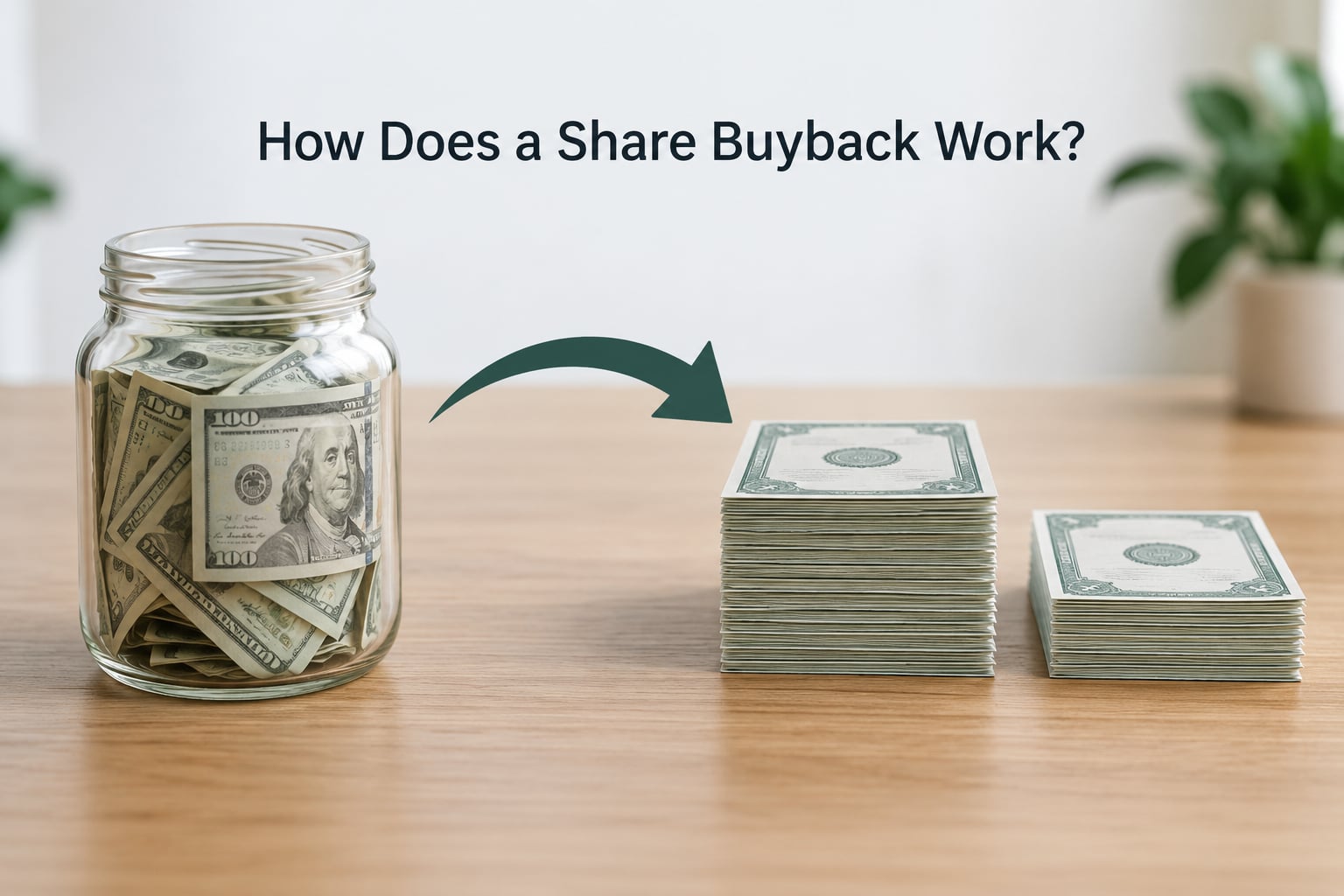
The process runs in five steps, and the order matters more than most explanations admit.
- The board authorises a budget. It approves a maximum amount, a programme length, and who may execute the purchases.
- Cash leaves the company. The money comes out of the balance sheet, usually from cash and cash equivalents accumulated from operations.
- Shares are bought. Either through a tender offer at a set price or in the open market over weeks or months.
- Shares are cancelled or parked. Cancellation permanently reduces shares outstanding. Treasury stock is held by the company and is excluded from shares outstanding, but it can be reissued later.
- Per-share figures are restated. Future reports show a smaller weighted average share count, so EPS and book value per share are calculated on fewer shares.
Common Methods
Most programmes use one of two routes, and the distinction matters if you hold the stock.
Open-Market Purchases
The company, or a broker acting for it, buys shares day by day at whatever the market asks. In the United States, a company cannot buy more than about a quarter of its average daily trading volume in one day, which is why programmes take months rather than a week. You have to sell into the programme yourself, at the market price, at the moment you choose.
Tender Offers
The company invites every shareholder to offer shares at a fixed price, usually at a premium to the market, within a window of two to five weeks. Shares that arrive by the deadline are scaled back by an acceptance ratio if demand exceeds the amount available. If you hold through a demat account, pledged or margin shares are usually ineligible until you unpledge them, and Indian brokers in particular warn about this before every tender.
An authorisation is not the same as a purchase. A board can approve a large programme and execute very little of it, and in some markets a programme is paused and restarted. You can only judge a buyback by what was actually completed, which is why the treasury stock line and the cash flow statement are more informative than the press release.
Why Do Companies Buy Back Their Own Shares?
The reasons fall into five groups, and they are not equally good for a shareholder.
- Returning excess cash. The company has generated more cash than it can invest in projects that earn above its cost of capital. Returning it beats letting it sit idle.
- Adjusting the balance sheet. Cash-heavy businesses use buybacks to reduce leverage or move capital from low-return to high-return uses.
- Offsetting dilution from employee compensation. Companies issue shares to staff every year. A buyback of the same size simply replaces what employees took, and shareholders gain nothing at all.
- Supporting per-share metrics and the price. A smaller denominator lifts EPS and can support the share price when sentiment is weak.
- Consolidating voting control or taking a company private. Concentrating ownership reduces the influence of outside shareholders, which is sometimes the real motive.
Only the first two are unambiguously about capital allocation. The third is housekeeping, the fourth flatters the reported numbers, and the fifth serves insiders. Telling them apart is the core skill.
What Happens to EPS When a Company Buys Back Shares?
EPS rises mechanically when profit is flat and the share count falls. Here is the arithmetic with a worked example, using a company with one billion shares outstanding and net income of 100 million.
| Measure | Before buyback | After buying back 10 percent at 100 per share |
|---|---|---|
| Shares outstanding | 1,000,000,000 | 900,000,000 |
| Net income | 100,000,000 | 100,000,000 |
| EPS | 0.10 | 0.111 |
| Cash on the balance sheet | unchanged | 10 billion lower |
| Market capitalisation at an unchanged price of 100 | 100 billion | 100 billion |
EPS rose by roughly 11 percent. Nothing about the business changed, and the market value of the company is identical, because ten billion of cash left the building in exchange for one hundred million shares.
This is why EPS growth from buybacks deserves scepticism. A rising EPS line that outpaces net income growth tells you about the denominator, not the company. Investors who compare businesses on EPS alone can end up preferring the company that simply bought the most stock.
How Does a Share Buyback Affect Shareholder Ownership?
Your percentage of the company rises automatically if you do nothing. Hold 10,000 shares when 1 billion are outstanding and you own 0.001 percent; after a 10 percent buyback you own about 0.00111 percent of a slightly smaller company.
Two things do not change. The number of shares you hold stays exactly the same, and the value of your holding is determined by the share price, not by your ownership percentage. Owning a bigger slice of a company worth the same total amount is not, on its own, a gain.
The gain shows up only if the company paid less for its own shares than those shares were really worth, or if cancelling them permanently prevents future dilution. That is the whole investment question, and it is a question about price paid, not about the number of shares left.
Can a Share Buyback Make a Stock Safer or More Valuable?
Sometimes, and the mechanism is specific. In the worked example above, the company held one billion shares at a price of 100, so its market capitalisation was 100 billion. It spent ten billion to cancel one hundred million shares, and the remaining nine hundred million shares are still worth about 100 billion. The per-share intrinsic value barely moved.
That near-neutrality surprises people, and it is worth sitting with. Cash out, shares cancelled, value per share roughly unchanged.
A buyback creates value under specific conditions:
- The shares were bought below intrinsic value, so each share retired was worth more than it cost.
- The cash had no productive use, and returning it earns shareholders a higher return than hoarding it.
- Cancelling the shares permanently removes a source of future dilution.
It destroys value in the mirror-image case: buying above intrinsic value, or spending borrowed money on shares while the company is already levered. A debt-funded buyback at a full price converts a balance sheet with cash into one with obligations, and the leverage risk lands on every remaining holder.
What Are the Risks and Drawbacks of Share Buybacks?
The critical case is not fringe. Warren Buffett and Charlie Munger were blunt that buybacks substitute for the reinvestment a good business should be doing, and that companies issuing shares to staff and buying them back are running a costless wealth transfer in the wrong direction. Their argument is about opportunity cost, and it deserves a fair hearing.
The main problems:
- Buying back stock at an inflated price. The company converts a permanent reduction in share count into a permanent loss of cash at the worst moment.
- Debt-funded buybacks. Financial flexibility shrinks, and the balance sheet becomes more fragile for all remaining holders.
- Buying back stock to offset stock-based compensation. If annual issuance equals the buyback, shareholders end up exactly where they started while paying the employee cost.
- Buying at the wrong time. Programmes often accelerate into weakness, which reads as management buying its own news.
- Obscuring the business. Per-share metrics improve while the actual operation does not, and screens reward the improvement.
- Captive dynamic. The seller is paid a premium, and only shareholders who chose not to sell capture whatever remains.
There is also a sequencing problem. A dividend arrives whether or not you act. A buyback only returns money to the shareholders who sell, so if you never tender, you hold the same shares in a company with less cash.
How Do Investors Evaluate a Company’s Buyback?
Seven checks separate a genuinely shareholder-friendly buyback from a cosmetic one.
- Size against market capitalisation and free cash flow. A programme of a few percent of market value spread over two years is routine. One that consumes a large share of annual free cash flow is a statement about the whole business.
- The price paid. Compare the average repurchase price with your own estimate of intrinsic value. Paying well above it is value destruction with a clean balance sheet.
- Authorisation versus completion. Check how much was actually executed. Many announced programmes are never finished.
- How it is funded. Free cash flow is one thing. New borrowing or a depleted cash pile is another, and the difference is leverage.
- Dilution from employee stock. Subtract annual share issuance from the buyback. A buyback smaller than issuance is not a return of capital.
- Management’s stated rationale. “We believe the shares are undervalued” and “we offset dilution” are different claims, and the second is not a return of capital at all.
- The trend in shares outstanding. The line in the filings over three to five years tells you more than any single announcement.
On the price question, one honest caveat: a buyback is not free money for shareholders, because the company usually pays a premium to the market price. The premium goes to whoever sells. That is why deciding whether to tender is a separate decision from whether the programme is sound.
Share Buyback vs Dividend: What Is the Difference?
Both return cash to owners, but the mechanics and the tax treatment differ, and the rules vary by country.
| Criterion | Share buyback | Dividend |
|---|---|---|
| Who receives the cash | Only shareholders who sell or tender | Every shareholder on the record date |
| Effect on share count | Falls permanently if shares are cancelled | Unchanged |
| Predictability | None; the company decides when and how much | Set by the board, often with a declared policy |
| Tax treatment | Generally taxed as a capital gain in many countries; specific rules differ | Often taxed as dividend income, sometimes with withholding |
| Flexibility | Fully reversible; the company can stop tomorrow | Harder to reverse without damaging the share price |
| Best fit | Volatile share price, changing capital needs | Stable businesses with mature, predictable cash flow |
Tax is where the two separate most sharply, and it is also the reason some managements prefer buybacks. In the United States, buyback proceeds are generally taxed as capital gains, often favourably for long holdings, while dividends face ordinary income rates plus a three-tier structure. India took the opposite route in 2019, removing the tax burden on the company and shifting it to the shareholder, and has adjusted the rates since. Check your own jurisdiction before assuming either route is cheaper.
The underlying economics are closer than most articles admit. In a world with no tax at all, a buyback and a dividend of equal size leave a shareholder in the same position, apart from who bothered to sell. The difference is tax, timing, and control.
Frequently Asked Questions
Often briefly, and not reliably. Removing shares reduces the float and can support the price near term, but the announcement itself is usually already priced in before the buying starts. Studies of large programmes find the effect fades within months unless the company keeps buying. A price rise that outlasts the programme is a statement about the business, not about the buyback.
It depends entirely on the price paid and the funding source. A buyback funded by surplus cash, executed below intrinsic value, permanently removes shares and usually serves shareholders well. A buyback funded by new debt, or executed at an inflated price, converts a strong balance sheet into a weaker one. Judge the specific programme, not the label.
Not by itself. Cash leaves the company and shares are cancelled, so the value per share is broadly unchanged. You only gain if the company bought its shares for less than they were worth, or if the cash had no productive use. Holders who do not sell receive no cash at all, unlike a dividend, which is paid to every shareholder on the record date.
It is a sale, not a gift, so compare the tender price with what you believe the shares are worth and with your own case for holding. Check whether the premium is being paid above the market, how the programme is funded, and how much has actually been executed versus merely authorised. If demand oversubscribes the programme, your shares are scaled back by an acceptance ratio.
Neither is universally better. A dividend is predictable, reaches every shareholder, and suits a mature business with steady cash. A buyback is flexible, shrinks the share count, and lets the company return capital when the price is depressed. Tax treatment often decides it, and those rules differ by country and change, so compare them on your own terms.
Conclusion
A share buyback is one tool for allocating capital, and on its own it is close to value-neutral: cash out, shares cancelled, value per share broadly unchanged. Start every assessment with five numbers: the cash position, the valuation, the debt load, the change in shares outstanding over several years, and the average price paid relative to what the business is worth. If the buyback is smaller than the annual share issuance, it is housekeeping rather than a return of capital.
Source: https://www.pgm-blog.com/what-is-a-share-buyback/
Anyone can join.
Anyone can contribute.
Anyone can become informed about their world.
"United We Stand" Click Here To Create Your Personal Citizen Journalist Account Today, Be Sure To Invite Your Friends.
Before It’s News® is a community of individuals who report on what’s going on around them, from all around the world. Anyone can join. Anyone can contribute. Anyone can become informed about their world. "United We Stand" Click Here To Create Your Personal Citizen Journalist Account Today, Be Sure To Invite Your Friends.
LION'S MANE PRODUCT
Try Our Lion’s Mane WHOLE MIND Nootropic Blend 60 Capsules
Mushrooms are having a moment. One fabulous fungus in particular, lion’s mane, may help improve memory, depression and anxiety symptoms. They are also an excellent source of nutrients that show promise as a therapy for dementia, and other neurodegenerative diseases. If you’re living with anxiety or depression, you may be curious about all the therapy options out there — including the natural ones.Our Lion’s Mane WHOLE MIND Nootropic Blend has been formulated to utilize the potency of Lion’s mane but also include the benefits of four other Highly Beneficial Mushrooms. Synergistically, they work together to Build your health through improving cognitive function and immunity regardless of your age. Our Nootropic not only improves your Cognitive Function and Activates your Immune System, but it benefits growth of Essential Gut Flora, further enhancing your Vitality.

Our Formula includes: Lion’s Mane Mushrooms which Increase Brain Power through nerve growth, lessen anxiety, reduce depression, and improve concentration. Its an excellent adaptogen, promotes sleep and improves immunity. Shiitake Mushrooms which Fight cancer cells and infectious disease, boost the immune system, promotes brain function, and serves as a source of B vitamins. Maitake Mushrooms which regulate blood sugar levels of diabetics, reduce hypertension and boosts the immune system. Reishi Mushrooms which Fight inflammation, liver disease, fatigue, tumor growth and cancer. They Improve skin disorders and soothes digestive problems, stomach ulcers and leaky gut syndrome. Chaga Mushrooms which have anti-aging effects, boost immune function, improve stamina and athletic performance, even act as a natural aphrodisiac, fighting diabetes and improving liver function. Try Our Lion’s Mane WHOLE MIND Nootropic Blend 60 Capsules Today. Be 100% Satisfied or Receive a Full Money Back Guarantee. Order Yours Today by Following This Link.


| Visits: | 1,834,001,127 |
| Stories: | 8,715,728 |
Whistler Blowers, Insiders

